
Products
Services
Resources
Selection Guides
About
Azide Building Blocks
AAT Bioquest offers a comprehensive collection of azide building blocks for click chemistry applications, enabling researchers to create custom bioconjugates through copper-catalyzed azide-alkyne cycloaddition (CuAAC) reactions. These azide-functionalized compounds react specifically with alkyne groups under mild conditions, providing efficient and selective labeling of proteins, nucleic acids, and other biomolecules. Our portfolio includes fluorescent dye azides spanning the full visible and near-infrared spectrum, dark quencher azides for FRET applications, biotin and hapten azides for detection systems, and specialized building blocks for sequencing, calcium sensing, and affinity purification.
Azide Product Group | Example Applications | Example Azides Available |
|---|---|---|
FastClick™ | Rapid reactions, mild conditions | FastClick™ Cy3, Cy5, FAM, biotin |
Fluorescent Dyes | Antibody labeling, imaging, flow cytometry, FISH | iFluor®, XFD, AATOM™, Cy3, Cy5, FAM, TAMRA |
FRET Building Blocks | FRET probes, peptide synthesis, molecular beacons | Tide Fluor™, Tide Quencher™ |
Specialty Labels | Pull-down, detection, purification | Biotin, DIG, Cal-520®, 6XHIS, Hoechst 33342 |
Fig. 1
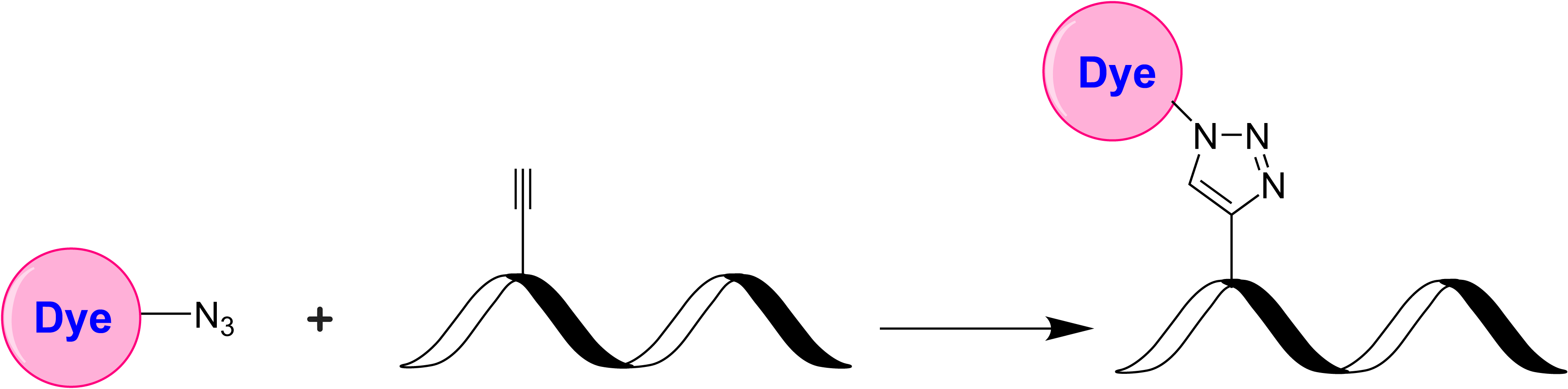
Schematic illustrating the azide–alkyne cycloaddition (“click chemistry”) between an azide‐functionalized dye and an alkyne‐presenting biomolecule. In the presence of a copper catalyst (CuAAC) or under strain‐promoted conditions (SPAAC), the azide and alkyne react to form a stable 1,2,3‐triazole linkage. This highly selective and robust reaction proceeds under mild conditions and tolerates a wide range of functional groups.
FastClick azides incorporate advanced reactivity enhancers that dramatically accelerate copper-catalyzed azide-alkyne cycloaddition (CuAAC) reactions. This enables rapid labeling at lower copper concentrations, reducing toxicity in live-cell applications.
- Enhanced Reaction Rate – 5-10x faster click chemistry compared to standard azides
- Lower Copper Requirements – Reduced copper concentration for improved cell viability
- Improved Yields – Higher coupling efficiency in a single step
- Broad Substrate Compatibility – Works with proteins, nucleic acids, and synthetic polymers
iFluor® azides are AAT Bioquest's premium fluorescent labeling dyes optimized for click chemistry conjugation. These dyes react efficiently with alkyne-modified biomolecules to produce bright, photostable conjugates ideal for imaging, flow cytometry, and other fluorescence-based applications.
- Superior brightness and photostability – Outperform classic fluorophores like FITC, Alexa Fluor®, and Cy dyes
- Minimal quenching at high dye-to-protein ratios – Maintain signal intensity during heavy labeling
- Excellent water solubility – Improves conjugation efficiency and reduces aggregation
- Full spectral coverage – From violet (405 nm) to near-infrared (790 nm)
- Direct comparables – iFluor® 488 outperforms FITC and Alexa Fluor® 488; iFluor® 647 exceeds Cy5 and Alexa Fluor® 647
XFD azides are spectrally matched to Alexa Fluor® dyes, providing cost-effective alternatives that deliver equivalent performance. These dyes offer the same excitation/emission profiles, enabling seamless integration into established protocols and instrument configurations.
- Spectrally identical to corresponding Alexa Fluor® dyes for direct protocol replacement
- Direct drop-in compatibility with existing Alexa Fluor®-based instrument setups
- Excellent brightness and photostability – Superior to many competing alternatives
- Comprehensive spectral coverage – From UV (350 nm) to NIR (790 nm)
- Standard filter compatibility – Works with common optical configurations
AATOM™ azides offer excellent performance for FACS, FISH, and advanced imaging applications. These dyes provide outstanding brightness and photostability across a wide spectral range with options for PEG3-modified variants to improve water solubility.
- High quantum yields and extinction coefficients for superior brightness
- Excellent photostability for extended imaging sessions and live-cell applications
- PEG3 variants available for improved water solubility and reduced aggregation
- Ideal for advanced applications – Single-molecule detection and super-resolution microscopy
AATOM™ dyes are manufactured by AAT Bioquest and are not affiliated with ATTO-TEC GmbH.
Cyanine dye azides provide classic cyanine dye fluorescence optimized for click chemistry applications. These well-characterized dyes are widely used for oligonucleotide labeling, FISH probes, and multicolor imaging experiments.
- Spectral equivalence to Cy3, Cy5, Cy5.5, and Cy7 dyes for compatibility with established protocols
- Well-characterized photophysical properties – Extensive published data for assay design
- Cy3B azide offers enhanced photostability compared to standard Cy3
- Standard filter set compatibility – Works with common cyanine optical configurations
- Ideal applications – Nucleic acid labeling, FISH, and multicolor fluorescence microscopy
This collection includes FAM, TAMRA, ROX, and other classic fluorophore azides widely used for oligonucleotide labeling, qPCR probes, and traditional bioconjugation applications.
- Industry standard dyes – FAM, TAMRA, ROX, HEX, and JOE for compatibility with established methods
- Proven performance – Decades of research and application data available
- qPCR and sequencing optimized – Spectrally matched to standard instruments
- Multiple isomers – 5- and 6-position FAM/TAMRA variants for flexible conjugation strategies
- Wide spectral range – Green (493 nm) through red (604 nm) for multicolor applications
Tide Fluor™ azides are optimized for click chemistry applications, providing excellent photostability and bright fluorescence across the visible and near-infrared spectrum. These azides are particularly suitable for labeling biomolecules in live cells without interfering with cellular function.
- Spectral Diversity – Coverage from UV-excited (TF1) to near-infrared (TF8WS) wavelengths
- Live-Cell Compatibility – Minimal phototoxicity and cellular autofluorescence
- Enhanced Photostability – Resistant to photobleaching under continuous illumination
- Optimized Reactivity – Enhanced click chemistry efficiency for rapid conjugation
Tide Quencher™ azides are dark quencher molecules designed for FRET and quenching-based assays. These non-fluorescent quenchers are excellent for detecting molecular interactions and conformational changes in real-time.
- Non-Fluorescent – Pure quenching without background fluorescence
- Broad Spectrum Coverage – Quench multiple fluorophores across the visible range
- Water-Soluble Variants – WS versions for enhanced aqueous solubility and cellular penetration
- Compatible Pairing – Work with complementary Tide Fluor™ fluorophores for optimal FRET
Biotin azides enable rapid bioaffinity labeling through click chemistry, providing alternatives to traditional biotin-protein coupling. These versatile reagents are ideal for developing antibodies, creating capture probes, and enabling streptavidin-based detection systems.
- Bioaffinity Purification – Streptavidin binding for rapid target isolation
- Multiple Linker Options – Direct, C2, PEG2, and PEG3 variants for customized spacing
- Reversible Options – ReadiLeave™ technology for gentle protein release
- Hapten Conjugation – Support for immunoassay and diagnostic development
Calcium indicators with azide functional groups enable ratiometric and intensity-based calcium imaging in live cells. These specialized probes provide enhanced sensitivity and reduced phototoxicity compared to traditional small-molecule indicators.
- Enhanced Sensitivity – Increased dynamic range for calcium detection
- Water-Soluble Variants – Improved cellular uptake and reduced compartmentalization
- Multiple Indicators – Complementary spectral properties for multiplexing
- Reduced Phototoxicity – Optimized for long-term live-cell imaging
His-tag azides and NTA (nitrilotriacetic acid) azides facilitate direct click-chemistry-based labeling and purification of histidine-tagged proteins. These reagents provide an alternative to traditional His-tag detection methods and enable rapid bioconjugation.
- Native Protein Interaction – Direct binding to polyhistidine tags without cross-linkers
- Metal Coordination – NTA variants chelate Ni²⁺ for reversible protein capture
- Functional Preservation – Minimal impact on protein structure or function
- Multiplexing Capability – Compatible with standard purification workflows
This collection includes specialized azides for nucleic acid applications including DNA staining, probe synthesis, and nucleic acid crosslinking.
- Nuclear Staining – Hoechst and Helixyte™ Green for DNA visualization
- Probe Stabilization – Minor groove binders for enhanced probe Tm
- Electrochemical Detection – Methylene Blue for biosensor applications
- Nucleic Acid Crosslinking – Psoralen derivatives for UV-activated crosslinking
- Oligo Synthesis – Phosphoramidites for internal azide labeling
This document (01.0349.251203r1) was last updated on Sat Feb 28 2026. All trademarks and registered trademarks mentioned herein are the property of their respective owners.
Azide Building Blocks