
Products
Services
Resources
Selection Guides
About
BCN Building Blocks
BCN (bicyclo[6.1.0]non-4-yne) building blocks enable copper-free click chemistry reactions with azide-modified biomolecules through strain-promoted alkyne-azide cycloaddition (SPAAC). AAT Bioquest offers a comprehensive selection of BCN-functionalized fluorescent dyes spanning the full visible to near-infrared spectrum, including classic fluorophores (FAM, TAMRA, ROX, Texas Red), cyanine dyes (Cy3, Cy5, Cy7), and the high-performance AATOM™ series. These reagents enable copper-free SPAAC labeling without cytotoxic catalysts, with the smaller BCN ring providing reduced steric bulk compared to DBCO conjugates, which can be advantageous for protein, nucleic acid, and densely packed targets.
Dye Series | Spectral Range | Best For | Key Products |
|---|---|---|---|
Classic Fluorophores | Green to Red (493–604 nm) | Standard fluorescence microscopy, qPCR applications | FAM, TAMRA, ROX, Texas Red BCN |
Cyanine Dyes | Orange to NIR (555–779 nm) | Multiplexing, deep tissue imaging, in vivo studies | Cy3, Cy5, Cy5.5, Cy7 BCN |
AATOM™ Series | Blue to NIR (390–715 nm) | High-performance imaging, super-resolution microscopy | AATOM™ 488, 594, 647N BCN |
Fig. 1
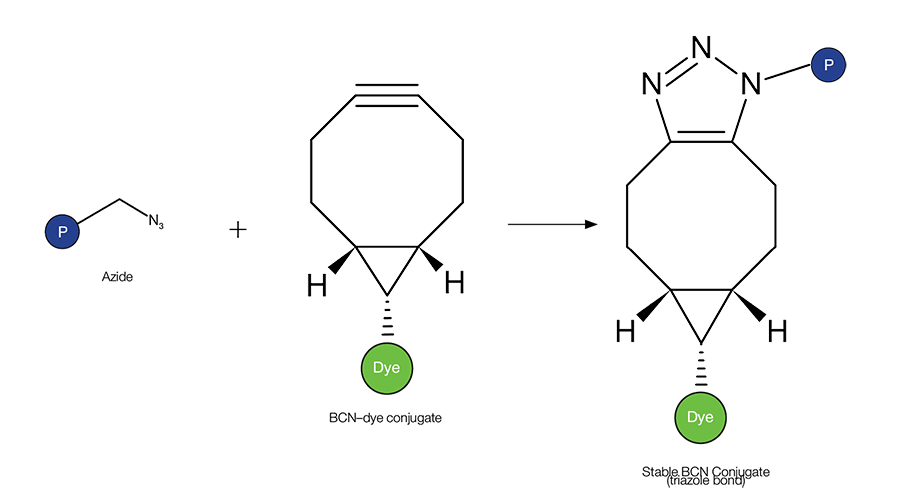
Schematic of the bicyclo[6.1.0]nonyne (BCN)–azide strain-promoted cycloaddition (SPAAC). An azide-functionalized molecule (left) reacts with a BCN-modified dye (right) in a copper-free “click” reaction to form a stable 1,2,3-triazole linkage, enabling covalent attachment of the dye to the azide-bearing molecule.
The AATOM™ series represents AAT Bioquest's high-performance fluorescent dyes optimized for demanding imaging applications. These dyes offer exceptional brightness, photostability, and water solubility compared to traditional fluorophores. The comprehensive spectral coverage from blue (390 nm) to near-infrared (715 nm) enables flexible experimental design for multiplexed detection. AATOM™ dyes are particularly well-suited for super-resolution microscopy, single-molecule imaging, and applications requiring extended illumination times.
- Superior photostability for extended imaging sessions and time-lapse experiments
- Higher quantum yields than many classic fluorophores for brighter signals
- Excellent water solubility reduces aggregation and non-specific binding
- Full spectral coverage from UV-excitable blue to near-infrared
- Super-resolution optimized for STORM, PALM, STED microscopy
- Compatible with common laser lines (405, 488, 532, 561, 594, 633, 647 nm)
Cyanine dyes offer excellent brightness and spectral coverage from orange to near-infrared wavelengths, making them ideal for multiplexed imaging experiments and in vivo applications. The Cy3 and Cy3.5 dyes provide strong orange fluorescence compatible with TRITC/Cy3 filter sets, while Cy5 and Cy5.5 extend into the far-red and near-infrared spectrum for reduced autofluorescence and deeper tissue penetration. Cy7 BCN enables near-infrared imaging with minimal background interference.
- High extinction coefficients for bright signal detection
- Excellent spectral separation for multiplexed imaging
- Deep tissue imaging with Cy5.5 and Cy7 for in vivo applications
- Wide instrument compatibility with well-characterized spectral properties
Classic fluorescent dyes with BCN functional groups provide reliable performance for copper-free click chemistry labeling. The FAM (fluorescein) derivatives offer bright green fluorescence ideal for standard FITC filter sets, while TAMRA and ROX provide orange-red emission for multiplexing applications. JOE and TET BCN dyes are commonly used as post-synthetic labeling reagents for azide-modified oligonucleotides intended for qPCR and sequencing probe development. The 5- and 6-isomer designations indicate the position of conjugation on the fluorophore, which can affect labeling efficiency and fluorescence properties depending on the target biomolecule.
- Bright, photostable fluorescence across green to red spectral range
- 5- and 6-isomers available for optimal conjugation flexibility
- Standard microscopy compatibility with fluorescence microscopy filter sets
- Proven peptide and oligonucleotide labeling performance
This document (01.0322.251203r1) was last updated on Sat Feb 28 2026. All trademarks and registered trademarks mentioned herein are the property of their respective owners.
BCN Building Blocks