
Products
Services
Resources
Selection Guides
About
Drug-HRP Conjugates
AAT Bioquest offers a comprehensive selection of Drug-HRP conjugates designed for developing sensitive competitive ELISA assays. These enzyme-labeled drug tracers combine small molecule analytes with horseradish peroxidase (HRP), enabling quantitative detection of antibiotics, opioids, sedatives, and other pharmaceutical compounds in food safety testing, veterinary diagnostics, and drug screening applications. Each conjugate is optimized with a controlled drug-to-enzyme ratio to ensure high sensitivity and robust performance in competitive immunoassay formats.
Drug Category | Example Analytes |
|---|---|
Antibiotic Residues | AHD, AOZ, AMOZ, SEM, Chloramphenicol, Florfenicol, Ofloxacin, Danofloxacin, Cinoxacin, Sulfadimidine, Sulfathiazol, Sulfacetamide, Spectinomycin, Salinomycin |
Opioids and Controlled Substances | Fentanyl, Norfentanyl, Isotonitazene |
Sedatives and Tranquilizers | Xylazine, Medetomidine, Diazepam |
Hormones | Estradiol |
Fig. 1
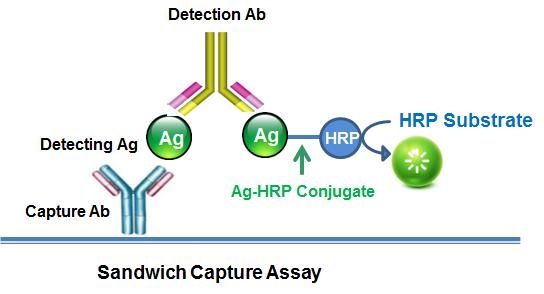
Sandwich Capture Assay.
Drug-HRP conjugates for antibiotic residue detection are essential components for competitive ELISA assays used in food safety and veterinary diagnostics. These conjugates enable sensitive detection of banned or regulated antibiotics in meat, milk, eggs, and other food products. The minimal drug-to-HRP ratio ensures optimal competition with free analyte in samples, providing accurate quantification at regulatory threshold levels.
- Optimized drug-to-enzyme ratio for maximum assay sensitivity
- Standard ELISA compatibility with competitive immunoassay formats
- Food safety applications for veterinary residue testing
- Cross-reactivity profiles available for related compound detection
- Stable conjugates for reproducible assay performance
Drug-HRP conjugates for opioid and controlled substance detection are critical reagents for forensic toxicology, clinical drug testing, and public health monitoring applications. These conjugates enable development of sensitive immunoassays for detecting fentanyl, fentanyl analogs, and emerging synthetic opioids that pose significant public health concerns. The high sensitivity of these conjugates supports detection at clinically and forensically relevant concentrations.
- High sensitivity for detecting potent synthetic opioids at low concentrations
- Parent and metabolite conjugates available for comprehensive detection
- Clinical, forensic, and point-of-care testing applications
- Rapid screening assays for emerging drug threats
- Metabolite confirmation testing with Norfentanyl conjugate
Drug-HRP conjugates for sedative and tranquilizer detection support veterinary diagnostics, toxicology screening, and drug adulteration testing. These conjugates enable quantification of alpha-2 adrenergic agonists (xylazine, medetomidine) and benzodiazepines (diazepam) in biological samples. Xylazine detection has become increasingly important due to its emergence as an adulterant in illicit drug supplies.
- Veterinary sedatives and emerging adulterants for comprehensive testing
- Xylazine-HRP supports detection of this emerging public health threat
- Medetomidine-HRP enables veterinary anesthesia monitoring
- Diazepam-HRP for benzodiazepine screening applications
- Xylazine Amine building block available for custom conjugate synthesis
Estradiol-HRP conjugate enables development of competitive ELISA assays for quantifying estradiol, the primary female sex hormone (17-beta-estradiol). This conjugate supports reproductive endocrinology research, fertility testing, and hormone level monitoring in clinical and veterinary applications.
This document (01.0253.251203r1) was last updated on Sat Feb 28 2026. All trademarks and registered trademarks mentioned herein are the property of their respective owners.