
Products
Services
Resources
Selection Guides
About
Gelite™ Safe DNA Stains
Gelite™ Safe DNA Gel Stains are AAT Bioquest's premium line of environmentally benign, non-mutagenic DNA gel stains designed as safer and more sensitive alternatives to ethidium bromide. Unlike commonly used cyanine-based nucleic acid stains such as SYBR Green, which have documented mutagenicity and handling concerns, Gelite™ Safe is membrane-impermeant and noncytotoxic. Ames testing demonstrates that Gelite™ Safe shows significantly reduced mutagenicity compared to ethidium bromide and SYBR® Green under the tested conditions.
Gelite™ Safe is the first single formulation optimized for use in either the green or red channel at your preference, compatible with UV transilluminators, blue-light transilluminators, gel documentation systems, and laser scanners. The exceptional DNA binding affinity produces fluorescence enhancement several orders of magnitude greater than ethidium bromide upon nucleic acid binding, while remaining essentially non-fluorescent in the absence of DNA for minimal background.
Feature | Gelite™ Safe | Ethidium Bromide | SYBR Green |
|---|---|---|---|
Ames Test (Mutagenicity) | Negative (Non-mutagenic) | Positive (Mutagenic) | Positive (Mutagenic) |
Sensitivity | ~0.1 ng DNA | ~1-10 ng DNA | ~0.1 ng DNA |
Background Fluorescence | Very Low | Moderate | Low |
Disposal Requirements | Standard waste | Hazardous waste | Varies by institution |
EtBr Filter Compatibility | Yes | Yes | No (requires FITC filters) |
Membrane Permeability | Impermeant (Noncytotoxic) | Permeant | Permeant (Cytotoxic) |
Dual Channel (Green/Red) | Yes | Red only | Green only |
Fig. 1
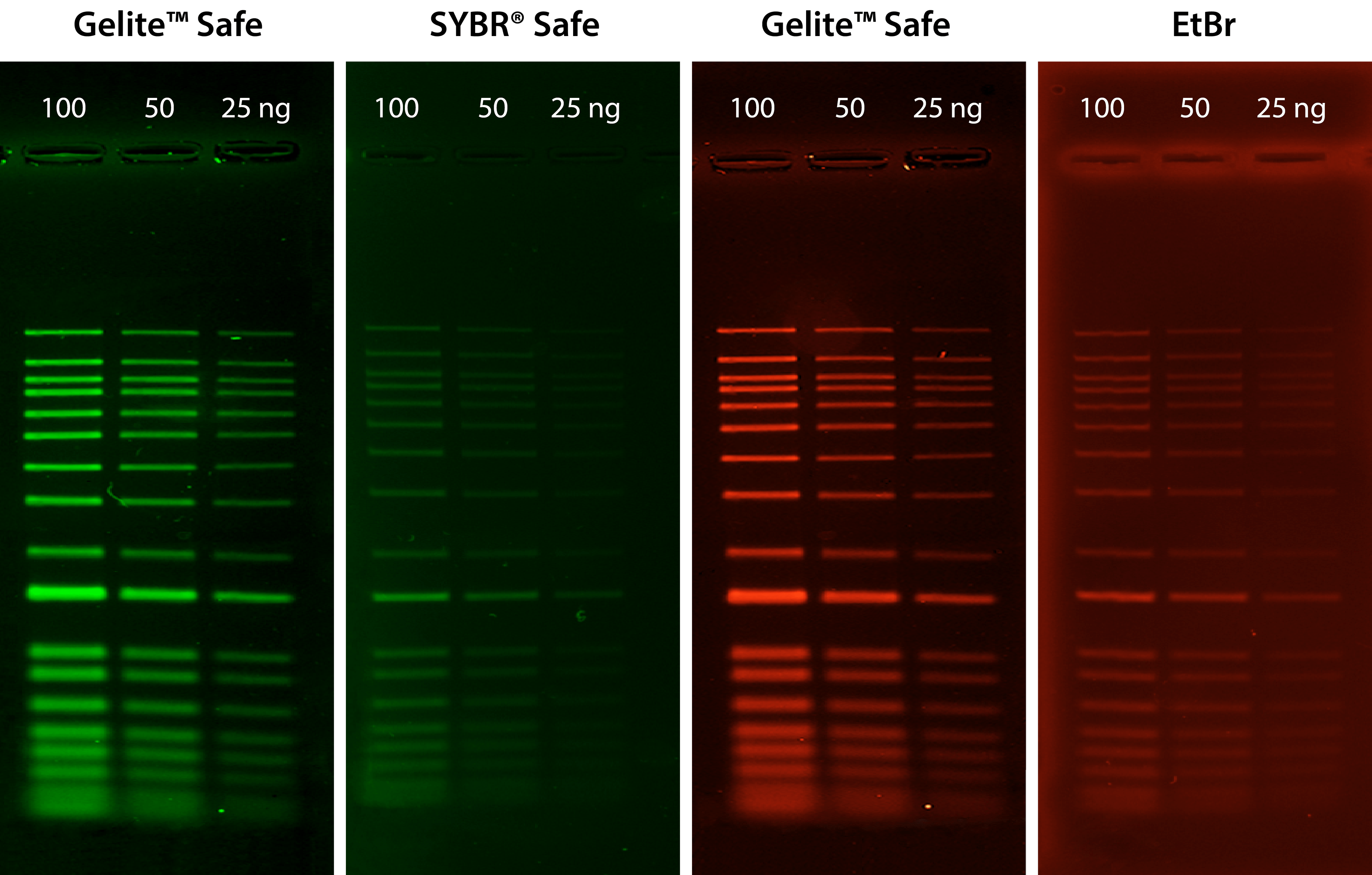
Comparison of DNA detection in 1% agarose gel in TBE buffer using Gelite™ Safe, EtBr, and SYBR® Safe. Two-fold serial dilutions of 1 kb DNA ladder were loaded in amounts of 100 ng, 50 ng, and 25 ng from left to right. Gels were stained for 60 minutes with Gelite™ Safe, EtBr, and SYBR® Safe according to the manufacturer's recommended concentrations and imaged using the ChemiDoc™ Imaging System (Bio-Rad®). Gels were illuminated using a 300 nm transilluminator fitted with GelGreen and GelRed filters.
Fig. 2
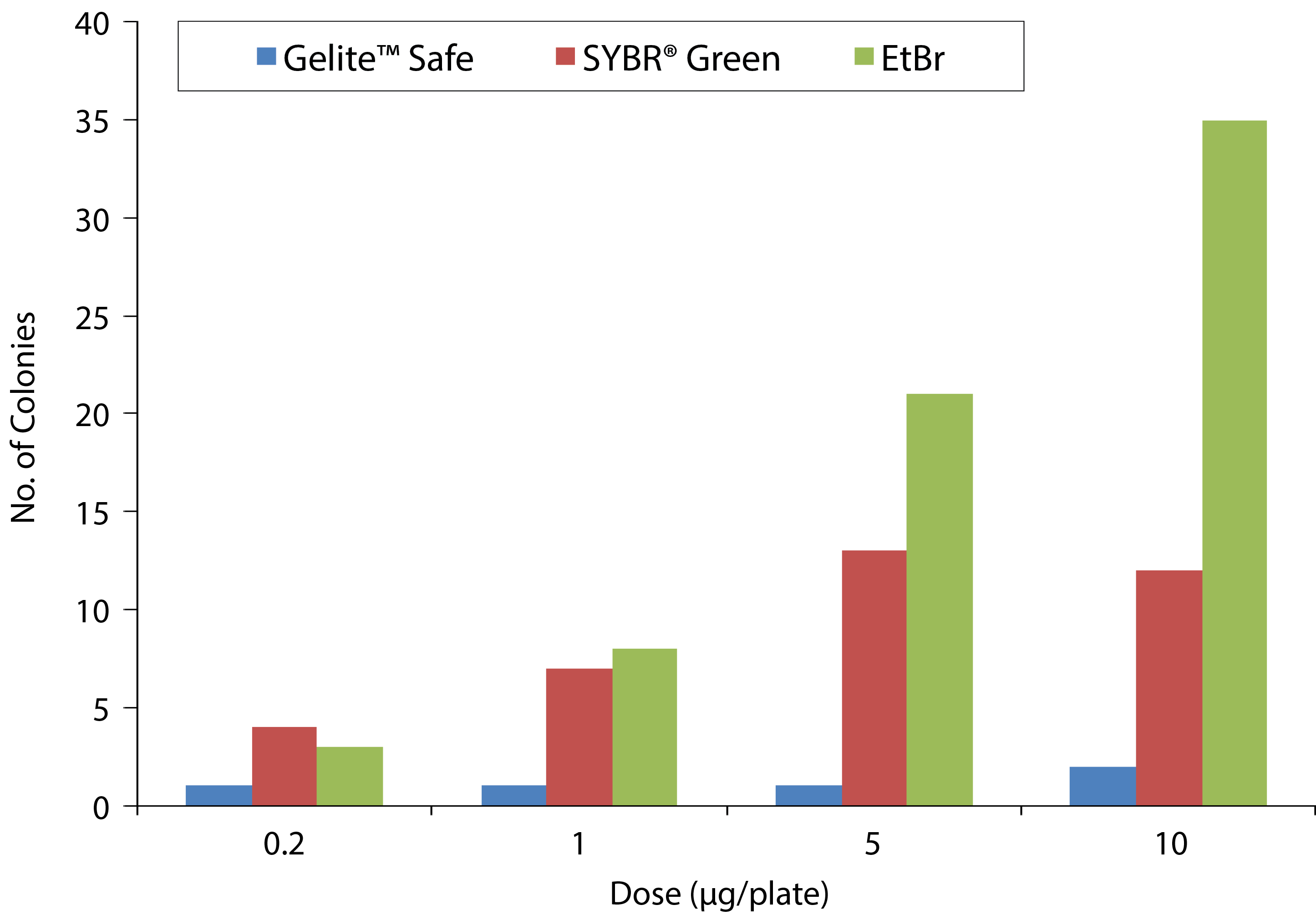
Summary of Ames test results. Ames mutagenicity test was performed in a dose-dependent manner for Gelite™ Safe, SYBR® Green, and EtBr. Samples were pretreated with an S9 fraction liver extract and then tested. With S. Typhimurium strain TA1538, an increase in revertants of more than two-fold over the background indicates a positive result for mutagenicity.
Gelite™ Safe DNA Gel Stain features a unique dual-excitation profile that provides exceptional versatility across different imaging systems.
- 280 nm (UV region) — Compatible with standard UV transilluminators
- 513 nm (Visible region) — Efficiently excited by blue LED and 488 nm laser sources
- 552 nm — Orange-red fluorescence detectable with standard ethidium bromide filter sets
- SYBR filter (green channel imaging)
- GelStar filter
- GelGreen filter
- GelRed filter (red channel imaging)
- 602/50 nm or 590/110 nm bandpass (EtBr standard filters)
- Texas Red filter sets
This unique spectral profile means Gelite™ Safe can be used as a direct drop-in replacement for ethidium bromide without changing your existing imaging setup, while also being compatible with SYBR-type green filters for maximum flexibility.
Fig. 3
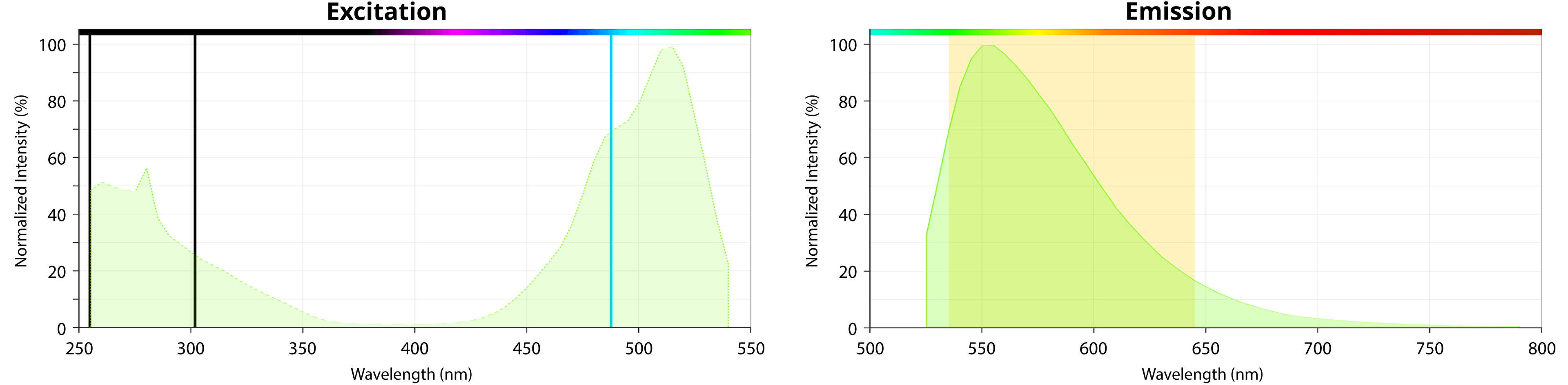
Normalized excitation and emission spectra for Gelite™ Safe DNA gel stain determined in the presence of DNA. Gelite™ Safe has excitation maxima in the UV region at 280 nm and in the visible region at 513 nm. It can be excited by instruments equipped with 254 nm (left black line), 300 nm (middle black line), or 488 nm (blue line) lasers. Gelite™ has a broad emission spectrum with a single emission maximum at 552 nm. It can be detected using either a 602/50 nm (EtBr) or 590/110 nm filter set.
Our flagship Gelite™ Safe stains provide the optimal balance of sensitivity, safety, and convenience. Choose between DMSO or water-based formulations based on your workflow preferences.
This document (01.0064.211015r2) was last updated on Sat Feb 28 2026. All trademarks and registered trademarks mentioned herein are the property of their respective owners.
Gelite™ Safe DNA Stains