
Products
Services
Resources
Selection Guides
About
PE Tandems
Phycoerythrin (PE) tandem conjugates combine the exceptional brightness of PE with far-red and near-infrared acceptor fluorophores, enabling high-sensitivity flow cytometry and complex multicolor immunoassay panels. Through fluorescence resonance energy transfer (FRET), these conjugates extend detectable emission from PE into the 600–800 nm spectral range via acceptor fluorophore emission, providing researchers with powerful tools for detecting low-abundance markers while enabling access to far-red and near-infrared detection channels in multicolor experiments.
AAT Bioquest offers PE tandems for a variety of applications, including conventional and spectral flow cytometry, with acceptors including classic and proprietary fluorescent dyes.
Phycoerythrin is an intensely bright orange fluorescent phycobiliprotein derived from red algae, with excitation at 565 nm and emission at 574 nm. PE ranks among the brightest (extinction coefficient = 1,960,000 cm-1M-1; Φ = 0.82) fluorophores available for biological applications, making it a common choice for detecting low-abundance cell surface markers and intracellular antigens when panel design permits. The protein is efficiently excited by both 488 nm argon and 561 nm yellow-green lasers commonly found in flow cytometry instruments.
PE tandem conjugates leverage FRET to shift emission into far-red and near-infrared regions through coupling with cyanine dyes (Cy5, Cy5.5, Cy7) or iFluor® acceptors. This spectral extension enables researchers to design complex multicolor panels spanning 574–800 nm emission while maintaining the exceptional brightness that makes PE-based detection ideal for rare cell populations and weakly expressed antigens.
The spectral properties table below provides excitation/emission maxima and filter configurations for each PE tandem conjugate. These specifications enable optimal instrument setup and facilitate panel design for multicolor flow cytometry experiments.
ReadiUse™ preactivated PE tandems are supplied in reactive formats ready for direct conjugation to antibodies and other proteins. These preactivated conjugates eliminate the need for separate activation chemistry, streamlining the labeling workflow while delivering higher conjugation yields than traditional approaches.
Amine-reactive PE tandems target primary amines (lysine residues and N-termini) present on antibodies and proteins. This chemistry provides straightforward conjugation without requiring antibody reduction, preserving disulfide bonds critical for maintaining antibody structure and binding activity. The amine-reactive format often achieves higher conjugation efficiency compared to thiol-reactive SMCC chemistry, depending on antibody structure and reaction conditions.
SMCC-activated PE tandems react specifically with free thiol groups generated by mild reduction of antibody disulfide bonds. This site-directed conjugation approach targets the hinge region of IgG antibodies, positioning the fluorophore away from antigen-binding sites. While requiring an additional reduction step, thiol-reactive chemistry offers controlled stoichiometry for applications demanding consistent labeling ratios.
Buccutite™ technology represents a significant advancement over conventional antibody labeling methods, achieving near 100% conjugation yields without purification through a proprietary click chemistry approach. The system employs two specialized crosslinkers—MTA and FOL—that react rapidly and specifically upon mixing, forming stable conjugates in under two hours.
Traditional SMCC-based PE conjugation requires reduction of antibody disulfide bonds to generate reactive thiols, a process that can increase the risk of antibody aggregation, loss of binding activity, and variable labeling results under suboptimal conditions. Buccutite™ chemistry eliminates these limitations by targeting native functional groups without disrupting antibody structure, preserving antigen recognition while ensuring complete conjugation efficiency.
The streamlined workflow requires only two incubation steps: addition of the MTA linker to the antibody (30 minutes) followed by addition of the FOL-activated PE tandem (60 minutes). The resulting conjugate is immediately ready for use in flow cytometry, immunofluorescence, or immunoassay applications without additional purification. Kits containing 1 mg of PE tandem include a spin column for optional buffer exchange and concentration.
For standard IgG antibodies (~150 kDa), typical reactions label one PE per antibody. While higher labeling ratios are achievable, excessive loading may reduce antigen binding due to steric hindrance at the antibody's variable regions.
Fig. 1
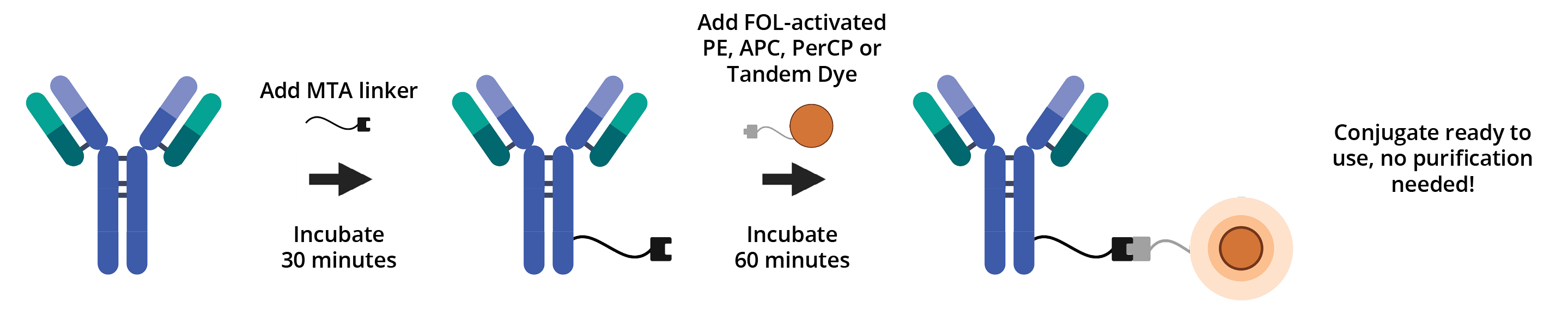
Buccutite™ Rapid Tandem Antibody Labeling Kit workflow.
This document (01.0202.251203r1) was last updated on Sat Feb 28 2026. All trademarks and registered trademarks mentioned herein are the property of their respective owners.