
Products
Services
Resources
Selection Guides
About
Phosphoramidites
Phosphoramidites are essential building blocks for automated oligonucleotide synthesis, enabling researchers to incorporate fluorescent labels, quenchers, biotin tags, and reactive functional groups directly during solid-phase synthesis. AAT Bioquest offers a comprehensive selection of phosphoramidite reagents for synthesizing labeled oligonucleotides used in qPCR probes, FRET-based assays, hybridization experiments, and diagnostic applications. Our portfolio includes industry-standard fluorescein and cyanine derivatives alongside advanced Tide Fluor™ and Tide Quencher™ phosphoramidites that deliver superior performance.
Fig. 1
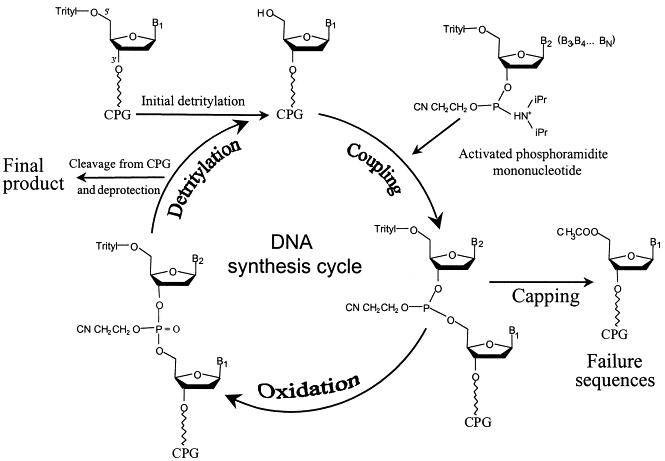
Oligonucleotide synthesis is carried out by a stepwise addition of nucleotide residues to the 5'-terminus of the growing chain until the desired sequence is assembled. Each addition is referred to as a synthetic cycle and consists of four chemical reactions: de-blocking (detritylation), coupling, capping, and oxidation.
Fluorescent dye-labeled phosphoramidites are useful for synthesizing hybridization probes, such as for FISH experiments. When paired with a dark quencher, they are also useful for FRET based applications, such as for the synthesis of molecular beacons or TaqMan probes. Popular fluorescent dyes for this application include FAM, Cy3, and Cy5. Additionally, AAT Bioquest offers our proprietary dye series, Tide Fluor™, for brighter fluorescence and longer photostability.
- FAM-xtra™ Phosphoramidite offers enhanced stability and purity for demanding applications
- dT-modified versions allow internal labeling within oligonucleotide sequences
- Compatible with standard oligonucleotide synthesis and deprotection conditions
- Tide Fluor™ 3 Phosphoramidite has same spectrum as Cy3 but enhanced performance
Dark quenchers are non-fluorescent molecules that absorb energy from nearby fluorophores through FRET, making them essential components of molecular beacons, TaqMan probes, and other FRET-based detection systems. AAT Bioquest offers DABCYL and the advanced Tide Quencher™ series, which provide broader quenching ranges and higher efficiency than traditional quenchers.
- Tide Quencher™ series delivers stronger absorption and higher quenching efficiency than DABCYL
- TQ1 superior DABCYL alternative with enhanced quenching of UV to blue-green fluorophores
- TQ2 optimized for FAM, HEX, TET, JOE, and rhodamine 6G quenching
- TQ3 designed for TAMRA, Tide Fluor™ 3, and Cy3 quenching
- Non-fluorescent output eliminates background signal for cleaner detection
Biotin phosphoramidites enable the direct incorporation of biotin tags into oligonucleotides during synthesis. Biotinylated oligonucleotides are widely used for affinity purification, immobilization on streptavidin-coated surfaces, and detection using streptavidin-reporter conjugates. Different linker lengths and attachment positions are available to optimize binding accessibility.
- DMT-protected for quantification of coupling efficiency during synthesis
- Multiple formats include 5'-terminal, internal (dT-based), and extended linker (TEG) options
- BiotinTEG provides longer spacer for improved streptavidin accessibility
- Compatible with standard deprotection and purification procedures
Amino modifier phosphoramidites introduce primary amine groups at specific positions within oligonucleotides, enabling post-synthetic conjugation with NHS esters, isothiocyanates, and other amine-reactive labels. Click chemistry building blocks (alkynyl-dT and azido-dT) enable bioorthogonal conjugation via copper-catalyzed azide-alkyne cycloaddition (CuAAC). 6-Aminohexanol provides a bifunctional C6 linker for preparing custom biotin- and dye-labeled phosphoramidites for oligonucleotide modification.
This document (01.0333.251203r1) was last updated on Sat Feb 28 2026. All trademarks and registered trademarks mentioned herein are the property of their respective owners.