
Products
Services
Resources
Selection Guides
About
RT-PCR
AAT Bioquest offers a specialized reverse transcription kit designed to streamline cDNA synthesis for downstream gene expression analysis. Reverse transcription PCR (RT-PCR) is an essential technique that converts RNA templates into complementary DNA (cDNA), enabling the detection and quantification of RNA transcripts using PCR-based methods. Our ReadiScript™ RT Reverse Transcription Kit provides researchers with a reliable, ready-to-use solution for two-step RT-PCR workflows.
RT-PCR can be performed using either one-step or two-step approaches, each offering distinct advantages for different applications. In one-step RT-PCR, reverse transcription and PCR amplification occur in the same tube, offering convenience for high-throughput applications and reducing hands-on time. In two-step RT-PCR, cDNA synthesis and PCR amplification are performed in separate reactions, providing greater flexibility for analyzing multiple targets from a single cDNA sample and enabling more precise optimization of each step.
Fig. 1
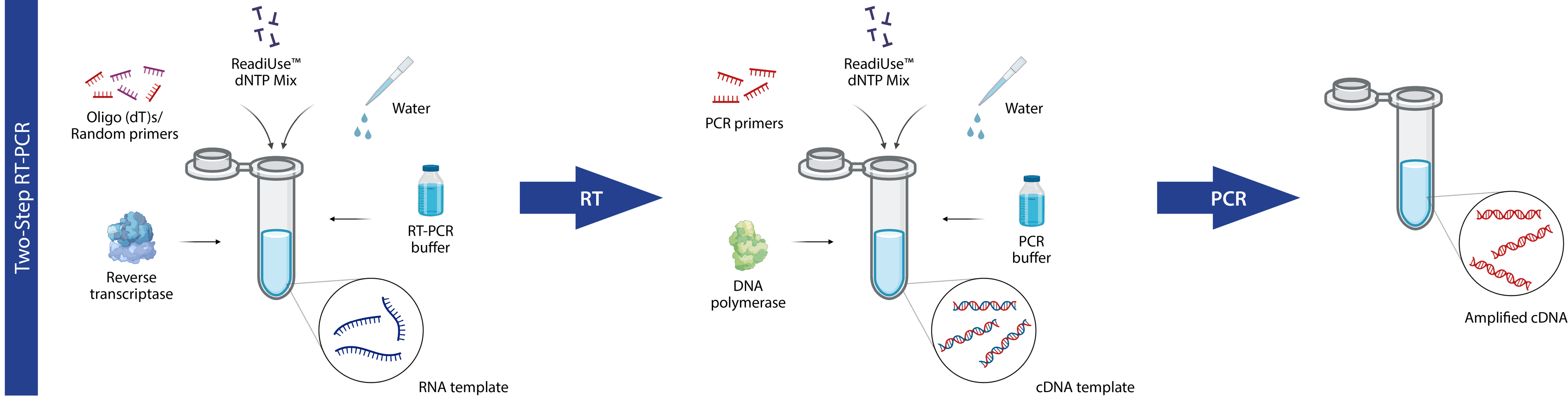
Two-step RT-PCR diagram. In two-step RT-PCR, cDNA synthesis via reverse transcription (RT) and subsequent PCR amplification occur in separate reaction vessels (figure made in BioRender).
The ReadiScript™ RT Reverse Transcription Kit is a convenient, all-in-one solution for synthesizing first-strand cDNA from RNA templates. This two-step RT-PCR kit provides optimized components for efficient reverse transcription, generating high-quality cDNA suitable for downstream qPCR and gene expression studies.
- Complete kit format - Contains all necessary components for cDNA synthesis in a single package
- Optimized for qPCR - Produces cDNA ideal for quantitative gene expression analysis
- Flexible priming options - Compatible with oligo(dT), random primers, or gene-specific primers
- Reliable performance - Engineered for consistent, reproducible results across various RNA inputs
- Convenient workflow - Streamlined protocol reduces hands-on time
Choosing the right primer type is crucial for successful RT-PCR amplification and accurate gene expression quantification. Different primer types offer distinct advantages depending on your RNA template and experimental goals.
Primer Type | Best For | Considerations |
|---|---|---|
Oligo(dT) | mRNA with poly(A) tails | Biased toward 3' end of transcripts |
Random Primers | All RNA species, degraded samples | Produces multiple cDNA fragments per transcript |
Gene-Specific Primers | Specific target detection | Highest specificity, limited to single target per reaction |
Different reverse transcriptase enzymes have varying performance characteristics suited to specific applications and template types. Consider the properties of your RNA template when selecting the appropriate enzyme for optimal results.
Problem | Possible Cause | Solution |
|---|---|---|
No PCR product | RNA degradation or inhibitor carryover | Verify RNA integrity; re-purify RNA sample |
Low yield | Suboptimal primer annealing | Adjust primer concentration or annealing temperature |
Non-specific bands | Primer dimers or mispriming | Optimize PCR conditions; redesign primers |
Genomic DNA contamination | Incomplete DNase treatment | Include DNase I treatment step; design intron-spanning primers |
This document (01.0307.251203r1) was last updated on Sat Feb 28 2026. All trademarks and registered trademarks mentioned herein are the property of their respective owners.