
Products
Services
Resources
Selection Guides
About
Amplite® Luminometric Nitroreductase Assay Kit
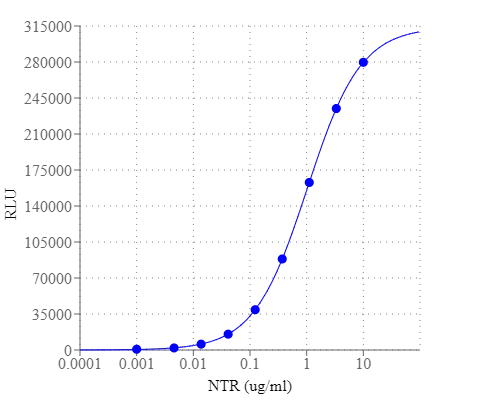
Amplite® Luminometric Nitroreductase Assay Kit is a chemiluminescent assay kit for quantification of nitroreductase activity in a microplate format.
- Detection Principle: Uses an NTR-reducible luciferin derivative, with generated luciferin measured by a luciferase detection system.
- Sensitivity: Detects nitroreductase down to 20 ng/mL.
- Workflow: Incubates the NTR reaction for 60 minutes at 37°C before luminescence detection.
- Instrument Compatibility: Luminescence detection using a microplate reader with solid white plates.


| Catalog | Size | Price | Quantity |
|---|---|---|---|
| 12470 | 100 Tests | Price |
Usage and storage
| Intended use | Research Use Only (RUO) |
Instrument settings
| Luminescence microplate reader | |
| Recommended plate | Solid white |
Contact us
| Telephone | |
| Fax | |
| sales@aatbio.com | |
| International | See distributors |
| Bulk request | Inquire |
| Custom size | Inquire |
| Technical support | Contact us |
| Request quotation | Request |
| Purchase order | Send to sales@aatbio.com |
| Shipping | Standard overnight for United States, inquire for international |
Page updated on October 23, 2026