
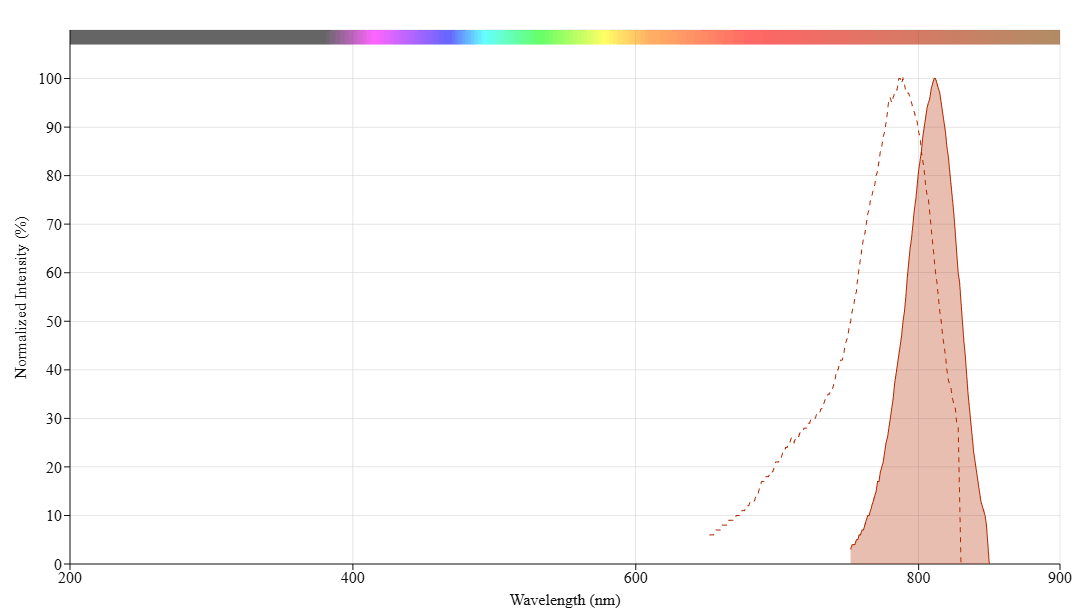
iFluor® 790 Azide readily reacts with biomolecules that contain an alkyne group. It can be conveniently used to develop NIR imaging probers. Our iFluor® 790 dye is designed to label proteins and other biomolecules with near infrared fluorescence. Conjugates prepared with iFluor® 790 have the excitation and emission spectra similar to that of indocyanine green (ICG) and the IRDye® 800 dye, with 783/814 nm excitation/emission maxima. iFluor® 790 dye emission is well separated from commonly used far-red fluorophores such as Cy5, Cy7 or allophycocyanin (APC), facilitating multicolor analysis. This fluorophore is extremely useful for small animal in-vivo imaging applications or for other imaging applications that require NIR detections such as the two-color western applications with the LI-COR® Odyssey® infrared imaging system. In vivo fluorescence imaging uses a sensitive camera to detect fluorescence emission from fluorophores in whole-body living small animals. To overcome the photon attenuation in living tissue, fluorophores with long emission at the near-infrared (NIR) region are generally preferred, including widely used small indocarbocyanine dyes. Recent advances in imaging strategies and reporter techniques for in vivo fluorescence imaging include novel approaches to improve the specificity and affinity of the probes and to modulate and amplify the signal at target sites for enhanced sensitivity. Further emerging developments are aiming to achieve high-resolution, multimodality and lifetime-based in vivo fluorescence imaging.


| Catalog | Size | Price | Quantity |
|---|---|---|---|
| 1363 | 1 mg | Price |
| Molecular weight | 1739.31 |
| Solvent | Water |
| Correction factor (260 nm) | 0.1 |
| Correction factor (280 nm) | 0.09 |
| Extinction coefficient (cm -1 M -1) | 250000 1 |
| Excitation (nm) | 787 |
| Emission (nm) | 812 |
| Quantum yield | 0.13 1 |
| Intended use | Research Use Only (RUO) |
| Storage | Freeze (< -15 °C); Minimize light exposure |
| Telephone | |
| Fax | |
| sales@aatbio.com | |
| International | See distributors |
| Bulk request | Inquire |
| Custom size | Inquire |
| Technical support | Contact us |
| Request quotation | Request |
| Purchase order | Send to sales@aatbio.com |
| Shipping | Standard overnight for United States, inquire for international |