
Products
Services
Resources
Selection Guides
About
Alkyne Building Blocks
AAT Bioquest offers a comprehensive collection of alkyne building blocks for click chemistry applications. These reagents contain terminal alkyne groups that react efficiently with azide-modified biomolecules through copper-catalyzed azide-alkyne cycloaddition (CuAAC), forming stable triazole linkages. Our alkyne building blocks span fluorescent dyes across the full spectrum, dark quenchers for FRET applications, and functional tags including biotin and haptens. The FastClick™ series features enhanced reactivity for faster conjugation under milder conditions, while our proprietary iFluor®, Tide Fluor™, and Tide Quencher™ families provide superior brightness, photostability, and quenching efficiency compared to traditional alternatives.
Product Type | Spectral Range | Best For | Key Products |
|---|---|---|---|
FastClick™ Alkyne Building Blocks | Blue to NIR | Rapid reactions, mild conditions, sensitive samples | FastClick™ Cy3/Cy5/XFD Alkynes |
iFluor® Alkyne Dyes | 488–790 nm | Protein labeling, high brightness needs | iFluor® 488, 555, 647, 790 Alkynes |
XFD Alkyne Dyes | 350–790 nm | Flow cytometry, microscopy (Alexa Fluor® replacement) | XFD488, XFD555, XFD647 Alkynes |
AATOM™ Alkyne Dyes | 390–700 nm | FACS, FISH applications | AATOM™ 488, 565, 647N Alkynes |
Cyanine Alkyne Dyes | 555–789 nm | Standard fluorescent labeling, imaging | Cy3, Cy5, Cy7 Alkynes |
Classic Fluorescent Alkyne Dyes | 346–604 nm | qPCR, sequencing, traditional applications | FAM, TAMRA, ROX, HEX Alkynes |
Tide Fluor™ Alkynes | 341–785 nm | FRET donors, peptide labeling | TF2, TF3, TF5WS Alkynes |
Tide Quencher™ Alkynes | Non-fluorescent | FRET acceptors, molecular beacons | TQ1–TQ8WS Alkynes |
Hapten Alkynes | – | Detection, purification, immunoassays | Biotin Alkyne, Digoxigenin Alkyne |
Fig. 1

The reaction scheme of a biomolecule azide with a dye alkyne.
FastClick™ alkynes incorporate a proprietary click-assisting group (CAG) that dramatically accelerates copper-catalyzed click reactions. These reagents enable efficient conjugation under extremely mild conditions with lower copper concentrations, making them ideal for sensitive biological samples and applications requiring rapid reaction times.
- 10-100x faster reaction rates compared to standard alkynes under identical conditions
- Works efficiently at low micromolar concentrations of both reactants
- Reduced copper requirements minimize sample damage and simplify purification
- Available with popular fluorophores (Cy dyes, FAM, TAMRA, ROX, XFD series) and detection tags (biotin, digoxigenin)
- Ideal for live cell applications and sensitive biomolecule conjugation
Fig. 2
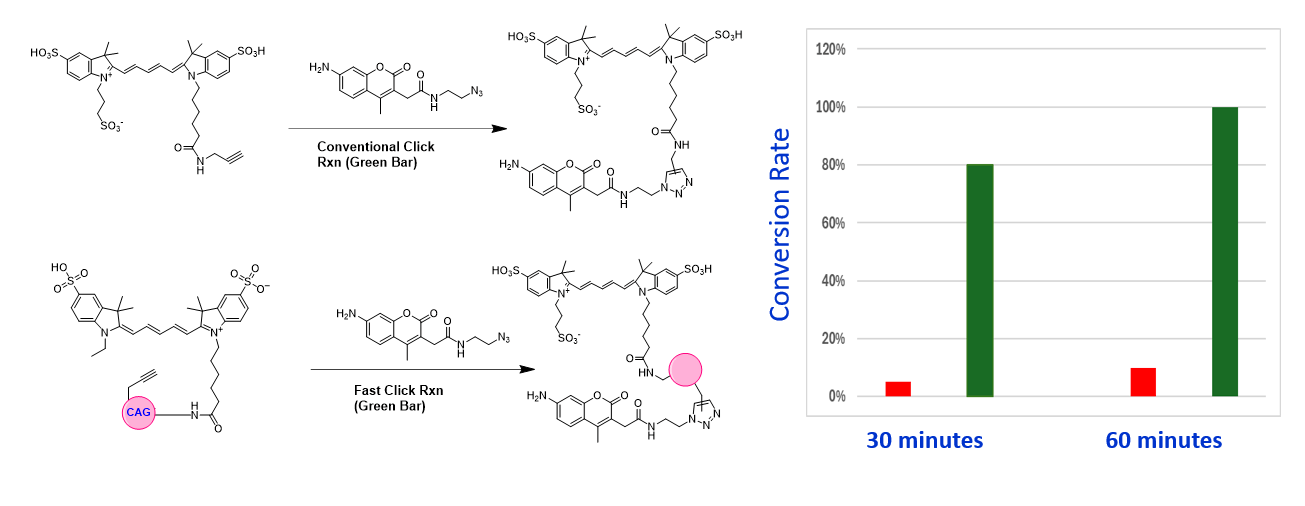
The reaction (Green Bar) of FastClick™ Cy5 Alkyne with coumarin azide occurs under extremely mild conditions (e.g., [Azide] = 0.02 mM, [Alkyne] = 0.02 mM, [CuSO4] = 0.02 mM, [Sodium Ascorbate] = 5 mM, in 100 mM HEPES) under which the common Cy5 alkyne does not effectively react with the coumarin azide substrate.
iFluor® dyes represent AAT Bioquest's premium line of fluorescent labeling reagents, specifically optimized for protein conjugation. These alkynes combine exceptional brightness with minimal self-quenching, making them ideal for applications requiring high sensitivity and consistent performance.
- Superior brightness with high quantum yields
- Minimal self-quenching even at high degrees of labeling
- Excellent photostability for prolonged imaging
- Optimized for protein labeling, particularly antibodies
- Available from green (488 nm) through NIR (790 nm)
XFD dyes are spectrally equivalent to Alexa Fluor® dyes, providing excellent brightness and photostability for flow cytometry and microscopy applications. These alkyne derivatives react with azide-modified biomolecules to create stable, highly fluorescent conjugates across the full visible and near-infrared spectrum.
- Spectrally matched to Alexa Fluor® dyes for direct replacement in existing protocols
- Excellent water solubility and pH-independent fluorescence (pH 4-10)
- Superior photostability for extended imaging sessions
- Full spectral coverage from UV (350 nm) to NIR (790 nm)
- Compatible with standard filter sets for common fluorophores
AATOM™ dyes are high-performance fluorophores that feature rigid chromophore structures based on rhodamine chemistry, delivering superior optical properties compared to flexible cyanine dyes. This structural rigidity ensures consistent absorption and fluorescence characteristics that are largely independent of solvent and environmental conditions.
- Rigid chromophore structure — Unlike cyanines, AATOM™ dyes do not form isomer equilibria, providing stable, well-defined optical properties
- Exceptional photostability — High resistance to photobleaching for extended imaging and single-molecule applications
- Strong absorption and high quantum yield — Bright fluorescence for sensitive detection
- Excellent water solubility — Compatible with biological buffers and aqueous applications
- Full spectrum coverage from UV (390 nm) through far-red (700 nm)
AATOM™ dyes are manufactured by AAT Bioquest and are not affiliated with ATTO-TEC GmbH.
Cyanine dyes are widely used fluorophores for biological labeling, offering excellent brightness and a range of emission wavelengths. These alkyne derivatives provide convenient click chemistry compatibility for labeling azide-modified biomolecules.
Traditional fluorescent dyes including fluoresceins (FAM, HEX, TET, JOE, VIC) and rhodamines (TAMRA, ROX) are widely used in qPCR, DNA sequencing, and molecular biology applications. These alkyne derivatives enable conjugation to azide-modified oligonucleotides and other biomolecules through click chemistry.
Tide Fluor™ dyes are designed as superior alternatives to classic fluorophores for FRET applications and peptide labeling. These alkynes offer stronger fluorescence intensity, higher conjugation efficiency, and excellent water solubility compared to traditional dyes like EDANS, Cy3, and Cy5.
- Stronger fluorescence than traditional FRET fluorophores (EDANS, Cy dyes)
- Higher conjugation efficiency with improved water solubility
- pH-independent fluorescence from pH 3-11
- Optimized FRET donor/acceptor pairs available
- Ideal for peptide labeling and molecular beacon development
Tide Quencher™ dyes are non-fluorescent molecules designed to efficiently quench fluorescence through FRET. These alkyne derivatives are superior alternatives to traditional quenchers like DABCYL, offering stronger absorption, higher quenching efficiency, and better water solubility across a broad spectral range from UV to NIR.
- Higher quenching efficiency than DABCYL and BHQ quenchers
- Stronger absorption for more effective energy transfer
- Non-fluorescent with minimal background
- Excellent water solubility (WS versions)
- Matched quenchers available for all common fluorophores from blue to NIR
Haptens, such as biotin and digoxigenin, are useful for high-affinity detection, purification, and immunoassay applications. Alkyne derivatives of these haptens enable easy introduction of the tags into azide-modified biomolecules.
- Biotin alkynes for streptavidin/avidin-based detection and purification
- ReadiLeave™ Reversible Biotin for applications requiring elution under mild conditions
- Digoxigenin alkyne for anti-DIG antibody detection systems
- PEG spacers available for improved solubility and reduced steric interference
AAT Bioquest offers optimized buffers and kits for performing copper-catalyzed click reactions. The FastClick™ Click Reaction Buffer Kit provides all components needed for efficient bioconjugation in biological samples.
This document (01.0320.251203r1) was last updated on Sat Feb 28 2026. All trademarks and registered trademarks mentioned herein are the property of their respective owners.
Alkyne Building Blocks