
Products
Services
Resources
Selection Guides
About
Anti-Tag Molecules
Anti-tag molecules are essential tools for detecting, visualizing, and purifying recombinant proteins bearing common affinity tags. AAT Bioquest offers a comprehensive selection of anti-tag detection reagents, including the HIS Lite™ series featuring NTA-nickel chelates conjugated to bright fluorescent dyes for His-tag detection, biarsenical FlASH/ReASH reagents for tetracysteine tags, and benzylguanine (BG) substrates for SNAP-tag labeling. These reagents enable sensitive, site-specific detection of tagged proteins in gel electrophoresis, Western blotting, live-cell imaging, and flow cytometry applications.
Tag Target | Detection Type | Best For | Key Products |
|---|---|---|---|
Polyhistidine (His-tag) | Fluorescent NTA-Ni Complexes | Gel staining, Western blot, live-cell imaging | HIS Lite™ iFluor®/Cy3/Cy5 conjugates |
Polyhistidine (His-tag) | In-gel fluorescent staining | SDS-PAGE, protein purity assessment | ProLite™ His-Tag Gel Staining Kit |
Tetracysteine (TC) | Fluorogenic biarsenical dyes | Live-cell protein tracking, minimal tag size | FlASH, ReASH reagents |
SNAP-tag | Covalent benzylguanine substrates | Irreversible labeling, pulse-chase experiments | BG-TMR, BG-SiR conjugates |
The HIS Lite™ series provides direct fluorescent detection of polyhistidine-tagged proteins through nitrilotriacetic acid (NTA)-nickel chelate chemistry. These probes feature bis-NTA or tris-NTA groups that coordinate with Ni²⁺ ions to bind His-tags with high specificity and affinity. The tris-NTA configuration provides enhanced binding stability compared to mono-NTA systems, enabling robust detection even in demanding applications like live-cell imaging.
- Site-specific binding — NTA-Ni²⁺ chemistry targets His-tags directly without antibodies
- Tris-NTA options — Enhanced binding stability for live-cell and solution-phase applications
- iFluor® dye technology — Superior brightness and photostability compared to classic fluorophores
- Flexible formats — Choose pre-loaded Ni²⁺ complexes or chelators for custom protocols
- Broad spectral coverage — Options from green (OG488) through far-red (Cy5, iFluor® 647)
The ProLite™ His-Tag Protein Gel Staining Kit enables rapid, in-gel detection of polyhistidine-tagged proteins following SDS-PAGE. This kit provides a fluorescence-based alternative to Western blotting for confirming His-tag expression and assessing protein purity.
- Direct in-gel detection — No transfer or membrane handling required
- Rapid protocol — Complete staining in approximately 1 hour
- Selective visualization — Specifically detects His-tagged proteins against background proteins
- Compatible with downstream analysis — Proteins remain accessible for excision and mass spectrometry
Fig. 1
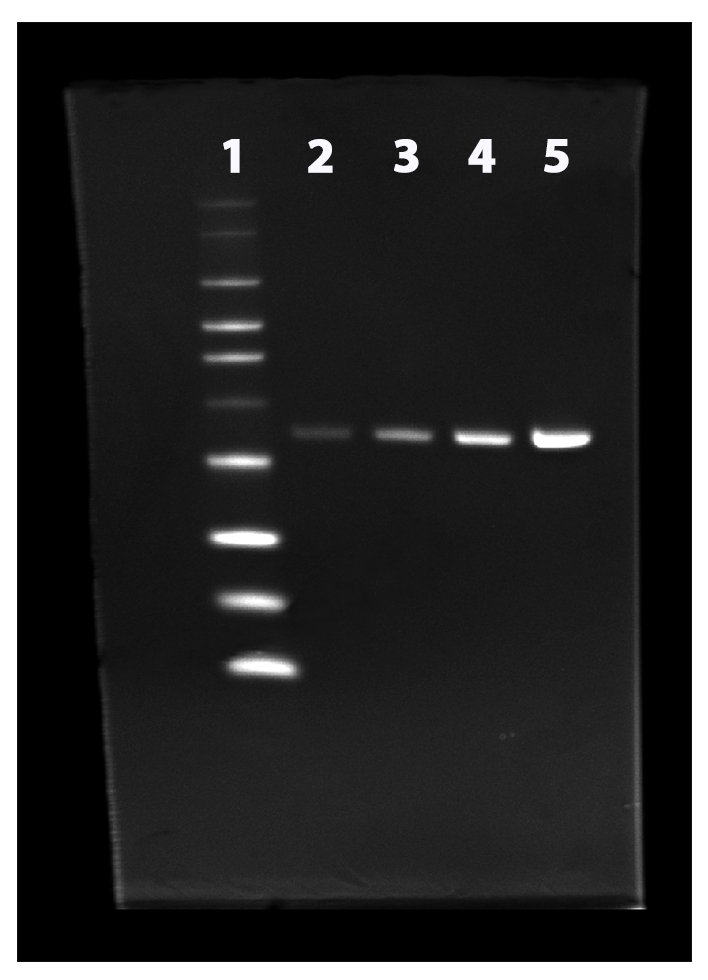
Two-fold dilution series of His-tagged annexin V were separated on a NuPAGE® 4–12% Bis-Tris gel and stained with the ProLite™ His-Tag Protein Gel Staining Kit according to standard protocols. Lane 1: His-tagged protein ladder, Lane 2 to 5: two-fold dilution of His-tagged annexin V.
NTA maleimide is a versatile building block for attaching nitrilotriacetic acid groups to thiol-containing substrates, enabling researchers to create custom His-tag detection surfaces, beads, or biomolecular conjugates.
Biarsenical fluorescent dyes (FlASH and ReASH) enable site-specific labeling of proteins engineered with a tetracysteine motif (Cys-Cys-X-X-Cys-Cys). These membrane-permeant reagents become highly fluorescent only upon binding to the tetracysteine tag, providing low background and enabling real-time protein visualization in living cells.
- Fluorogenic labeling — Minimal background fluorescence until bound to tetracysteine motif
- Cell-permeant — Live cell compatible for real-time protein tracking
- Two-color options — Green (FlASH, fluorescein-based) and red (ReASH, resorufin-based) for multiplexing
- Minimal tag size — Small tetracysteine motif (~12 amino acids) reduces impact on protein structure
SNAP-tag technology enables irreversible, covalent labeling of fusion proteins through the reaction between O⁶-benzylguanine (BG) derivatives and the SNAP-tag enzyme (a modified human O⁶-alkylguanine-DNA alkyltransferase). These substrates provide bright, photostable labels for visualizing SNAP-tagged proteins in live cells and fixed samples.
- Covalent labeling — Irreversible attachment ensures stable signal throughout experiments
- Cell-permeant — Suitable for live cell imaging applications
- Multiple fluorophore options — TMR (orange) and SiR (far-red) for different imaging needs
- Ideal for pulse-chase — Sequential labeling enables protein turnover studies
This document (01.0289.251203r1) was last updated on Sat Feb 28 2026. All trademarks and registered trademarks mentioned herein are the property of their respective owners.