
Products
Services
Resources
Selection Guides
About
Cell Transfection
AAT Bioquest offers a comprehensive line of lipid-based Transfectamine™ transfection reagents engineered for efficient delivery of nucleic acids into eukaryotic cells. These advanced formulations provide high transfection efficiency with minimal cytotoxicity, outperforming conventional lipid-based transfection formulations. Each reagent in the Transfectamine™ series is optimized for specific cargo types—including plasmid DNA, CRISPR/Cas9 components, siRNA, and mRNA—ensuring researchers have the right tool for their gene delivery applications.
Product | Cargo Type | Best For | Key Advantage |
|---|---|---|---|
Transfectamine™ 5000 | Plasmid DNA | General gene expression studies | Versatile, broad cell type compatibility |
Transfectamine™ 6000 | CRISPR/Cas9 | Gene editing applications | Optimized for large CRISPR plasmids/RNPs |
Transfectamine™ 7000 | siRNA | Gene knockdown experiments | Efficient siRNA delivery, robust silencing |
Transfectamine™ mRNA | mRNA | Transient protein expression | High mRNA loading, low toxicity |
The Transfectamine™ series represents AAT Bioquest's advanced transfection technology, providing reliable nucleic acid delivery across diverse cell types. These reagents utilize proprietary formulations that facilitate efficient cellular uptake while maintaining cell health, making them ideal for sensitive downstream applications including protein expression, gene editing, and functional genomics studies.
- Superior transfection efficiency — Outperforms Lipofectamine™ 2000 and 3000 in head-to-head comparisons across multiple cell lines
- Low cytotoxicity — Optimized formulations maintain high cell viability for accurate experimental results
- Application-specific optimization — Each reagent is tailored for its target cargo (DNA, CRISPR, siRNA, or mRNA)
- Broad cell line compatibility — Effective in commonly used cell lines including HeLa, CHO-K1, HEK293, and others
- Simple protocol — Ready-to-use formulation requires no additional components for standard transfections
AAT Bioquest Transfectamine™ reagents deliver superior transfection efficiency compared to industry-standard lipofection products. Performance testing demonstrates higher transfection rates across multiple cell lines with maintained cell viability.
- Transfection efficiency — Outperforms Lipofectamine™ 2000 and 3000 in HeLa and CHO-K1 cells
- Cell viability — Maintains >85% viability post-transfection
- Reproducibility — Consistent results across passage numbers
Fig. 1
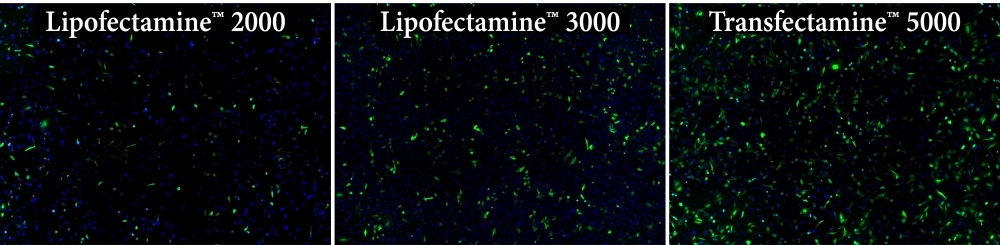
Transfection efficiency comparison in HeLa cells using Transfectamine™ 5000, Lipofectamine 2000 and Lipofectamine 3000 reagents. Each reagent was used to transfect HeLa cells in a 96-well format, and GFP expression was analyzed 24 hours post-transfection. Transfectamine™ 5000 transfection reagent provided higher GFP transfection efficiency compared to Lipofectamine 2000 and Lipofectamine 3000 reagents.
Transfectamine™ reagents enable a wide range of cell-based research and therapeutic applications.
Gene Overexpression Studies — Introduce expression constructs to study gene function, protein localization, or create disease models. Transfectamine™ 5000 delivers efficient plasmid transfection across diverse cell types, supporting functional studies and protein expression validation.
RNA Interference (RNAi) — Deliver siRNA or shRNA to knock down target gene expression. Proper optimization with Transfectamine™ 7000 ensures effective silencing with minimal off-target effects for functional genomics research.
CRISPR-Cas9 Gene Editing — Transfect Cas9 protein or mRNA along with guide RNAs for precise genome modification. Transfectamine™ 6000 is optimized for efficient ribonucleoprotein (RNP) delivery, a format commonly used to support transient Cas9 activity and reduce off-target risk when combined with appropriate guide design.
mRNA Delivery — Transfect synthetic mRNA for rapid, transient protein expression without risk of genomic integration. Transfectamine™ mRNA is ideal for sensitive applications, vaccine research, and protein replacement studies.
Reporter Assays — Deliver luciferase, GFP, or other reporter constructs to study promoter activity, signaling pathways, or drug responses. Reporter constructs enable high-throughput screening and pathway validation.
This document (01.0337.251203r1) was last updated on Sat Feb 28 2026. All trademarks and registered trademarks mentioned herein are the property of their respective owners.
Cell Transfection