
Products
Services
Resources
Selection Guides
About
Crosslinkers
AAT Bioquest offers a comprehensive selection of crosslinkers for bioconjugation applications, including heterobifunctional reagents, photoaffinity probes, click chemistry building blocks, and preactivated proteins. These reagents enable efficient coupling of biomolecules through various reactive groups targeting amines, thiols, and other functional moieties. Our portfolio includes our proprietary Buccutite™ crosslinking technology for high-efficiency protein-protein conjugation, as well as classic NHS ester and maleimide reactive chemistries that are designed to work in combination with crosslinkers to streamline conjugation workflows.
Crosslinker Type | Reactive Groups | Best For | Key Products |
|---|---|---|---|
Buccutite™ Technology | MTA + FOL (proprietary) | High-yield antibody conjugation with minimal activity loss | Buccutite™ MTA NHS, Buccutite™ MTA Maleimide |
NHS/Maleimide Heterobifunctional | Amine + Thiol | Antibody-enzyme conjugates, protein-protein crosslinking | SMCC, SMCC Plus™, SM(PEG)n |
Click Chemistry | Azide + DBCO/Alkyne | Copper-free bioorthogonal labeling, two-step conjugation | DBCO-PEG-NHS, Azido-PEG4-NHS |
Photoaffinity Probes | Diazirine/Benzophenone/Azide + NHS/Maleimide | UV-activated crosslinking, protein interaction studies | SDA derivatives, NHS-Diazirine |
Psoralen Derivatives | DNA intercalation + NHS/Maleimide | Nucleic acid crosslinking, DNA probe development | Psoralen MOP/TMP derivatives |
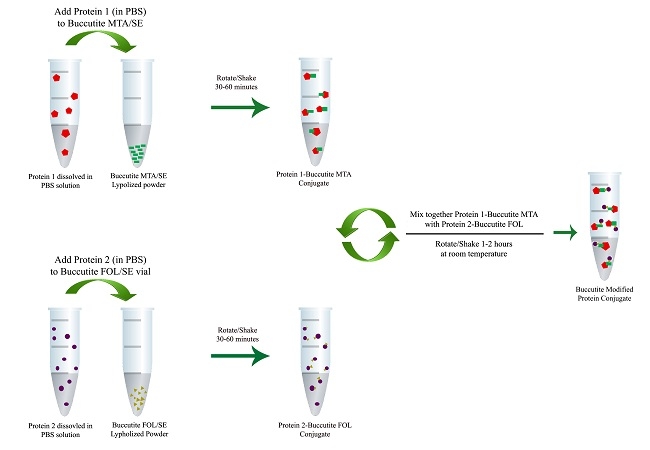
Buccutite™ technology represents a breakthrough in protein-protein conjugation, utilizing a proprietary MTA-FOL coupling chemistry that provides higher conjugation yields while preserving biomolecule activity. Unlike traditional NHS ester chemistry that can over-modify proteins, Buccutite™ crosslinking produces more consistent conjugates with predictable stoichiometry.
- Higher conjugation yields compared to traditional SMCC-based methods
- Minimal loss of antibody binding activity
- Simple two-component system - MTA (maleimide or NHS) + FOL
- Consistent, reproducible conjugates with predictable stoichiometry
- Compatible with antibodies, enzymes, and other proteins
Heterobifunctional crosslinkers containing both NHS ester (amine-reactive) and maleimide (thiol-reactive) groups enable controlled two-step conjugation between proteins. The NHS ester first reacts with primary amines to form stable amide bonds, followed by maleimide conjugation to free sulfhydryls. This approach minimizes unwanted homo-conjugation and allows sequential coupling of two different biomolecules.
- Stable non-cleavable linkages with defined spacer lengths
- SMCC Plus™ offers enhanced water solubility and crosslinking efficiency compared to standard SMCC
- PEGylated versions (SM(PEG)n) provide improved solubility and reduced aggregation
- Variable spacer arms range from 8.3Å (SMCC) to 24.6Å (SM(PEG)4)
Click chemistry-based crosslinkers enable bioorthogonal conjugation through highly selective azide-alkyne reactions. DBCO (dibenzocyclooctyne) reagents undergo copper-free strain-promoted alkyne-azide cycloaddition (SPAAC), making them ideal for live cell applications and sensitive biomolecules where copper catalysts may cause toxicity or interference.
- Copper-free bioorthogonal reaction eliminates metal toxicity concerns
- Highly selective - does not react with native functional groups on biomolecules
- PEG spacers improve aqueous solubility and reduce steric hindrance
- Enables two-step labeling strategies for complex conjugation schemes
Photoaffinity crosslinkers contain light-activated moieties (diazirine, benzophenone, or phenyl azide) that form covalent bonds upon UV irradiation. These reagents are invaluable for studying transient protein-protein interactions, mapping binding sites, and identifying unknown interaction partners. Diazirine-based probes offer advantages including smaller size, stability in the dark, and efficient activation at approximately 350 nm.
- Diazirine probes activate at longer wavelengths (~350 nm) with minimal protein damage
- Benzophenone derivatives are highly stable and can be reactivated multiple times
- Tetrafluorophenyl azides activate at ~260 nm for photolabeling applications
- Various reactive handles (NHS, maleimide, azide, alkyne) for flexible conjugation strategies
Psoralens are photoactivatable DNA intercalators that form covalent crosslinks with pyrimidine bases upon UV irradiation. These derivatives (MOP and TMP variants) are conjugated with reactive handles for developing nucleic acid probes and studying DNA structure and interactions. Psoralen crosslinking is widely used for DNA-protein interaction studies and antisense applications.
- Intercalate between DNA base pairs for specific crosslinking
- UV-activated covalent bond formation with pyrimidines
- TMP (trimethylpsoralen) derivatives offer enhanced reactivity
- Available with NHS, maleimide, and azide reactive groups
This document (01.0325.251203r1) was last updated on Sat Feb 28 2026. All trademarks and registered trademarks mentioned herein are the property of their respective owners.