
Products
Services
Resources
Selection Guides
About
Buccutite™ Protein Crosslinking Kits
Buccutite™ is a highly efficient crosslinking technology for bioconjugation, such as the covalent attachment of a label (e.g., fluorescent dye, phycobiliprotein, or enzyme) to a target (e.g., antibody or protein). It works through a complementary pair of small linkers, Buccutite™ MTA and Buccutite™ FOL, which react rapidly and selectively with each other, so that the label and target couple in a single, directed pairing.
Selective label-target coupling without self-reactivity | Mild, catalyst-free coupling at neutral pH |
Compatible with fluorophores, enzymes, proteins, and oligonucleotides | Preformulated kits yield bioconjugates in under two hours without purification |
| I am looking for... | Examples | Jump to section |
|---|---|---|
| Labeling strategies that match my target (e.g., antibody) | Lysine-directed, hinge-directed, Fc site-specific | Choosing a Conjugation Strategy |
| Ready-to-use kits for popular labels | xtraFluor™ Violet 420, phycobiliproteins and tandems, HRP and ALP | Buccutite™ Labeling Kits |
| Standalone reagents for popular labels | PE, APC, PE-Cy5, APC-Cy7 | ReadiUse™ Standalone Reagents |
| Custom or specialty labels | Streptavidin, oligonucleotides, trFluor™ D2 acceptor, FOL/MTA reagents | Specialty & Custom Conjugation |
| Reaction cleanup or conjugation QC | Scavengers and quantitation dyes | Supporting Reagents |
Buccutite™ crosslinking uses two complementary reactive groups, MTA and FOL, that selectively react with each other to covalently link a target and label together. The conjugation process involves three simple steps:
- Modify one component with MTA. MTA can be attached through lysine-directed (NHS ester), hinge-directed (maleimide), or Fc glycan-directed chemistry, depending on the desired labeling site.
- Modify the other component with FOL. FOL is attached using a compatible labeling method. In most Buccutite™ kits and applicable ReadiUse™ standalone reagents, the label is already FOL-activated, eliminating this preparation step.
- Mix the two modified components. MTA and FOL react spontaneously to form a covalent bond, joining the two components together.
The final coupling reaction occurs at neutral pH without catalysts or reducing agents. Both modified components remain stable until mixed.
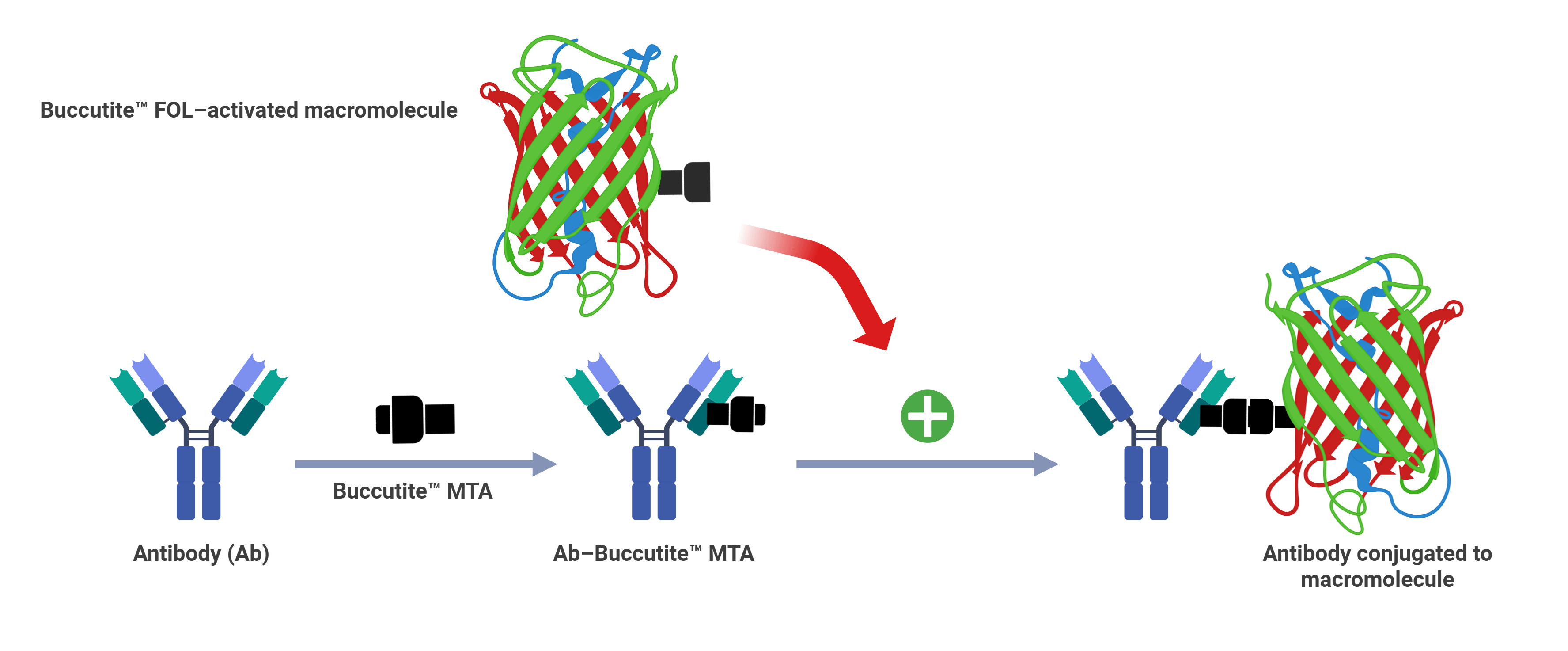 Buccutite™ antibody conjugation. The antibody (Ab) is first modified with Buccutite™ MTA, at lysines, hinge-region cysteines, or the Fc glycans depending on the labeling target. Adding a Buccutite™ FOL-activated macromolecule, such as a phycobiliprotein or an enzyme, couples it to the Ab–Buccutite™ MTA through a covalent FOL–MTA bond at neutral pH, without a catalyst, giving the antibody conjugated to the macromolecule. In most Buccutite™ kits the label is supplied FOL-activated, so only these two mixing steps are needed.
Because FOL and MTA react with each other rather than with themselves, coupling is directed between the two partners, which minimizes homo-crosslinking and antibody-to-antibody aggregation. Handle density and the mixing ratio set the degree of labeling (DOL), the number of labels per antibody. When a conjugate is built from the individual reagents, the FOL-modified partner is typically added in a 1.5–2.0-fold molar excess to drive the reaction to completion.
For popular labels, Buccutite™ kits come pre-optimized for rapid and convenient bioconjugation. This is achieved by supplying the label pre-activated with FOL, which reduces the process to two simple mixing steps:
- Activate the antibody — tag it with Buccutite™ MTA.
- Couple the label — add the FOL-activated label and mix.
Small-scale conjugations can be completed in less than two hours, with no purification required. This system can also be scaled up for production workflows.
The Buccutite™ conjugation system offers customers the flexibility to define where a label should attach on a target. The three most common strategies are lysine-directed, hinge-directed, and Fc site-specific, as explained in the figure below.
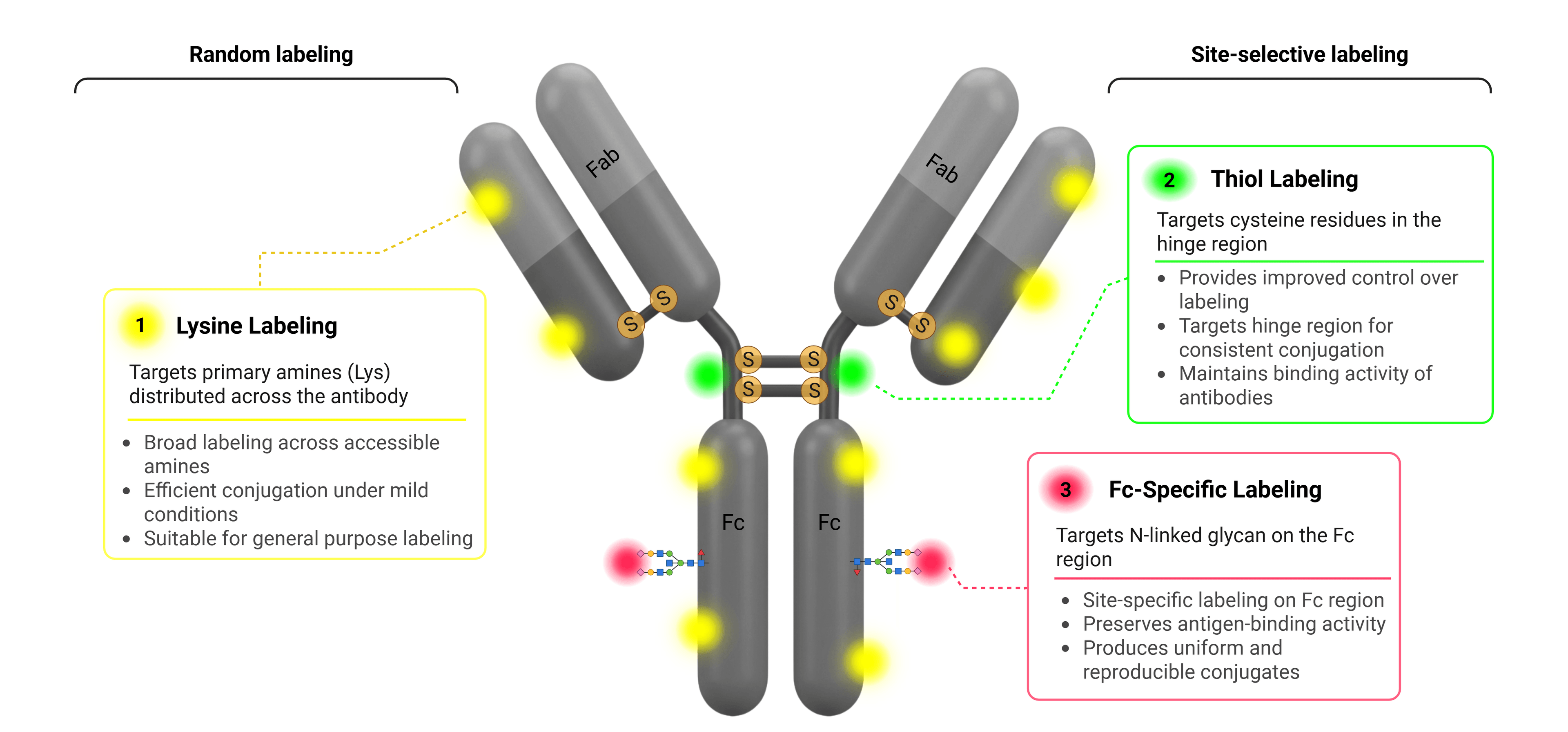 Buccutite™ can label an antibody at three targets, color-coded on the IgG: lysine (yellow), distributed across accessible primary amines; hinge (green), localized to the thiols exposed by limited reduction of the hinge disulfides; and Fc (pink), directed to the N-linked Fc glycans, away from the antigen-binding sites. Control over label placement increases from lysine to hinge to Fc.
When choosing the appropriate conjugation strategy, it is important to consider the tradeoffs of each approach. Such considerations are briefly outlined in the table below and further explored in the sections that follow.
| Route | Chemistry | Pros | Cons |
|---|---|---|---|
| Lysine-directed | NHS ester (amine-reactive) | Large selection of labels; good for routine bioconjugation | Because label distribution is random, antigen-binding sites may be obstructed, and DOL may vary |
| Hinge-directed | Maleimide (thiol-reactive) | Restricted to hinge region, away from binding sites | Reduction of disulfide bridges may degrade antibody stability |
| Fc site-specific | Fc glycan-directed chemistry | Restricted to Fc region, away from binding sites | Maximum DOL of two, one per Fc glycan |
Lysine-directed labeling is the default and most broadly applicable route. The Buccutite™ FOL and MTA NHS ester reagents react with primary amines on the antibody surface (the ε-amino groups of lysine residues and the N-terminus), installing the handle wherever an amine is accessible. This route requires no antibody engineering and works across a broad range of proteins, so it underlies the pre-optimized Buccutite™ labeling kits, offered in IgG formats from microscale through production scale and in IgM formats at microscale. Because the amines are labeled wherever they happen to sit, the number and position of labels vary from one antibody to the next, and a lysine in or near the antigen-binding site can occasionally be modified. When the label must stay clear of that site, the hinge or Fc route is the better choice.
Hinge-directed labeling trades some of lysine labeling's universality for control over label placement. This route is supplied as crosslinker reagents rather than as kits. The Buccutite™ maleimide reagents (FOLM and MTAM) target free thiols on a small, well-defined set of cysteines away from the antigen-binding site, exposed by a limited reduction of the antibody's interchain hinge disulfides. MTAM installs the MTA handle on the antibody, which then couples to any FOL-activated label; FOLM installs the FOL handle instead, for coupling to an MTA-modified dye or protein. Unlike conventional thiol chemistries such as SMCC, this hinge-region site-selective crosslinking (HRC) approach forms more stable intermediates and keeps the side reactions of thiol labeling, such as self-reactivity and homo-crosslinking, to a minimum. It reaches up to 70% conjugation yield within one hour under mild, catalyst-free conditions.
Buccutite™ Fc Site-Specific Labeling kits provide the greatest control over label placement among Buccutite™ labeling methods. These kits target the N-linked glycans in the antibody’s Fc region, away from the antigen-binding domains, minimizing interference with antigen recognition and helping preserve antibody binding activity. Because a standard IgG contains two Fc glycosylation sites, this approach restricts labeling to defined regions, producing more uniform conjugates with a more controlled degree of labeling (DOL) and improved batch-to-batch reproducibility.
In contrast, conventional NHS ester chemistry modifies accessible lysine residues throughout the antibody, resulting in less predictable label placement and greater DOL variability. Excessive labeling can also cause fluorescence self-quenching, promote aggregation, and impair antigen binding. By directing conjugation to the Fc region, Buccutite™ Fc Site-Specific Labeling offers a more consistent and reproducible alternative to random lysine labeling.
Label attached at the Fc N-glycans, away from the antigen-binding site | Enzyme-free, with no antibody reduction |
Controlled degree of labeling for more consistent conjugates | Yields bioconjugates with higher stain index than sulfo-SMCC |
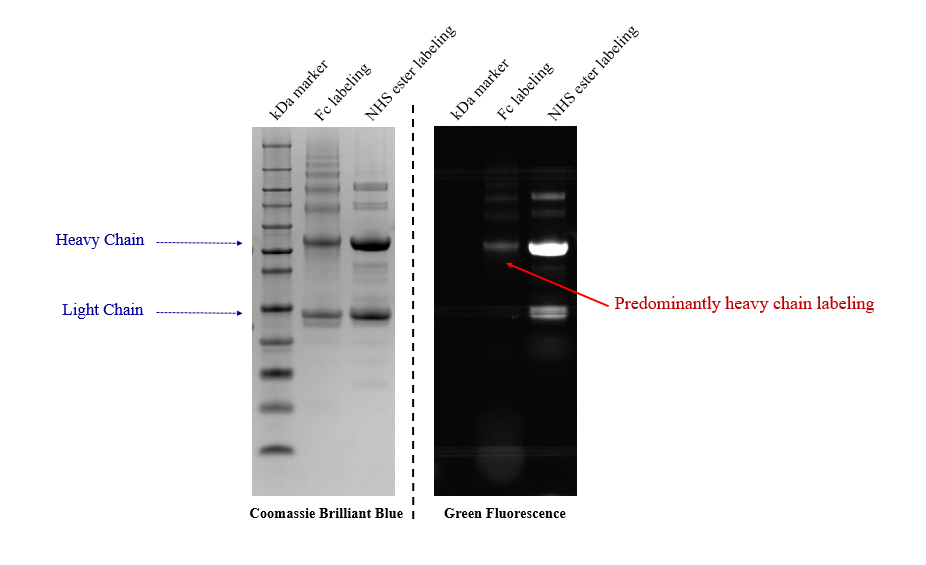 Comparison of heavy- and light-chain labeling patterns in iFluor® 488-conjugated anti-CD4 (SK3) antibodies. The Fc-labeled sample shows fluorescence predominantly associated with the heavy chain (where Fc glycans are conserved) with minimal light chain labeling.
Buccutite™ Fc site-specific labeling products are available in two formats: conjugation kits, which include the label and yield a finished Fc-labeled antibody, and modification kits, which install a reactive handle on the Fc glycans so that customers can attach their own labels.
SMCC is a widely used heterobifunctional crosslinker containing two distinct reactive groups on the same molecule: an NHS ester and a maleimide. The NHS ester side reacts with primary amines on one conjugation partner, while the maleimide side reacts with the free thiols of another, forming a covalent linkage between target and label. However, because both target and label often contain both free thiols and primary amines, unwanted side reactions and homo-crosslinking are common, leading to reduced conjugation efficiency and poor product uniformity.
To address these issues, Buccutite™ was developed using a novel bioconjugation workflow. Complementary FOL and MTA groups are installed separately on each of the respective conjugation partners, then joined through a highly selective reaction. Because neither handle reacts with itself, this approach reduces unwanted self-coupling, improves conjugation yields, and increases product uniformity.
An overview of Buccutite™ versus SMCC is outlined in the table below.
| Parameter | Buccutite™ | Traditional SMCC |
|---|---|---|
| Hands-on time | Under two hours | Up to six hours |
| Homo-crosslinking | Minimal | Common |
| Purification | Minimal to none required | Multiple desalting and clean-up steps required |
| Reaction conditions | Neutral pH, no catalyst | Careful pH control required |
| Antibody reduction | Only needed if using hinge-directed labeling | Always required to expose antibody thiols |
| Activated intermediates | Stable until mixed | Unstable and must be used promptly |
| Complexity | Simple, two steps | Complicated, multiple activation and purification steps required |
| Coupling chemistry | Selective reaction of target-MTA and FOL-label | Heterobifunctional linker containing both NHS ester and maleimide reacts with primary amines and free thiols of target and label |
In a comparison using anti-human CD4 clone SK3 labeled with APC, both Buccutite™ lysine-directed and Fc site-specific conjugates greatly outperformed SMCC, offering significantly improved stain indices.
| Labeling method | Conjugate (clone) | Background (− mean) | Signal (+ mean) | Stain index | Yield |
|---|---|---|---|---|---|
| Buccutite™ lysine labeling | CD4 (SK3)–APC | 193 | 766,686 | 1303 | 73% |
| Buccutite™ Fc labeling | CD4 (SK3)–Fc–APC | 176 | 221,129 | 397 | 49% |
| S-SMCC | CD4 (SK3)–APC | 277 | 167,009 | 250 | 60% |
Additional comparisons also demonstrate that both Buccutite™ hinge-directed labeling (using MTA maleimide) and Buccutite™ Fc site-specific conjugates produce conjugates with higher stain indices, while also providing greater control of label placement.
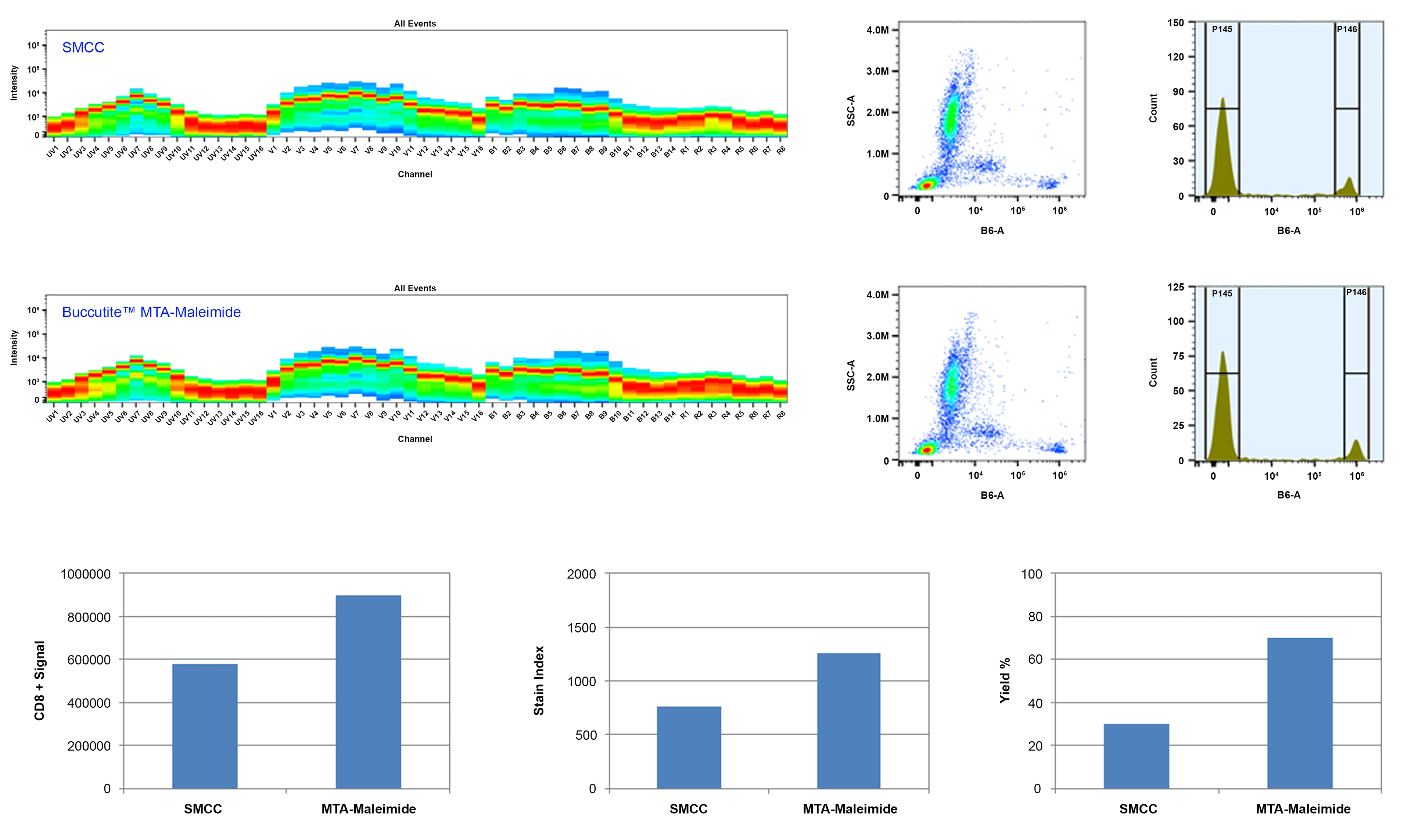 Flow cytometry analysis of whole blood stained with PE-iFluor® 610 anti-human CD8 SK1 conjugates. Two different methods were used to prepare the conjugates: the SMCC method and the Buccutite™ MTA-Maleimide method. The fluorescence signal was monitored using an Aurora spectral flow cytometer in the B6-A channel. Top) Flow cytometry data was generated using a 4-laser (355 nm, 405 nm, 488 nm, and 640 nm) spectral cytometer. Bottom) CD8+ signal intensity in the B6-A channel, stain index and yield were compared between the two methods.
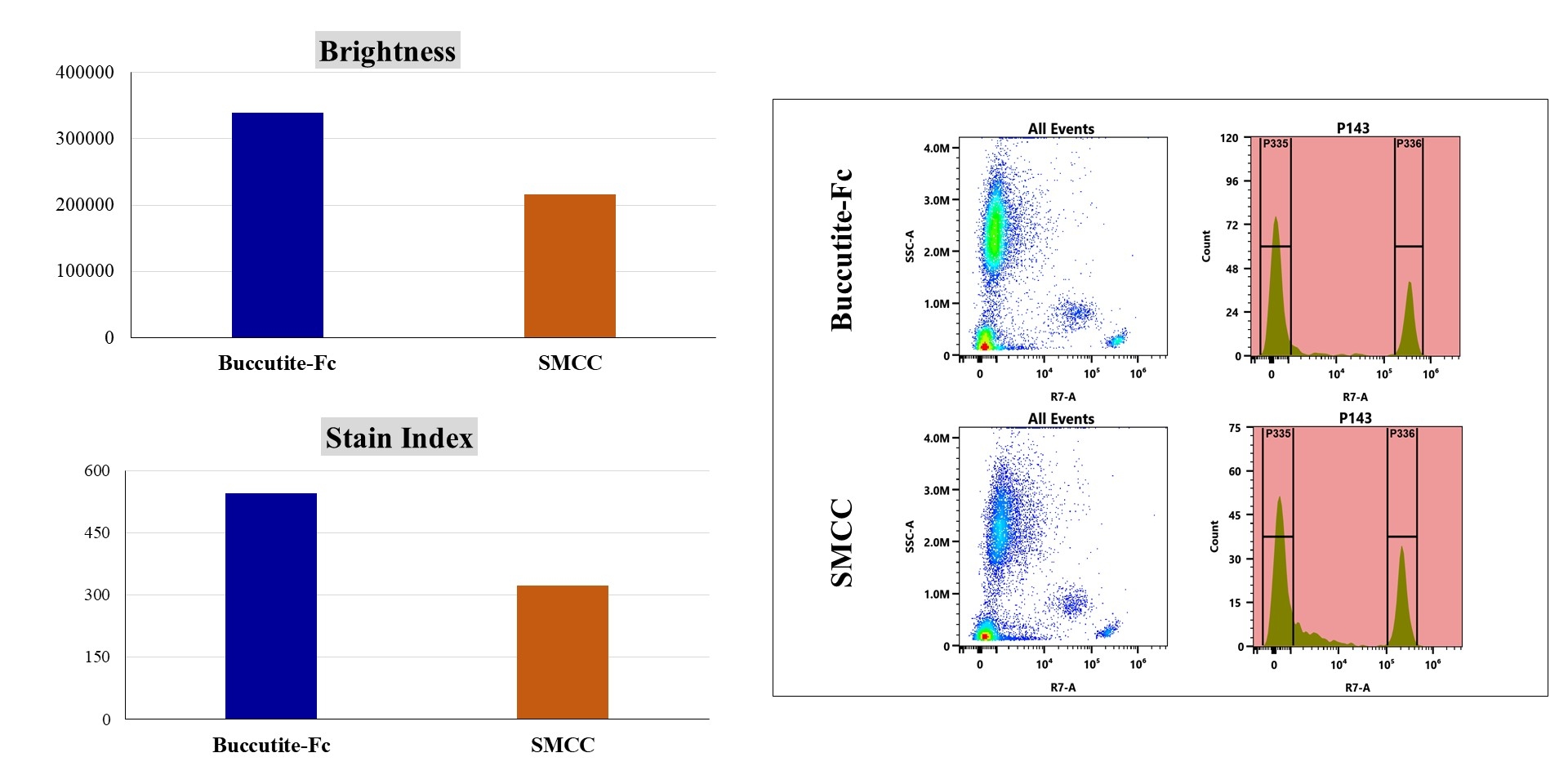 Comparison of conventional SMCC labeling and Fc site-specific conjugation using Anti-CD4 (SK3) APC-iFluor® 750 conjugates. Conjugates were prepared using either a regular SMCC labeling method or Buccutite™ Fc Site-Specific conjugation (#5572) and evaluated by whole blood staining. Fc site-specific conjugation demonstrated increased brightness and stain index compared to conventional SMCC labeling.
Buccutite™ labeling kits provide a convenient, ready-to-use format for antibody conjugation, making them an excellent choice for both researchers evaluating Buccutite™ technology for the first time as well as demanding production workflows. Each kit contains preformulated reagents optimized for efficient conjugation, minimizing preparation and optimization steps. The kits are available with a wide selection of popular labels, including fluorescent dyes, phycobiliproteins and their tandems, and reporter enzymes. They are also available in both lysine-directed and Fc site-specific labeling formats.
xtraFluor™ Violet 420 is an ultrabright, 405 nm violet laser excitable fluorophore that replaces BV421. It is available as a standalone reagent, as well as in Buccutite™ lysine-direct and Fc site specific labeling kits.
Spectral match to BV421 — fits existing violet-laser panels | Brighter than BV421, with a higher stain index and better signal stability |
Brighter than Pacific Blue and BD Horizon™ V450 (EC 3,000,000 M⁻¹cm⁻¹, QY 0.80) | 405 nm violet-laser excitation (Ex/Em 407/424 nm) |
On a spectral cytometer, xtraFluor™ Violet 420 gives a distinct violet-excited signature across the 355, 405, 488, and 640 nm lasers. A CD4 (RPA-T4) conjugate cleanly resolves CD4⁺ cells in whole blood. Against a matched BV421 conjugate, it gives brighter staining and retains signal better over extended storage, so results are more consistent from run to run.
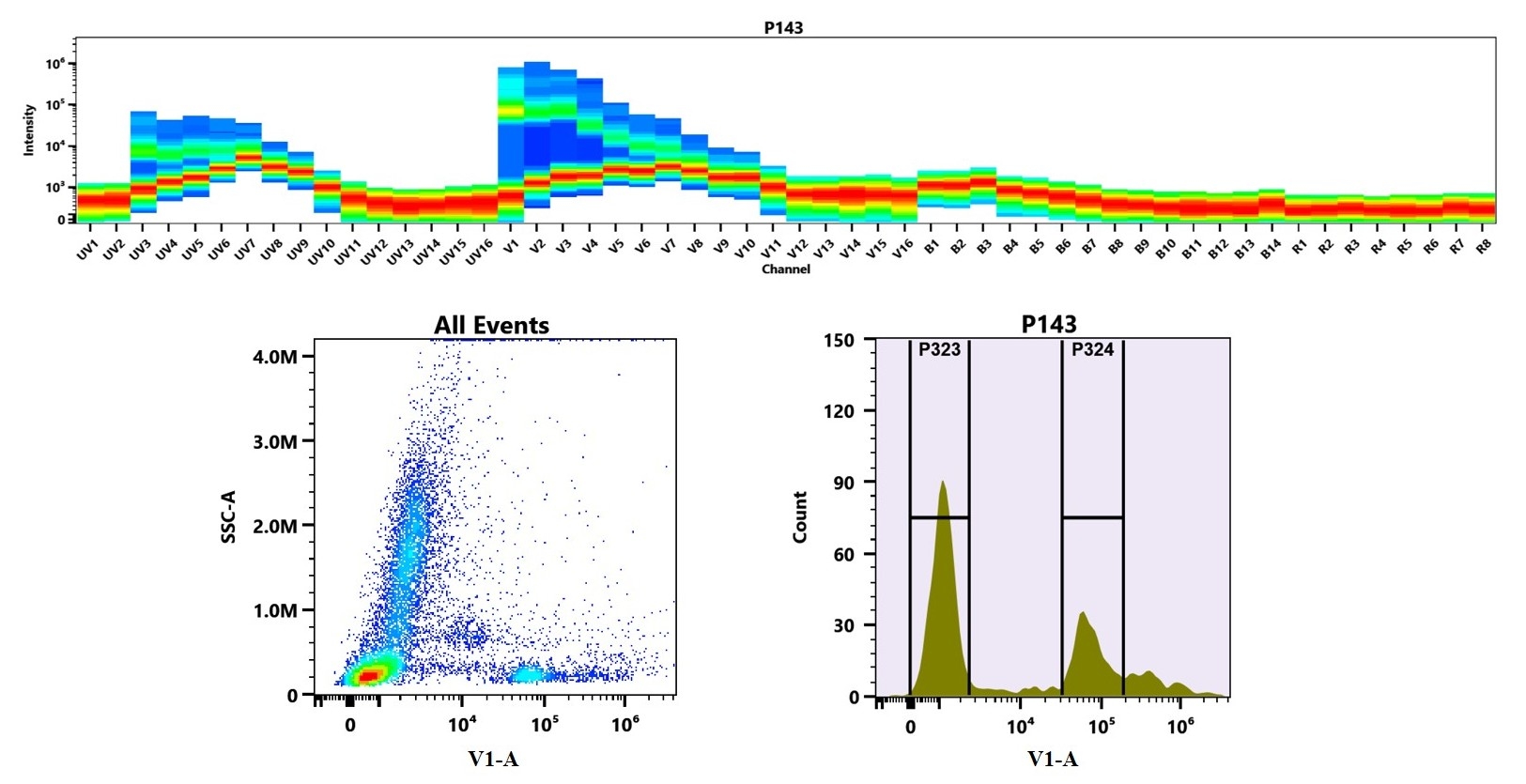 (Top) Spectral emission profiles generated using four spatially offset lasers (355 nm, 405 nm, 488 nm, and 640 nm). Each laser produced a distinct emission pattern, and their combination yielded the composite spectral signature. (Bottom) Flow cytometry analysis of human whole blood stained with a CD4 (RPA-T4)-XV420 conjugate prepared using the Buccutite™ Rapid XV420 Antibody Labeling Kit (#70810). The fluorescence signal was monitored on a Cytek Aurora spectral flow cytometer in the V1-A channel, demonstrating clear detection of CD4⁺ cells.
Phycobiliproteins are among the brightest labels available for flow cytometry and immunofluorescence. Each protein carries many bilin chromophores, giving it an exceptionally high extinction coefficient. However, because a phycobiliprotein is itself a large protein rather than a small reactive dye, attaching it to an antibody with traditional conjugation methods can be potentially problematic:
- Steric hindrances negatively affect conjugation yield
- Antigen site blocking negatively affects antibody affinity
- Unwanted side reactions negatively affect lot-to-lot consistency and conjugate performance
Buccutite™ kits have been preformulated to address these issues, coupling the target and label through mild, directed protein-to-protein crosslinking that helps preserve both antibody function and fluorophore brightness.
| Phycobiliprotein | Excitation | Emission | EC (M⁻¹cm⁻¹) |
|---|---|---|---|
| R-PE | 565 | 574 | 1,960,000 |
| APC | 651 | 660 | 730,000 |
| PerCP | 477 | 678 | 406,000 |
The three base phycobiliproteins are also offered as tandem dyes, which keep the donor's excitation but shift emission further into the red. In a tandem, the phycobiliprotein donor transfers absorbed energy by FRET (Förster resonance energy transfer) to a small-molecule acceptor, whose red-shifted emission opens additional detection channels for multicolor panels.
IgM Antibody Kits
Phycobiliprotein and tandem labels are offered in formats for IgM as well as IgG. IgM is a roughly 950 kDa, J-chain-linked pentamer with up to ten antigen-binding sites, and the disulfide bonds holding its subunits together make it sensitive to the reduction step used in thiol-directed coupling. Buccutite™ avoids the reduction step by conjugating through the antibody's lysine side-chain amines, the same reduction-free route used for the IgG kits, so the pentamer's inter-subunit disulfides stay intact.
Buccutite™ attaches reporter enzymes as well as fluorophores, coupling horseradish peroxidase (HRP) or alkaline phosphatase (ALP) to an antibody while helping preserve both antibody binding and enzyme activity. Enzyme-conjugated antibodies drive the colorimetric, chemiluminescent, and fluorescent readouts of ELISA, Western blotting, and IHC. When maximum sensitivity is needed from a limited sample, the PolyHRP kit can be used to load polymeric HRP onto each antibody to amplify the signal.
In addition to preformulated Buccutite™ kits, ReadiUse™ standalone reagents are provided that come pre-activated with FOL. These include, for example, phycobiliproteins and their tandems, and can be used in conjunction with an MTA reagent to add labels onto a target. The compatible MTA reagents, which often are sold together with ReadiUse™ reagents, are:
- Buccutite™ MTA, NHS ester for lysine-directed labeling
- Buccutite™ MTA, maleimide for hinge-directed labeling
- Buccutite™ Fc Site-Specific MTA Antibody Modification Kit for Fc site-specific labeling
Furthermore, any amine-bearing dye or protein can be FOL-activated with Buccutite™ FOL, NHS ester (#5350), and any thiol-bearing one with Buccutite™ FOL, maleimide (#5356), for pairing with a MTA-activated macromolecule.
Beyond fluorophores and enzymes, the FOL/MTA chemistry builds conjugates with streptavidin, oligonucleotides, and TR-FRET acceptors for time-resolved assays, as well as fully custom protein-to-protein pairings. For conjugates assembled from individual components, the Buccutite™ FOL and MTA NHS ester reagents install either handle on any amine-bearing protein.
Scavengers and quantitation dyes support the Buccutite™ reaction. Scavengers quench any unreacted FOL or MTA to suppress side reactions and improve purity. Quantitation dyes give a quick spectrophotometric readout of how much crosslinker has been incorporated before the final coupling step.
This document (01.0210.251203r2) was last updated on Thu Oct 15 2026. All trademarks and registered trademarks mentioned herein are the property of their respective owners.
Buccutite™ Protein Crosslinking Kits