
Products
Services
Resources
Selection Guides
About
DBCO Building Blocks
DBCO (dibenzocyclooctyne) building blocks are essential reagents for copper-free click chemistry, enabling strain-promoted azide-alkyne cycloaddition (SPAAC) reactions without the cytotoxic copper catalysts required in traditional CuAAC chemistry. AAT Bioquest offers a comprehensive selection of DBCO-functionalized fluorescent dyes, crosslinkers, and specialty conjugates for bioorthogonal labeling of azide-modified biomolecules in living cells and sensitive biological systems.
Product Type | Spectral Range | Best For |
|---|---|---|
XFD DBCO Dyes | Blue to NIR (350-790 nm) | Flow cytometry, microscopy; Alexa Fluor® replacement |
AATOM™ DBCO Dyes | Blue to Far-Red (390-700 nm) | FACS, FISH |
Cyanine DBCO Dyes | Orange to Far-Red (555-670 nm) | Single molecule imaging, FRET |
DBCO Crosslinkers | Non-fluorescent | Introducing DBCO to proteins/biomolecules |
Quencher DBCO | Dark quenchers | FRET probes, molecular beacons |
Specialty Conjugates | Various | Specific applications (calcium, actin, tags) |
Fig. 1
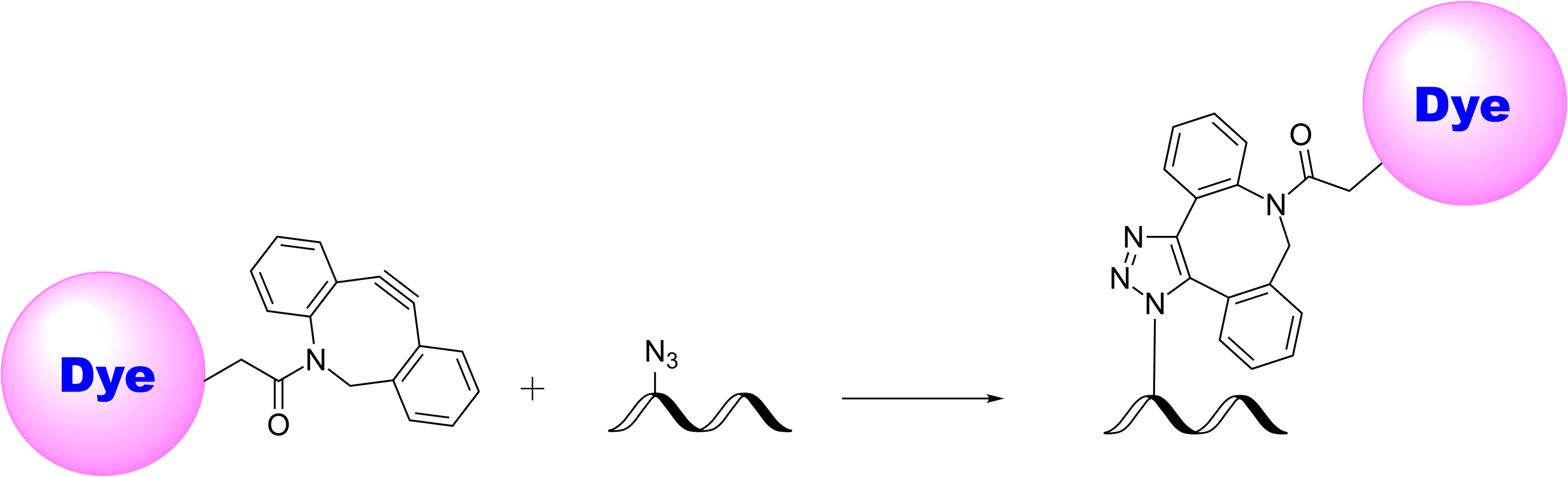
Schematic illustrating the strain‐promoted azide–alkyne cycloaddition (SPAAC) between a dibenzocyclooctyne (DBCO)–dye conjugate and an azide‐modified biomolecule. The DBCO’s ring strain drives the copper‐free reaction with the azide to form a stable 1,2,3-triazole linkage, avoiding potential toxicity of copper catalysts. This bioorthogonal labeling strategy proceeds efficiently under mild conditions, making it especially valuable for live‐cell imaging, in vivo studies, and other sensitive bioconjugation applications.
XFD DBCO dyes are high-performance fluorescent dyes designed as direct replacements for Alexa Fluor® dyes. These water-soluble dyes feature a PEG4 spacer that enhances aqueous solubility and reduces non-specific binding while maintaining optimal reactivity with azide-containing biomolecules.
- Spectral equivalence to Alexa Fluor® dyes with comparable or superior brightness
- Hydrophilic PEG4 linker minimizes aggregation and background fluorescence
- Full spectral coverage from UV to near-infrared (343-805 nm)
- Excellent photostability for extended imaging applications
- Compatible with standard filter sets for major fluorescence platforms
AATOM™ dyes are high-performance fluorophores optimized for demanding applications such as fluorescence-activated cell sorting (FACS) and fluorescence in situ hybridization (FISH). These DBCO-functionalized dyes provide excellent brightness and photostability across a broad spectral range.
- Exceptional brightness and quantum yield for sensitive detection
- Superior photostability for extended imaging and sorting applications
- Available with direct DBCO attachment or PEG4 spacer for improved solubility
- Optimized for FACS and FISH applications requiring high signal-to-noise ratios
- Spectral options from blue (390 nm) to deep red (700 nm)
AATOM™ dyes are manufactured by AAT Bioquest and are not affiliated with ATTO-TEC GmbH.
Cyanine dyes are among the most widely used fluorophores for biological imaging and detection. These DBCO-functionalized Cy3 and Cy5 derivatives enable copper-free click conjugation to azide-labeled targets, providing bright, photostable labeling for applications including single-molecule imaging, FRET studies, and cellular tracking.
- Industry-standard Cy3 and Cy5 spectral properties for compatibility with existing filter sets
- Cy3B offers enhanced brightness and photostability compared to standard Cy3
- Excellent for FRET donor-acceptor pairs (Cy3/Cy5)
- Well-characterized for single-molecule fluorescence applications
DBCO crosslinkers can be used to introduce the DBCO moiety onto proteins, peptides, and other biomolecules containing primary amines. Once conjugated, these molecules become reactive toward azide-containing compounds via SPAAC, enabling downstream click chemistry applications without copper catalysts.
- NHS ester chemistry for efficient amine labeling
- Water-soluble Sulfo-NHS option available for aqueous reactions
- PEG spacers improve solubility and reduce steric hindrance
- DBCO-PEG4-Amine provides a bifunctional building block for custom conjugations
For non-fluorescent detection and affinity purification of azide-labeled biomolecules, AAT Bioquest offers azide-functionalized biotin and streptavidin reagents that react directly with DBCO-modified targets via copper-free SPAAC chemistry. These detection tags enable colorimetric, chemiluminescent, or enzyme-amplified readouts as alternatives to fluorescent labeling. For experiments where the biomolecule carries DBCO, pair with a product from our azide building blocks. To introduce DBCO onto proteins, antibodies, or other amine-containing molecules for subsequent reaction with azide-labeled detection tags, use the DBCO-NHS crosslinkers listed in the table above.
Dark quencher-DBCO reagents are essential building blocks for constructing FRET-based molecular probes, including molecular beacons, nucleic acid probes, and protease substrates. These non-fluorescent acceptors efficiently quench fluorescence through energy transfer, enabling turn-on or ratiometric detection strategies.
- Tide Quencher 4WS provides broad quenching range (optimized for ROX, Texas Red®, Alexa Fluor® 594)
- Stronger absorption and more efficient quenching than standard DABCYL
- Water-soluble quencher reduces aggregation in aqueous buffers
- DABCYL-DBCO offers economical option for blue-green fluorophore quenching
AAT Bioquest offers DBCO-functionalized specialty reagents for specific research applications, including cell structure visualization, affinity tagging, calcium chelation, time-resolved fluorescence, and immunology research. These conjugates enable click chemistry incorporation of specialized functional groups into azide-modified biomolecules.
This document (01.0321.251203r1) was last updated on Sat Feb 28 2026. All trademarks and registered trademarks mentioned herein are the property of their respective owners.