
Products
Services
Resources
Selection Guides
About
Metal Ion Indicators
AAT Bioquest offers a comprehensive selection of indicators and quantitation kits for detecting biologically relevant metal ions in cellular and biochemical systems. This collection includes sensitive probes for zinc, iron, lead, and several others. Products range from cell-permeable AM ester indicators for live-cell imaging to Amplite® assay kits optimized for high-throughput microplate quantification.
Physiological metals such as zinc, iron, and magnesium play essential roles in enzymatic activity, structural stability, and intracellular signaling. Precise regulation of their labile pools is critical for maintaining normal cellular function and signaling homeostasis.
Zinc is the second most abundant transition metal in living organisms after iron. Mounting evidence indicates that zinc has multiple roles in cell biology, as a part of metalloenzyme catalytic sites, as a structural component of gene regulatory proteins, and as a free signal ion, particularly in the cortex of the brain. The key to the further progress in understanding the multiple roles of zinc is the availability of fluorescent Zn²⁺ indicator systems that
permits quantitative determination and imaging of zinc fluxes and levels over a broad concentration range both intracellularly and extracellularly using fluorescence microscopy and flow cytometry. AAT Bioquest offers the classic TSQ and zinquin, as well as our proprietary Zn-620™ and Metal Fluor™ Zn 520 dyes, to help elucidate the role of Zn²⁺ release and the localization of free or chelatable Zn²⁺ in cells.
AAT Bioquest’s Amplite® Zinc Ion Quantitation Kits provide simple methods for detecting zinc concentration in biological samples. The colorimetric variant uses our proprietary Zin-620™, which exhibits a large increase in 620 nm absorption in response to Zn²⁺ binding (>100 folds). On the other hand, the fluorimetric kit uses our proprietary Metal Fluor™ Zn 520, which exhibits a large increase in fluorescence in response to Zn²⁺ binding ( >200~300 folds, Ex/Em= 485/525 nm). Our kit formulations have enhanced Zn²⁺-specificity with little responses to other metals, e.g., Ca²⁺ and Mg²⁺. The assays can be used with biological samples such as serum, plasma, and urine. The colorimetric variant has a detection sensitivity of 1 µM, while the fluorimetric variant can detect as little as 0.2 μM (13 ng/mL).
Fig. 1
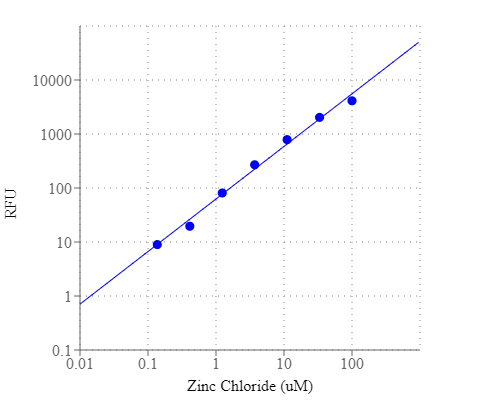
Zinc Chloride dose response was measured on a 96-well black plate with the Amplite® Fluorimetric Zinc Ion Quantitation Kit.
Metal Fluor™ Zn 520 indicator is designed for the detection of Zn²⁺ at higher concentrations that are present in synaptic vesicles and released in response to electrical stimulation or excitotoxic agonists. It is designed for the detection of Zn²⁺ in the 0.1 - 100 μM range with minimal Ca²⁺ interference. Its cell permeant AM-ester is useful for detecting high intracellular Zn²⁺ levels and small Zn²⁺ concentration changes.
TSQ is selective for Zn²⁺ in the presence of physiological concentrations of Ca²⁺ and Mg²⁺ ions. TSQ-based assays for Zn²⁺ in seawater and other biological systems exhibit a detection limit of ~0.1 nM.
Zinquin ethyl ester and AM ester are lipophilic, zinc-sensitive and cell-permeant fluorescent probes. They are retained in living cells and can be observed under microscope, FACS or fluorescence spectrophotometer.
Iron plays critical roles in oxygen transport, electron transfer, and cellular metabolism. Dysregulated iron homeostasis is associated with numerous pathologies including ferroptosis, a form of iron-dependent regulated cell death. The Amplite® Colorimetric Iron Assay Kit provides a simple and reliable method for quantifying total iron in biological and environmental samples. The assay is based on FerroBrite™ Purple 590, a chromogenic reagent that reacts specifically with ferrous iron (Fe²⁺) to form a purple-colored complex. To enable measurement of total iron, ferric iron (Fe³⁺) present in the sample is first reduced to Fe²⁺. The resulting color intensity, measured at 590 nm, is directly proportional to the iron concentration in the sample, with a linear detection range of 8 μM to 200 μM.
Ferroptosis is an iron-dependent form of regulated cell death associated with the increase in lipid peroxides. Divalent iron (Fe²⁺) can lead to spontaneous lipid peroxidation through the Fenton reaction. Ferroptosis is regulated by signaling pathways that control iron storage and oxidative stress. FerroBrite™ Green has been developed for detecting ferroptosis via fluorescence imaging. FerroBrite™ Green has superior photostability and responds quickly to ferroptosis. The dye is permeable to live cells. Upon induction of ferroptosis, the imbalance of Fe²⁺ causes the reduction in the fluorescence intensity of FerroBrite™ Green. The fluorescence of FerroBrite™ Green can be readily monitored using the common FITC filter, which is equipped in most of fluorescence instruments. FerroBrite™ Green enables the real-time tracking of ferroptosis.
Fig. 2
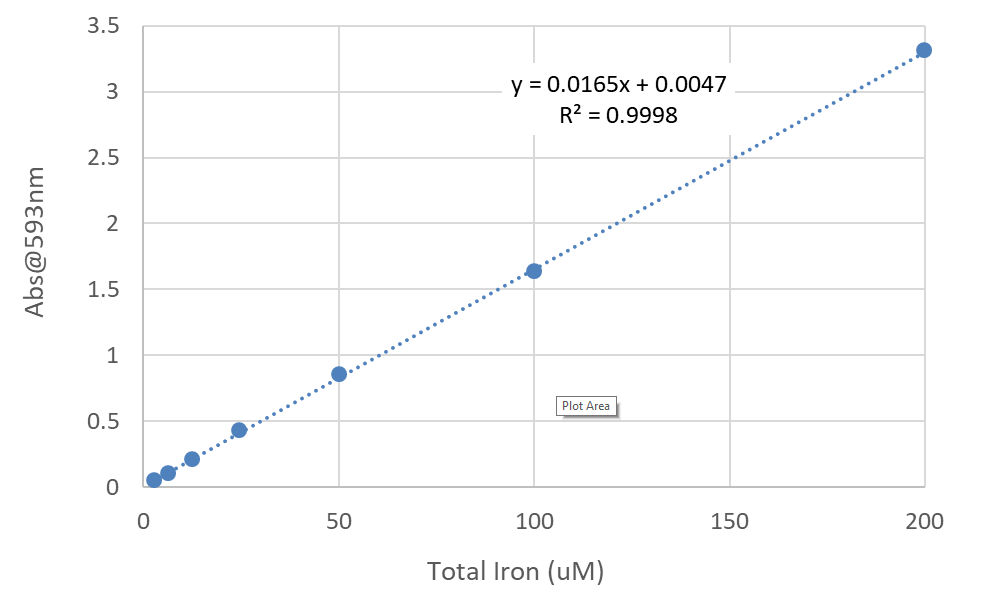
The iron standard curve was generated using the Amplite® Colorimetric Iron Assay Kit in a 96-well clear-bottom microplate, and absorbance was measured at 593 nm with a ClarioStar microplate reader (BMG).
Intracellular magnesium is important for mediating enzymatic reactions, DNA synthesis, hormone secretion, and muscle contraction. A vast majority of the existing magnesium ion indicators are based on tricarboxylate APTRA chelator derived from the popular tetracarboxylate BAPTA calcium ion chelator. They include mag-fura-2, mag-indo-1, mag-fluo-4 and mag-rhod-3. However, all of them have higher affinity for calcium than magnesium although they were designed for detecting magnesium ion. Mag-520™ is the first commercial magnesium indicator that has higher affinity for magnesium than calcium. Its significantly improved selectivity can be used for magnesium signaling applications with fluorescence microscopy or flow cytometry. Mag-520™ AM is cell-permeable with almost identical spectra to those of FITC, making it a convenient fluorescent probe used with FITC filter set that is ubiquitously equipped with almost all fluorescence instruments.
Toxic and environmental metals such as lead, mercury, and lithium can disrupt biological systems or accumulate to harmful levels, making their accurate measurement essential for toxicology, environmental monitoring, and biomedical research. Sensitive detection tools enable reliable quantification of these metals across diverse sample types and concentration ranges.
Lead is a highly poisonous metal to human beings, interfering with cell signaling and gene expression, causing severe damages to the brain, liver, kidney, and even death. Because of its long history in mining and smelting, as well as widespread use in battery, paint and gasoline, lead pollution in soil and groundwater has been one of the most serious environmental problems. Amplite® Fluorimetric Lead (II) Ion Quantitation Kit provides a robust method for detecting lead (II) ion in solution. It uses Lead Green™, a selective and sensitive green fluorescence probe that can be easily monitored with a fluorescence microplate reader (Ex/Em = 490/530 nm). The Amplite® Fluorimetric Lead (II) Ion Quantitation Kit can be performed in a convenient 96-well or 384-well microplate format and easily adapted to automation with no separation steps required. The assay can be completed within 30 minutes. With the Amplite® Fluorimetric Lead (II) Ion Quantitation Kit, as little as 4µM lead (II) ion was detected.
Quantifying lithium ions is important in various scientific fields and industries, including biochemistry, medicine, environmental analysis, and food sciences. The rapid and accurate determination of lithium ions is particularly important in the battery industry. There are several methods commonly used to quantify lithium ions, including flame photometry, ion-selective electrodes (ISE), atomic absorption spectroscopy, and fluorescence spectrophotometry. Flame photometry and atomic absorption spectroscopy require the inflammation of the samples. They are tedious to use and require expensive and sophisticated instrumentation. Ion-selective electrodes require large volumes of samples and often have low selectivity. Among all the methods, fluorescence spectrophotometry is the most convenient method for quantifying lithium ions. Fluorescence spectrophotometry involves complexing lithium ions with specific reagents and measuring the resulting fluorescence changes. However, there is still lacking a fluorescence-based lithium ion assay kit in the commercial market due to the absence of a robust fluorescence lithium ion indicator. Amplite® Fluorimetric Lithium Ion Quantification Kit uses our new robust lithium-ion indicator dye, Lithiumighty™ 520, which exhibits great fluorescence intensity enhancement upon binding to lithium ions. Lithiumighty ™ 520 is perhaps the most robust lithium-ion indicator with high selectivity. It enables the kit to be useful for the rapid determination of lithium concentrations in a variety of samples compared to the other commercial lithium-ion assays. This microplate-based assay kit requires an extremely small amount of sample. It is particularly suitable for the determination of lithium ion concentration in a microvolume format.
Mercuric ion is an essential metal ion that plays an important role in a number of biological processes. It is, however, also considered to be one of the most hazardous pollutants and highly dangerous materials. The high toxicity of Hg²⁺ is caused by its high affinity to the thiol groups in biological ligands such as proteins, DNA, and enzymes. When Hg²⁺ is absorbed in the human body from the environment, it induces aberrations in microtubules, ion channels, and mitochondria presumably and significant damage to the kidneys, heart, brain, stomach, intestines, central nervous system and immune systems. Because of its environmental impacts and biological complications, it has been intensively studies. However, there are very few commercial products that were developed for rapid detection mercuric ion. Amplite® Fluorimetric Mercuric Ion Quantitation Kit offers a robust fluorescence-based assay for measuring mercury ion (Hg²⁺) with high selectivity. Mercury Lite™ 590 itself is nearly non-fluorescent, but generates more than 500-fold fluorescence enhancement upon binding Hg²⁺ ion. The fluorescence signal can be measured with a fluorescence microplate reader. With this kit, we were able to detect as low as 8 µM Hg²⁺ in a 100 µL reaction volume.
This document (01.0242.251203r1) was last updated on Sat Feb 28 2026. All trademarks and registered trademarks mentioned herein are the property of their respective owners.