
Products
Services
Resources
Selection Guides
About
Nucleotides, NTPs and dNTPs
AAT Bioquest offers a comprehensive selection of nucleotides, NTPs, and dNTPs for DNA and RNA synthesis, sequencing, and labeling applications. This portfolio includes standard PCR-grade dNTPs, chain-terminating ddNTPs for Sanger sequencing, reversible terminators for next-generation sequencing (NGS), and modified nucleotides for probe labeling. From fluorescent dUTPs featuring iFluor® dyes to biotin-conjugated nucleotides for non-radioactive detection, these high-quality building blocks support applications ranging from routine PCR to advanced FISH imaging and sequencing-by-synthesis platforms.
Product Type | Application | Detection | Key Products |
|---|---|---|---|
dNTPs | PCR, cloning, DNA synthesis | — | ReadiUse™ dNTP Mix |
ddNTPs (Chain Terminators) | Sanger sequencing | Fluorescent or unlabeled | MagaDye™ Terminators |
3'-O-Azidomethyl dNTPs | NGS (sequencing by synthesis) | Reversible termination | 3'-O-Azidomethyl series |
Fluorescent dUTPs | FISH, probe labeling, microarrays | Fluorescence microscopy | iFluor® dUTPs, Cy3/Cy5-dUTP |
Fluorescent UTPs | RNA labeling, in vitro transcription | Fluorescence | Cy3-UTP, Cy5-UTP, XFD-UTP |
Biotin-dNTPs | Non-radioactive labeling, pull-down | Streptavidin detection | Biotin-11/16-dUTP |
Aminoallyl/Aminopropargyl NTPs | Post-labeling conjugation | Amine-reactive dye coupling | AA-dUTP, Aminopropargyl dNTPs |
High-purity deoxynucleotide triphosphates (dNTPs) are essential building blocks for DNA synthesis in PCR, sequencing, and molecular cloning. AAT Bioquest provides PCR-grade individual dNTPs and convenient pre-mixed solutions that have been extensively tested for consistent performance in demanding applications.
- ReadiUse™ format — Pre-mixed, ready-to-use solutions eliminate preparation time and reduce pipetting errors
- High purity — Verified for PCR, RT-qPCR, and sequencing applications
- Convenient concentrations — 10 mM and 100 mM formats available for flexible scaling
Dideoxynucleotide triphosphates (ddNTPs) lack the 3'-OH group required for chain elongation, causing chain termination when incorporated during DNA synthesis. These terminators are essential for Sanger sequencing and are available as unlabeled ddNTPs or as fluorescently labeled MagaDye™ terminators for four-color capillary electrophoresis detection.
- MagaDye™ fluorescent ddNTPs — Four spectrally distinct dyes (Em: 536, 561, 588, 613 nm) enable single-lane, four-color sequencing
- Single excitation wavelength — All four MagaDye™ terminators can be excited at 488-498 nm
- Complete kit available — MagaDye™ 4 Color Kit provides all four terminators in optimized ratios
Fig. 1
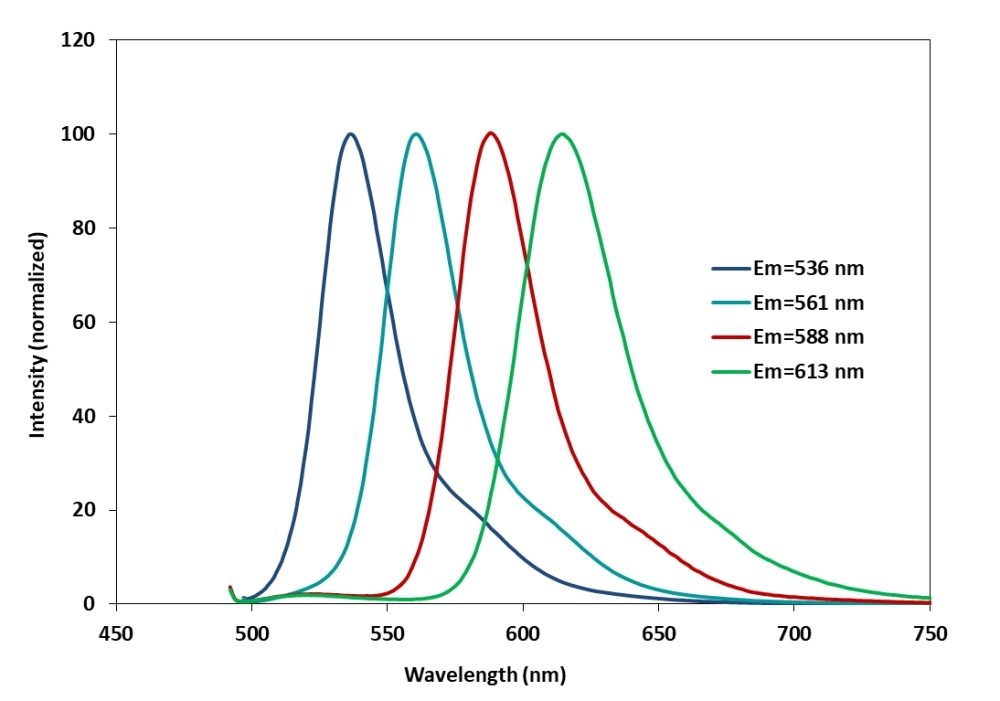
The normalized fluorescence spectra of the four fluorescent ddNTPs provided in MagaDye™ 4 Color Sanger Sequencing Terminator Kit. They emit 4 different fluorescence colors when illuminated by 488 nm laser beam. The four MagaDye™ fluorescent ddNTP terminators have almost identical spectra to the four BigDye ddNTPs used in Sanger sequencing.
Reversible terminators are critical components for sequencing-by-synthesis (SBS) platforms used in next-generation sequencing. The 3'-O-azidomethyl modification provides a cleavable blocking group that allows controlled, stepwise incorporation. Propargylamino-modified versions enable subsequent fluorophore conjugation for detection.
- Reversible termination — 3'-O-azidomethyl group blocks further extension until chemically cleaved
- Complete base set — All four bases (A, C, G, T) plus dUTP available
- Conjugation-ready — Propargylamino variants provide alkyne handles for click chemistry labeling
Fluorescent dUTPs incorporate into DNA probes via nick translation, random priming, or PCR, enabling direct detection in fluorescence in situ hybridization (FISH), microarray analysis, and other imaging applications. AAT Bioquest offers an extensive selection spanning the full visible spectrum, featuring proprietary iFluor® dyes alongside classic fluorophores.
Our iFluor® fluorescent dUTPs leverage the brightness and photostability of our iFluor® product family to bring unmatched image quality to FISH and other probe hybridization experiments. These conjugates are available in a variety of emission colors, ranging from UV to far-red.
- Superior brightness — iFluor® dyes provide enhanced fluorescence intensity compared to classic dyes
- Excellent photostability — Resist photobleaching during extended imaging sessions
- Full spectral coverage — Options from UV (350 nm) through far-red (647 nm)
- PEG12 linkers available — Improved water solubility and reduced steric interference for select wavelengths
Fig. 2
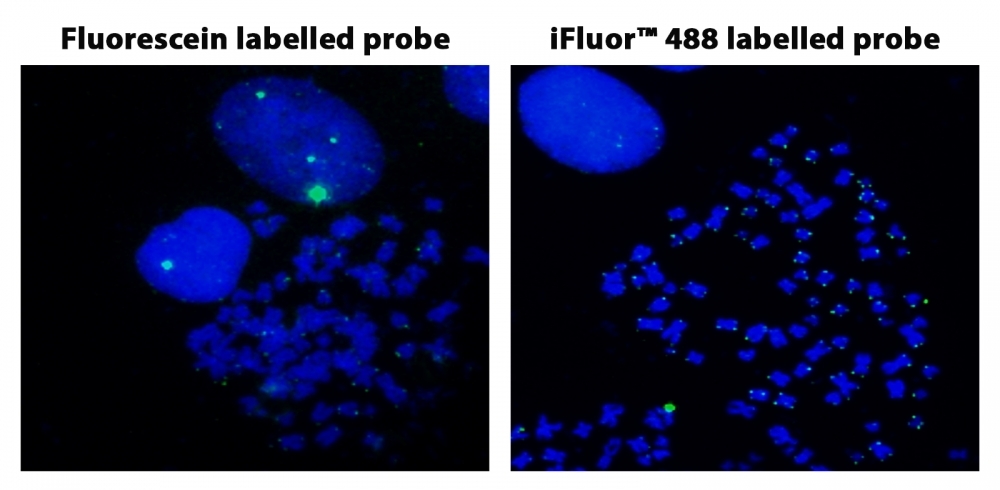
Fluorescence In Situ Hybridization of Fluorescein and iFluor® 488-dUTP labelled Telomere probes in metaphase HeLa cells.
Classic cyanine dyes (Cy3, Cy5) and fluorescein-labeled nucleotides remain widely used for established protocols and instrument compatibility. These dUTPs incorporate efficiently via standard enzymatic methods and provide reliable detection across common filter sets.
Fluorescent UTPs incorporate into RNA during in vitro transcription with T7, SP6, or T3 RNA polymerases, generating labeled RNA probes for Northern blots, in situ hybridization, microarray analysis, and RNA trafficking studies. Options span from orange to far-red emission wavelengths.
Biotin-modified nucleotides enable non-radioactive DNA and RNA labeling for detection via streptavidin-conjugated reporters. These nucleotides incorporate efficiently via nick translation, random priming, PCR, or in vitro transcription, providing versatile options for Southern/Northern blots, ISH, and pull-down assays. Various linker lengths (11, 14, 16, 20 atoms) optimize accessibility for streptavidin binding.
- Non-radioactive detection — Safe alternative to radioactive probes
- Multiple linker lengths — Choose 11–20 atom spacers based on steric requirements
- Versatile bases — dUTP, dATP, dCTP, dGTP, and UTP options available
Amine-modified nucleotides (aminoallyl and aminopropargyl derivatives) incorporate primary amine groups into DNA or RNA, enabling subsequent conjugation with NHS-ester or other amine-reactive labels. This two-step approach provides flexibility to couple any desired reporter, often yielding higher labeling density than direct incorporation of bulky dye-conjugates.
- Flexible labeling — Couple with any amine-reactive dye, hapten, or functional group post-incorporation
- Higher incorporation efficiency — Smaller amine groups incorporate more readily than bulky dye conjugates
- Aminoallyl vs. Aminopropargyl — Aminopropargyl nucleotides also enable click chemistry via alkyne-azide reactions
Halogenated nucleotides (BrdUTP, BrUTP) incorporate into newly synthesized DNA or RNA and are subsequently detected using anti-BrdU antibodies. These tools enable analysis of cell proliferation, DNA replication timing, and nascent RNA synthesis.
Ready-to-use qPCR master mixes containing optimized dNTP concentrations, hot-start Taq polymerase, and Helixyte™ Green DNA-binding dye are available for real-time PCR applications. These are available in different ROX formulations for compatibility with various instrument platforms.
- TAQuest™ FAST format — Optimized for rapid cycling protocols
- Helixyte™ Green — Bright, DNA-selective intercalating dye for melt curve analysis
- ROX options — Low ROX and No ROX versions for different instrument requirements
This document (01.0298.251203r1) was last updated on Sat Feb 28 2026. All trademarks and registered trademarks mentioned herein are the property of their respective owners.
Nucleotides, NTPs and dNTPs