
Products
Services
Resources
Selection Guides
About
Proteases
AAT Bioquest offers a portfolio of protease substrates and activity assay kits for measuring enzymatic activity across multiple protease families, including serine proteases, cysteine proteases, metalloproteases, and proteasomes. Our collection includes fluorogenic and luminogenic substrates based on AMC (7-amino-4-methylcoumarin), rhodamine 110 (R110), and aminoluciferin reporters, as well as complete Amplite® assay kits optimized for specific protease targets including MMPs, DPP4, elastase, thrombin, renin, as well as proteasome activity associated with ubiquitin–proteasome pathway studies.
Section | Targets | Best For | Key Products |
|---|---|---|---|
Serine Proteases | Thrombin, elastase, DPP4, plasmin, Factor Xa | Coagulation, inflammation, diabetes research | BOC-VPR-AMC, AAPV-AMC, Gly-Pro-AMC |
Metalloproteases (MMPs) | MMP-1, -2, -3, -7, -8, -9, -12, -13, -14, TACE, ACE2 | Cancer, ECM remodeling, cardiovascular | MMP Green™, MMP Red™, Amplite® MMP Kits |
Cysteine Proteases (Cathepsins) | Cathepsin C | Lysosomal function, immune activation | Gly-Phe-2-naphthylamide |
Viral Proteases | SARS-CoV-2 3CLpro (Mpro), PLpro | Antiviral drug screening, viral research | Covidyte™, Covipyte™, Z-LRGG-AMC |
Proteasome Activity Assays | 20S proteasome (chymotrypsin-like, trypsin-like, caspase-like) | Protein degradation, drug discovery | Suc-LLVY-AMC, (Suc-LLVY)₂R110, Amplite® 20S Kit |
Broad-Spectrum Protease Activity | General proteases, aminopeptidases, renin, BACE | General protease screening, aminopeptidase profiling | Amplite® Universal Kits, Casein-FITC, Leu-AMC |
Serine proteases use a catalytic serine residue to cleave peptide bonds and play critical roles in coagulation (thrombin, Factor Xa, plasmin), inflammation (neutrophil elastase), glucose metabolism (DPP4), and digestion (chymotrypsin, enterokinase). AAT Bioquest offers fluorogenic substrates (AMC, R110), bioluminescent substrates (aminoluciferin), and complete Amplite® assay kits for detecting and quantifying serine protease activity.
- Multiple reporter systems — AMC (blue), R110 (green), and aminoluciferin (bioluminescent) for flexible detection
- Complete Amplite® kits for elastase, DPP4, enterokinase with optimized protocols
- Inhibitor screening kits for DPP4 and elastase drug discovery
- Thrombin-specific substrates for coagulation studies with high selectivity
Matrix metalloproteinases (MMPs) are zinc-dependent endopeptidases that degrade extracellular matrix components and play key roles in tissue remodeling, wound healing, cancer metastasis, and cardiovascular disease. Some examples of commonly studied MMPs include MMP-1, -2, -3, -7, -8, -9, -12, -13, -14, and other zinc-dependent metalloproteases such as TACE/ADAM17 (TNF-alpha converting enzyme) and ACE2 (angiotensin-converting enzyme 2). To facilitate the study of MMPs, AAT Bioquest offers MMP Green™ and MMP Red™, two FRET-based peptide substrates that remain quenched until cleaved, producing fluorescence proportional to enzyme activity.
- FRET-based design provides low background and high signal-to-noise ratio
- Broad MMP specificity for MMP-1, -2, -3, -7, -8, -9, -12, -13, -14
- MMP-3-specific substrate for selective stromelysin detection
- Complete Amplite® kits with optimized protocols for universal and MMP-3-specific activity
- TACE/ADAM17 and ACE2 substrates for related metalloprotease research
Fig. 1
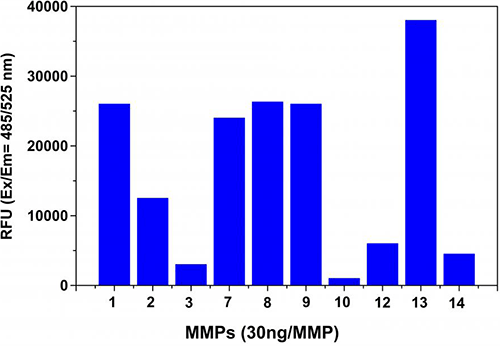
MMP activity monitored using Amplite® Universal Fluorimetric MMP Activity Assay. APMA-activated MMPs (30 ng each) were mixed with MMP Green™ substrate. One hour after starting the reaction the fluorescence signal was monitored using a NOVOStar microplate reader (BMG Labtech) at Ex/Em = 490/525 nm. The reading from all wells was subtracted by the reading from substrate control, which contains MMP Green™ substrate but no MMPs. The MMP Green™ substrate can detect the activity of sub-nanogram of all MMPs (n=3).
Cysteine proteases use a nucleophilic cysteine residue in their active site to cleave peptide bonds. Cathepsins are lysosomal cysteine proteases involved in protein turnover, immune response activation, and antigen processing. Cathepsin C (dipeptidyl peptidase I) activates granule serine proteases in immune cells and is a therapeutic target for inflammatory diseases.
- Cathepsin C–specific substrate selectively cleaved by cathepsin C for targeted protease activity measurement
- Lysosomal protease activity detection for proteolytic pathways associated with lysosomes
Covidyte™ and Covipyte™ substrates are designed for detecting SARS-CoV-2 main protease (3CLpro/Mpro) and papain-like protease (PLpro) activities. These essential viral enzymes process viral polyproteins and are prime targets for antiviral drug development. The FRET-based peptide substrates and AMC substrates enable sensitive detection of protease activity for drug screening and viral research applications.
- 3CLpro (Mpro) substrates — multiple fluorophore options (blue, far-red) for the main protease
- PLpro substrates — FRET-based and AMC-based options for papain-like protease
- High-throughput screening compatible for antiviral drug discovery
- High signal-to-background ratio for reliable inhibitor IC₅₀ determination
Fig. 2
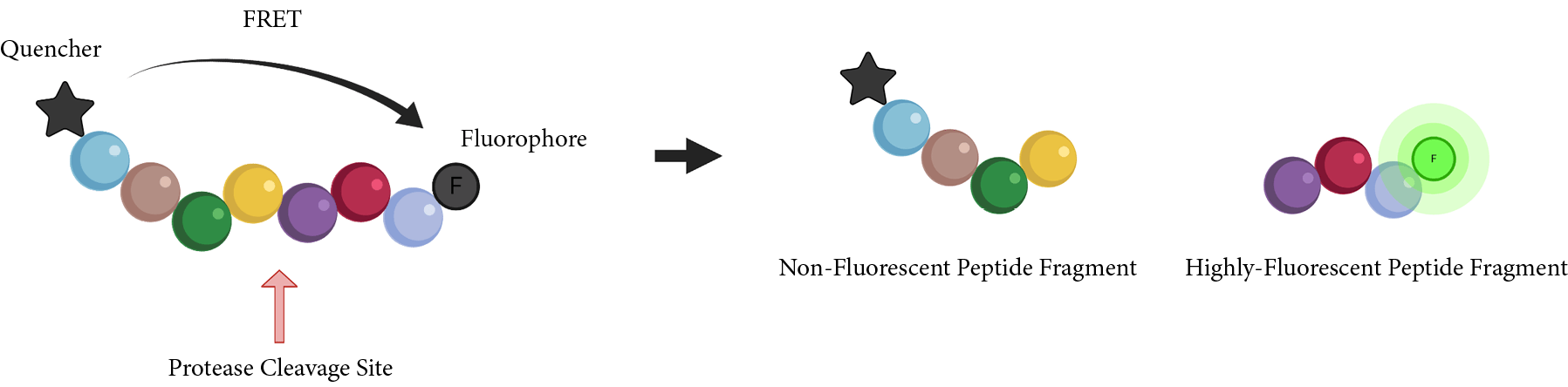
FRET mechanisms of Covidyte™ and Covipyte™ COVID-19 peptide substrates (figure made in BioRender). FRET protease substrates are widely used for detecting protease activities, in particular, for virus protease that often require a long peptide sequence for optimal binding such as coronavirus, HIV and HCV proteases. The internally quenched FRET peptide substrate is digested by a protease to generate the highly fluorescent peptide fragment. The fluorescence increase is proportional to the protease activity (figure drawn in BioRender).
The 20S proteasome is a multi-catalytic complex responsible for degrading ubiquitinated proteins and plays a central role in protein homeostasis, cell cycle regulation, and immune response. It contains three distinct catalytic activities: chymotrypsin-like (β5 subunit), trypsin-like (β2 subunit), and caspase-like/PGPH (β1 subunit). AAT Bioquest offers substrates targeting each activity using AMC, R110, and aminoluciferin reporters, plus a complete Amplite® assay kit.
- All three proteasome activities covered — chymotrypsin-like (Suc-LLVY), trypsin-like (Ac-KQL), caspase-like (Z-LLE)
- Multiple reporter options — AMC (blue), R110 (green), and aminoluciferin (bioluminescent)
- Immunoproteasome-specific substrates — (Ac-ANW)₂R110 for β5i subunit
- Complete Amplite® kit with optimized protocols for 20S proteasome
Fig. 3
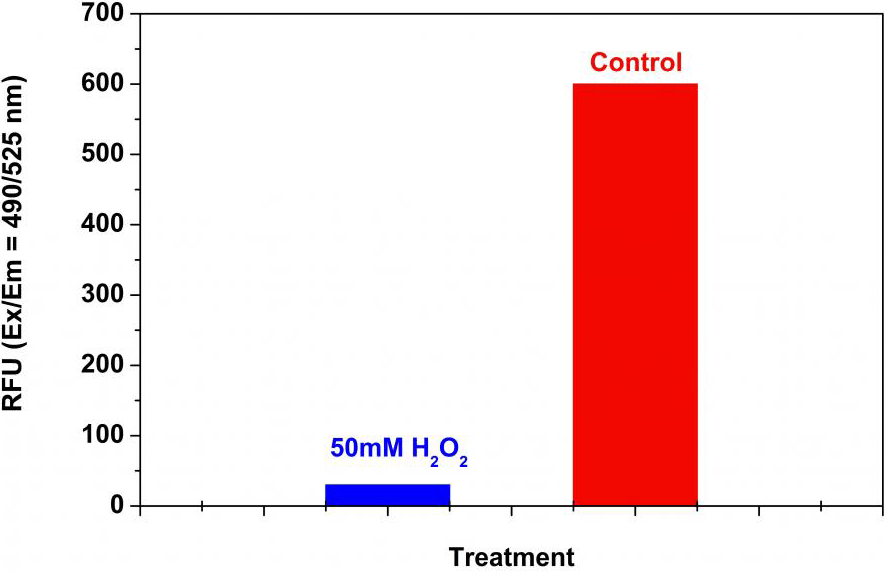
Detection of proteasome activity in Jurkat cells with Amplite® Fluorimetric Proteasome 20S Activity Assay Kit. Jurkat cells were seeded on the same day at 500,000 cells/90 µL/well in a 96-well black wall/clear bottom Costar plate. The cells were treated with or without 50 mM H2O2 for 30 minutes. The proteasome assay loading solution (100 µL/well) was added and incubated in a 5% CO2, 37°C incubator for 3 hours. The fluorescence intensity was measured at Ex/Em = 490/525 nm using a Gemini fluorescent microplate reader (Molecular Devices).
AAT Bioquest offers universal protease activity kits, aminopeptidase substrates, labeled protein substrates, and specialty reagents for general protease screening and profiling. These tools detect broad classes of proteolytic activity without specificity for a single enzyme class, making them ideal for initial activity screening, quality control, and characterizing unknown protease samples.
- Amplite® Universal Kits detect total protease activity regardless of class
- Aminopeptidase substrates (AMC and R110) for exopeptidase profiling
- Fluorescent casein substrates for general endoprotease screening
- Renin and BACE substrates for aspartyl protease detection
- Protease inhibitor building blocks for pepstatin synthesis
Fig. 4
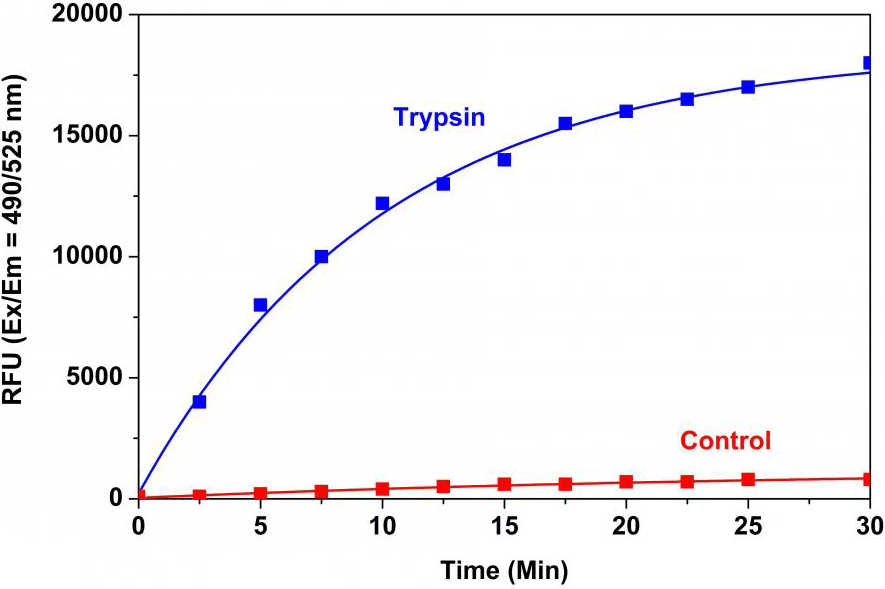
Trypsin protease activity was analyzed by Amplite® Universal Fluorimetric Protease Activity Assay Kit. Protease substrate was incubated with 1 unit trypsin in the kit assay buffer. The control wells had protease substrate only (without trypsin). The fluorescence signal was measured starting from time 0 when trypsin was added. Samples were done in triplicates.
This document (01.0262.251203r1) was last updated on Sat Feb 28 2026. All trademarks and registered trademarks mentioned herein are the property of their respective owners.