
Products
Services
Resources
Selection Guides
About
Reductases
Reductases and dehydrogenases are oxidoreductase enzymes that catalyze reduction reactions in metabolic pathways. Dehydrogenases typically transfer electrons from substrates to cofactors such as NAD⁺ or NADP⁺, while reductases accept electrons to reduce their substrates. AAT Bioquest offers Amplite® assay kits for quantifying key metabolic enzymes including lactate dehydrogenase (LDH), glucose-6-phosphate dehydrogenase (G6PD), glyceraldehyde-3-phosphate dehydrogenase (GAPDH), and nitroreductase, with fluorimetric, colorimetric, and luminometric detection options.
Enzyme Target | Detection Options | Primary Application |
|---|---|---|
Glucose-6-Phosphate Dehydrogenase | Fluorimetric, Colorimetric | Pentose phosphate pathway, G6PD deficiency screening |
Lactate Dehydrogenase (L-LDH) | Fluorimetric, Colorimetric | Mammalian metabolism, cytotoxicity assays |
Lactate Dehydrogenase (D-LDH) | Fluorimetric, Colorimetric | Bacterial metabolism, microbiome studies |
GAPDH | Colorimetric | Glycolysis studies, metabolic normalization |
Nitroreductase | Luminometric | Prodrug activation, reporter gene systems |
Glucose-6-phosphate dehydrogenase (G6PD) catalyzes the conversion of glucose-6-phosphate to 6-phosphoglucono-δ-lactone, the first and rate-limiting step in the pentose phosphate pathway. This enzyme plays a critical role in generating NADPH for reductive biosynthesis and protection against oxidative stress. G6PD deficiency is one of the most common human enzyme deficiencies worldwide, affecting over 400 million people and predisposing individuals to hemolytic anemia triggered by certain drugs, infections, or fava beans.
Amplite® G6PD Assay Kits quantify enzyme activity through direct measurement of NADPH generation. The fluorimetric kit offers higher sensitivity for detecting low enzyme concentrations, while the colorimetric version provides convenience with standard absorbance readers.
Fig. 1
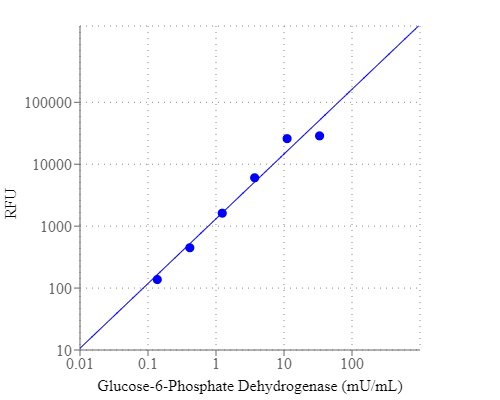
G6PD dose response was measured with Amplite® Fluorimetric Glucose-6-Phosphate Dehydrogenase Assay Kit in a 96-well solid black plate using a Gemini (Molecular Devices) microplate reader. The concentration of the Glucose-6-Phosphate Dehydrogenase in X-axis is based on the 50 uL standard, the final in-well concentration should be 1/2 for each point.
Lactate dehydrogenase (LDH) is an oxidoreductase enzyme that catalyzes the reversible interconversion of pyruvate and lactate with concomitant interconversion of NADH and NAD⁺. LDH exists in two stereoisomer-specific forms: L-lactate dehydrogenase (L-LDH), the predominant mammalian isoform, and D-lactate dehydrogenase (D-LDH), primarily found in bacteria.
LDH release from damaged cells is a widely used biomarker for cytotoxicity and cell death. AAT Bioquest offers stereospecific assay kits enabling researchers to distinguish between mammalian and bacterial enzyme activities.
L-LDH is the predominant form in mammalian tissues and is frequently measured as a marker of cell membrane integrity in cytotoxicity assays. When cells are damaged or dying, LDH is released into the culture medium where it can be quantified.
D-LDH is primarily found in bacteria and certain microorganisms. D-lactate levels in biological fluids can serve as a marker for bacterial metabolism, intestinal bacterial overgrowth, or microbiome activity studies.
Fig. 2
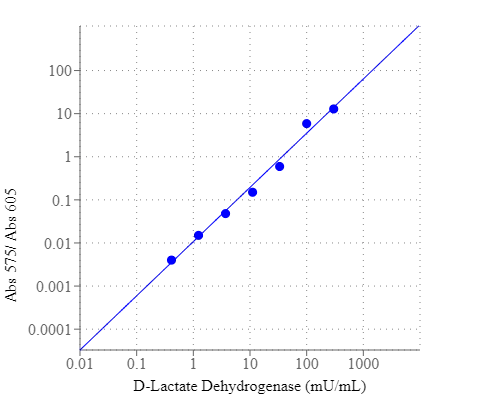
D-LDH dose response was measured with Amplite® Colorimetric D-Lactate Dehydrogenase (LDH) Assay Kit in a 96-well white wall/clear bottom plate using a SpectraMax Plus (Molecular Devices) microplate reader.
Glyceraldehyde-3-phosphate dehydrogenase (GAPDH) catalyzes the sixth step of glycolysis, converting glyceraldehyde-3-phosphate to 1,3-bisphosphoglycerate while reducing NAD⁺ to NADH. Beyond its metabolic role, GAPDH is involved in numerous non-glycolytic processes including transcription regulation, membrane fusion, and apoptosis. GAPDH is commonly used as a housekeeping gene reference in molecular biology experiments.
The Amplite® Colorimetric GAPDH Activity Assay Kit uses a coupled enzymatic reaction system to monitor GAPDH activity with high sensitivity and specificity.
Fig. 3
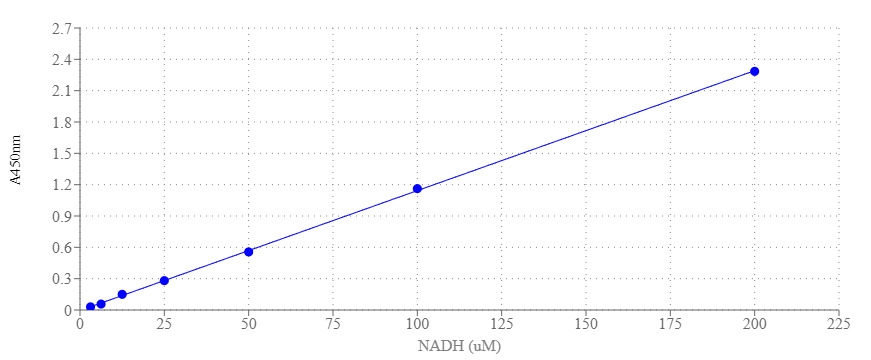
The NADH dose response was measured using the Amplite® Colorimetric Glyceraldehyde-3-Phosphate Dehydrogenase (GAPDH) Assay Kit on a 96-well clear bottom microplate. The assay was incubated for 10 minutes and measured at 450 nm using a ClarioStar microplate reader (BMG).
Nitroreductases (NTR) are a family of bacterial enzymes that catalyze the reduction of nitrogen-containing compounds. These enzymes are absent in mammalian cells, making them valuable tools for gene-directed enzyme prodrug therapy (GDEPT) and reporter gene systems. In GDEPT applications, nitroreductase expressed in target cells can convert non-toxic prodrugs into cytotoxic agents for selective cell killing.
The Amplite® Luminometric Nitroreductase Assay Kit provides sensitive bioluminescence-based detection for quantifying NTR activity in research applications.
This document (01.0269.251203r1) was last updated on Sat Feb 28 2026. All trademarks and registered trademarks mentioned herein are the property of their respective owners.