
Products
Services
Resources
Selection Guides
About
Tide Fluors™ (TF)
Tide Fluor™ dyes by AAT Bioquest are a series of highly water-soluble fluorescent reagents designed to label oligonucleotides and peptides for molecular imaging and diagnostic applications. Conjugates produced with Tide Fluor™ dyes exhibit bright fluorescence and high photostability, providing performance comparable to or exceeding that of many conventional dye-labeled conjugates, including fluorescein, cyanine, and spectrally similar Alexa Fluor® dye conjugates. For optimum results in FRET biosensing, Tide Fluor™ dyes should be used collectively with complementary non-fluorescent Tide Quencher™ dyes. The efficient FRET relationship between Tide Fluor™-Tide Quencher™ pairs facilitates the detection of molecular interactions within live cells at the nanometer range.
Tide Fluor™ dyes are available in 10 emission variants spanning the UV to infrared spectrum, with excitation and emission properties matched to common light sources. The strong fluorescence and high photostability exhibited by Tide Fluor™ dyes and their conjugates help reduce photobleaching effects during high-intensity or prolonged illumination. Tide Fluor™ dyes are made available in a variety of conjugation chemistries, including amine-reactive (e.g., succinimidyl ester), thiol-reactive (e.g., maleimide), and click chemistry formats (e.g., alkyne and azide) for labeling N-terminal and cysteine residues or for use with appropriately functionalized biomolecules. For in-synthesis labeling (e.g., solid-phase synthesis), Tide Fluor™ 1 CPG (Catalog Number 2240 and 2241) and Tide Fluor™ 3 phosphoramidite dyes (Catalog Number 2274) are available in either 100 mg or 100 µmoles unit sizes, respectively. In addition, Tide Fluor™ 3-labeled FMOC amino acids are available for directly labeling aspartic acid, glutamic acid, and lysine residues during FMOC solid-phase synthesis.
- Efficient absorption of excitation light from common light sources
- pH-insensitive fluorescence between pH 3 to 11
- Brighter fluorescence and better photostability than conventional dyes and Alexa Fluor® dyes
- Exceptional FRET efficiency with Tide Quencher™ acceptor dyes
Tide Fluor™ dyes share nearly identical fluorescence spectra with common fluorophores, making upgrading to Tide Fluor™ dyes effortless. Traditional fluorophores and their conjugates can easily be replaced with spectrally similar Tide Fluor™ dyes without affecting instrument configuration (e.g., lasers and optical filters). For example, spectra of Tide Fluor™ 2WS and Tide Fluor™ 3WS dyes match those of fluorescein and Cy3 dyes and can be detected with standard fluorescein or TRITC/Cy3 filter sets, respectively. Each of the Tide Fluor™ dyes and their equivalents are listed in the table below.
Fig. 1
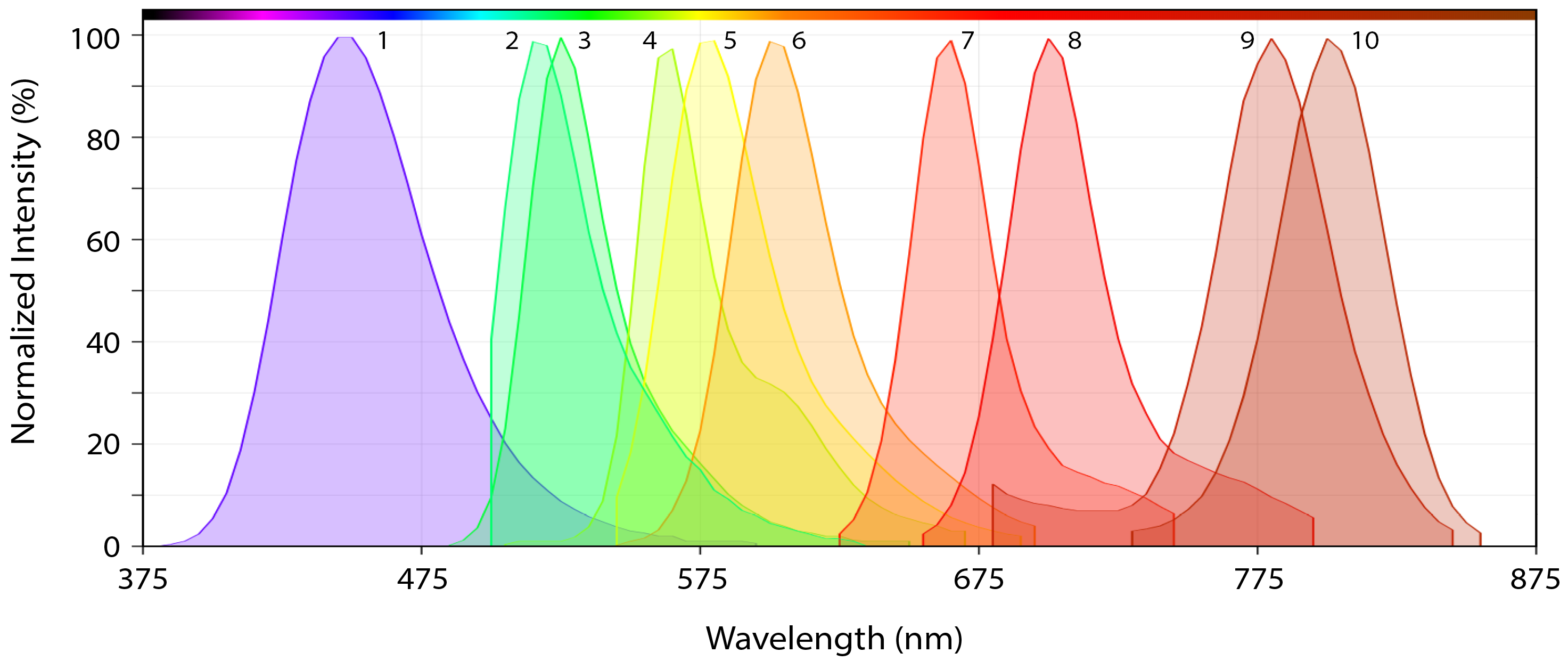
Emission spectra of Tide Fluor™ dyes.
Together Tide Fluor™ and Tide Quencher™ dyes can be used to produce highly sensitive FRET probes for a variety of applications, including enzyme studies, pharmacological drug screening, and qPCR analysis. Since the absorbances of Tide Quencher™ dyes are well-tuned to quench their Tide Fluor™ equivalent, substrates exhibit minimal background fluorescence, and background interference resulting from nonsensitized acceptor excitation is significantly reduced. Separating the two dyes either by proteolysis (i.e., FRET peptides) or nucleic acid hybridization (i.e., FRET nucleotides) restores fluorescence characteristic of the Tide Fluor™ label.
M/Z (mass-to-charge ratio) values are used to confirm the identity of molecules via mass spectrometry. The M/Z values listed below represent the expected molecular ions for each Tide Fluor™ and Tide Quencher™ dye. These reference values can be used to verify successful conjugation when attaching dyes to peptides, oligonucleotides, or other biomolecules—ensuring the correct fluorophore or quencher is incorporated and the final construct has the expected mass.
This document (01.0004.211015r2) was last updated on Sat Feb 28 2026. All trademarks and registered trademarks mentioned herein are the property of their respective owners.