
Products
Services
Resources
Selection Guides
About
Tide Quenchers™ (TQ)
Classic dark quenchers like DABCYL have long-standing use in FRET applications, but limitations such as narrower spectral coverage, environment-sensitive absorption, and reduced quenching efficiency for some longer-wavelength fluorophores can compromise assay sensitivity in certain applications.
Tide Quenchers™ span the entire visible and near-infrared spectrum (450–880 nm) and are designed to provide high quenching efficiency across this range. Each quencher is individually optimized to match specific fluorophore emission profiles: TQ2 is well matched to FAM, HEX, TET, and JOE; TQ3 provides superior performance with TAMRA and Cy3®; TQ5 series quenches Cy5® and Alexa Fluor® 647; and TQ7/TQ8 extend coverage into the NIR range for Cy7® and ICG applications. Compared to classic quenchers, Tide Quenchers offer stronger molar absorption coefficients and higher quenching efficiency, resulting in complete substrate quenching with minimal background from non-specific acceptor excitation.
Feature | Benefit |
|---|---|
| Higher Absorption Coefficients | Stronger energy transfer for more efficient quenching |
| Superior Quenching Efficiency | Lower background fluorescence than DABCYL, BHQ, and QSY dyes |
| Environment-Insensitive | Consistent performance across pH and buffer conditions |
| Full Spectral Coverage | TQ1–TQ8 spans 450 nm to 880 nm (visible through IR) |
| Enhanced Water Solubility | WS and HWS versions for aqueous assays without organic solvents |
| Versatile Reactive Forms | Acid, NHS ester, maleimide, azide, alkyne, DBCO, CPG, phosphoramidite |
| Cost-Effective | Competitive pricing with better performance |
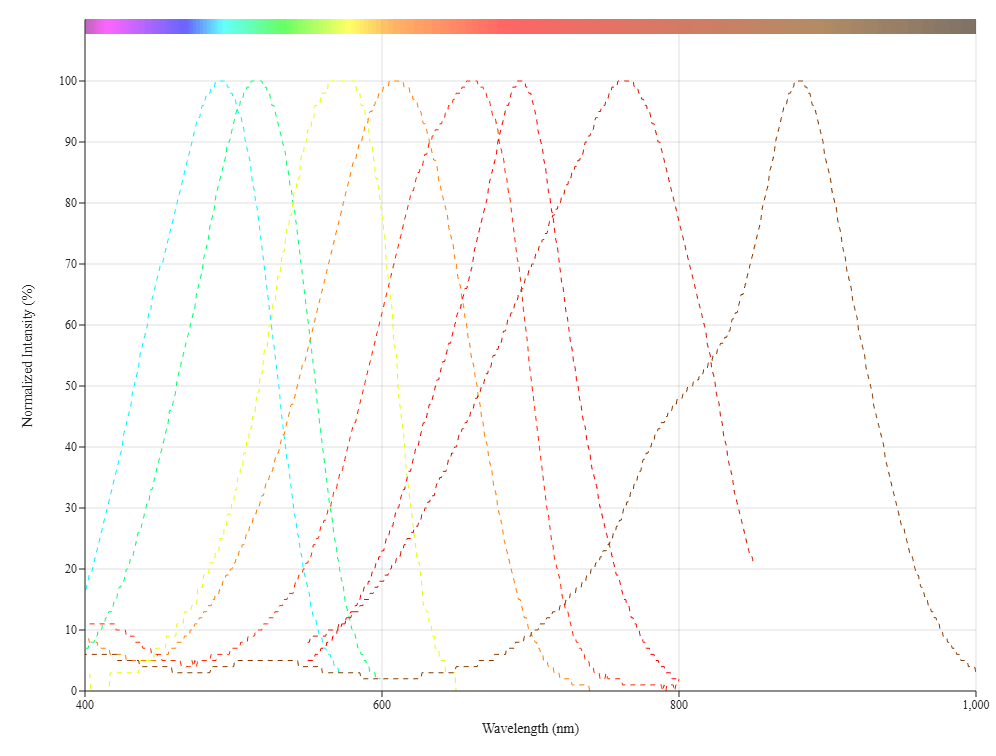
Effective FRET requires spectral overlap between donor emission and acceptor absorption. Tide Quencher™ dyes are precisely tuned to match the emission spectra of Tide Fluor™ (TF) donors and classic fluorophores including EDANS, FAM, TAMRA, ROX, HEX, JOE, TET, and the Cy® dye series. This optimization ensures maximum quenching efficiency in the intact probe and strong signal recovery upon cleavage.
The tables below can be used to determine the optimal Tide Quencher™ to pair with a particular donor fluorophore as well as which classic quenchers can be upgrade to Tide Quenchers™.
Tide Quenchers™ are available in multiple reactive forms to accommodate different conjugation chemistries:
Reactive Form | Target Group | Best For | Conditions |
|---|---|---|---|
| Acid | Amines (via EDC/carbodiimide) | Peptides, reference standards | Aqueous, pH 4–6 |
| NHS Ester (SE) | Primary amines (–NH₂) | Amino-modified oligos, Lys, N-terminus | pH 7–9, avoid Tris buffer |
| Maleimide | Thiols (–SH) | Cys residues, thiol-modified oligos | pH 6.5–7.5 |
| Amine | Carbonyls (aldehydes, ketones) | Reductive amination | Reducing agent required |
| Azide | Alkynes, DBCO | Click chemistry (CuAAC, SPAAC) | Copper catalyst or strain-promoted |
| Alkyne | Azides | Click chemistry (CuAAC) | Copper catalyst required |
| DBCO | Azides | Copper-free click chemistry (SPAAC) | Physiological conditions |
| CPG (500Å/1000Å) | — | In-synthesis oligo labeling | Automated DNA synthesizer |
| Phosphoramidite | — | In-synthesis oligo labeling | Automated DNA synthesizer |
Standard Tide Quenchers™ are suitable for most organic synthesis and conjugation workflows. Water-soluble (WS) versions incorporate sulfonate groups that dramatically improve aqueous solubility, reduce aggregation, and minimize non-specific interactions in biological assays.
WS variants are particularly recommended when:
- Working in strictly aqueous buffer systems
- Labeling hydrophobic peptide sequences (TQ-WS conjugation can enhance peptide solubility)
- Performing live-cell applications
- Minimizing organic solvent use in conjugation reactions
The newer HWS (highly water-soluble) variants—including TQ3HWS, TQ5HWS, and TQ7HWS—offer even greater hydrophilicity for the most demanding aqueous applications.
M/Z (mass-to-charge ratio) values are used to confirm the identity of molecules via mass spectrometry. The M/Z values listed below represent the expected molecular ions for each Tide Fluor™ and Tide Quencher™ dye. These reference values can be used to verify successful conjugation when attaching dyes to peptides, oligonucleotides, or other biomolecules—ensuring the correct fluorophore or quencher is incorporated and the final construct has the expected mass.
Pre-labeled FMOC-amino acids streamline solid-phase peptide synthesis (SPPS) of FRET substrates. These building blocks—available as FMOC-Lys, FMOC-Glu, and FMOC-Asp derivatives with TQ2 or TQ3—eliminate post-synthetic labeling steps and ensure consistent, high-purity products for protease assay development.
Tide Quenchers™ are ideal for nucleic acid detection assays where low background and high signal-to-noise ratios are critical. The quencher suppresses fluorescence until a specific event—such as probe cleavage, strand separation, or primer extension—results in an increase in donor fluorescence for quantification.
- TaqMan® Probes — Dual-labeled hydrolysis probes for real-time PCR
- Molecular Beacons — Hairpin probes for SNP detection and gene expression
- Scorpion Primers — Self-probing amplification primers
FRET peptide substrates incorporating Tide Quenchers™ enable sensitive detection of protease activity. Enzyme hydrolysis spatially separates the donor and quencher, restoring fluorescence for quantification. These substrates are widely used in drug discovery screening campaigns.
- FRET Peptide Substrates — HIV protease, MMPs, secretases, caspases
- High-Throughput Screening — Drug discovery and enzyme kinetics
Multiple labeling strategies accommodate both automated synthesis and post-synthetic modification workflows.
- In-Synthesis Labeling — CPG (500 Å and 1000 Å pore sizes) and phosphoramidite reagents for automated synthesis
- Post-Synthetic Labeling — NHS esters for amino-modified oligos, maleimides for thiol-modified oligos
This document (01.0072.211015r2) was last updated on Mon Sep 21 2026. All trademarks and registered trademarks mentioned herein are the property of their respective owners.
Tide Quenchers™ (TQ)