
Products
Services
Resources
Selection Guides
About
Transporters
AAT Bioquest offers a comprehensive selection of transporter assay kits designed for studying cellular uptake mechanisms including glucose transporters (GLUTs), fatty acid transport proteins, chloride channels, and multidrug resistance (MDR) efflux pumps. These ready-to-use kits support high-throughput screening applications with fluorimetric, colorimetric, and imaging-based detection options for metabolic research, drug discovery, and cancer studies.
Glucose transport systems are responsible for transporting glucose across cell membranes. Measuring uptake of 2-deoxyglucose (2-DG), a glucose analog, in tissues and cells is widely accepted as a reliable method to estimate the amount of glucose uptake and to investigate the regulation of glucose metabolism and mechanism of insulin resistance. The 2-DG uptake is commonly determined by using non-metabolized 2-DG labeled with tritium or C14. However, routine use of a radiolabelled probe is costly and requires a tedious special handling procedure. AAT Bioquest's Screen Quest™ Glucose Uptake Assay Kits provide sensitive and non-radioactive assays in cells. In these assays 2-DG is taken up by glucose transporters, and metabolized to 2-DG-6-phosphate (2-DG6P). The non-metabolizable 2-DG6P accumulates in the cells, and is proportional to glucose uptake by cells. The accumulated 2-DG6P is enzymatically oxidized and generates NADPH, which is specifically monitored by a NADPH sensor. The signal can be read by either a fluorescence or absorption microplate reader.
- Screen Quest™ HTS Kits: Enzyme-coupled detection of accumulated 2-deoxyglucose-6-phosphate; no radioactivity required unlike traditional ³H-2-DG assays
- Multiple Detection Options: Choose green fluorescence (2-NBDG) or colorimetric plate reader formats
- Validated Performance: Demonstrated sensitivity to insulin stimulation in adipocyte differentiation models
Fig. 1
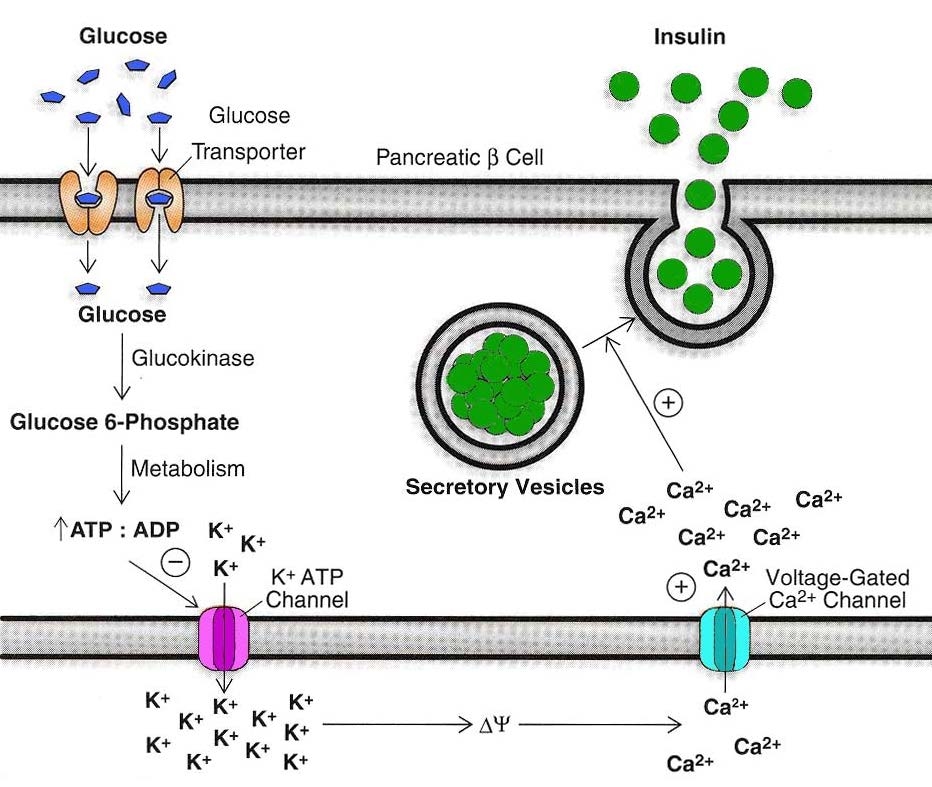
Glucose transportation into cells via glucose transporters, Glu 1, Glu 2, Glu 3 and Glu 4.
Fig. 2
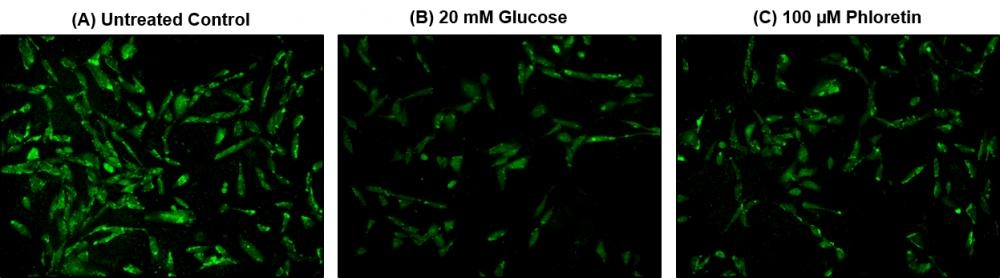
Fluorescence images of 2-NBDG uptake in CHO-K1 cells using Cell Meter™ 2-NBDG Glucose Uptake Assay Kit. CHO-K1 cells at 40,000 cells/well/100 µL were seeded overnight in a 96-well black wall/clear bottom plate. Cells were treated with 20 mM Glucose (B) or 100 µM Phloretin (C) at 37oC for 1 hour, then incubated with 100 µM 2-NBDG staining solution for 20 minutes. Untreated control cells were stained under the same conditions. The fluorescence signal was measured using a fluorescence microscope with FITC filter.
Fatty acid transporters including CD36, FABPs, and FATPs mediate cellular uptake of long-chain fatty acids, playing critical roles in lipid metabolism and energy homeostasis. The Screen Quest™ Fluorimetric Fatty Acid Uptake Assay Kit provides a convenient method to measure fatty acid transport activity using fluorescently labeled fatty acid analogs.
- Non-radioactive Detection: Safe alternative to traditional ¹⁴C-labeled fatty acid uptake assays
- HTS-Compatible: Optimized for 96-well and 384-well microplate formats
- Therapeutic Relevance: Supports research on obesity, type 2 diabetes, hepatic steatosis, and cardiovascular disease
AAT Bioquest provides assay kits for studying potassium channels, chloride channels and multidrug resistance (MDR) efflux transporters. Chloride channels regulate pH, cell volume, and organic solute transport. MDR transporters, particularly P-glycoprotein (P-gp), actively efflux chemotherapeutic drugs from cancer cells, representing a major obstacle in cancer treatment.
- Chloride Channel Kit: Colorimetric detection suitable for standard plate readers; measures channel-mediated chloride flux
- MDR Assay Kit: Fluorimetric detection of P-glycoprotein efflux activity; ideal for identifying MDR inhibitors and characterizing drug resistance phenotypes
- Drug Discovery Applications: Screen for modulators affecting transporter function in cancer chemotherapy and cystic fibrosis research
This document (01.0275.251203r1) was last updated on Sat Feb 28 2026. All trademarks and registered trademarks mentioned herein are the property of their respective owners.