
Products
Services
Resources
Selection Guides
About
A Homogeneous Fluorimetric HDAC Activity Assay Using Non-Peptide HDAC Green Substrate
Histone deacetylases (HDAC) are a class of enzymes that remove acetyl groups from the ε-N-acetyl lysine amino acid on a histone. It is involved in a series of pathways within the living system including cell cycle, signal transduction, and cancer such as chronic myeloid leukemia. Histone acetylation plays an important role in the regulation of gene expression. Deacetylation restores the positive electric charge of the lysine amino acids, which increases the histone's affinity for the negatively charged phosphate backbone of DNA. HDACs are involved in the pathway by which the retinoblastoma protein (pRb) suppresses cell proliferation. HDAC inhibitors are being studied as a treatment for cancer.
Fig. 1
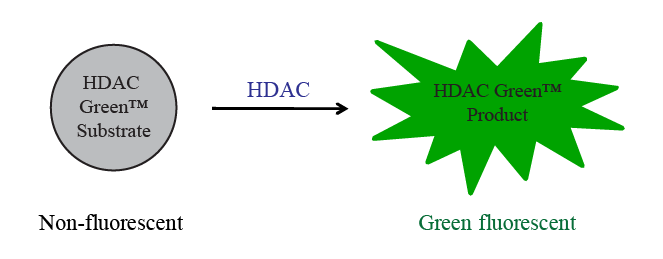
Amplite® Fluorimetric HDAC Activity Assay Principle. The increased fluorescent signal is proportional to the increased HDAC enzyme activity.
We have developed a novel HDAC assay for the detection of HDAC activity using fluorogenic HDAC Green™ substrate. Our non-peptide HDAC Green™ substrate is much more sensitive than the peptide-based HDAC substrates such as Ac-RGK(Ac)-R110, Ac-RGK(Ac)-AMC and Ac-RGK(Ac)-AFC. HDAC Green™ substrate is also much more resistant to protease hydrolysis than the other commercial peptide-based HDAC substrates. The HDAC Green provides a quick, convenient, and sensitive method for measuring HDAC activity in solutions and cell lysates. It can be readily used for screening HDAC inhibitors with cell extracts or purified enzymes due to its large assay window. The long wavelength emission and higher extinction coefficient of the HDAC Green™ substrate minimizes background interference from compounds and cell components.
- All standard dilutions and HDAC reactions were performed at room temperature with Amplite® Fluorimetric HDAC Activity Assay Kit (Cat No. 13601).
- For HDAC inhibitor experiment, the HDAC inhibitor were pre-incubated with Hela nuclear extract for 10 min.
- Standard curves (Hela nuclear extract) and HDAC reactions were performed in 50 µL volumes in costar 96-solid black well plates for 30 min.
- HDAC activity was measured as described in Amplite® Fluorimetric HDAC Activity Assay Kit using a Gemini microplate reader (Molecular Devices) at Ex/Em = 490/525 nm.
- Prepare HDAC containing test samples (40 µL)
- Add known HDAC inhibitor or test compounds (10 µL)
- Incubate at room temperature or 37 °C for 10 to 20 min
- Add HDAC Green™ substrate working solution (50 µL)
- Incubate at room temperature for 30 to 60 min
- Read fluorescence at Ex/Em = 490/525 nm
Fig. 2
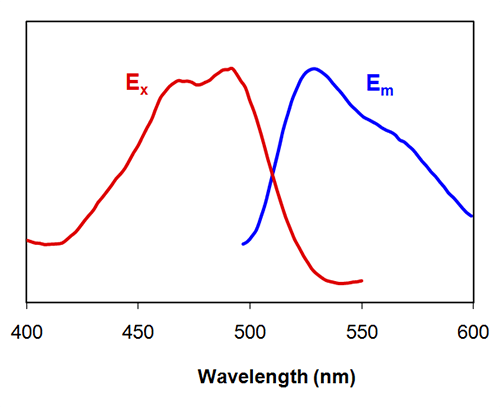
Excitation and emission spectra of Thiolite™ Green substrate.
Fig. 3
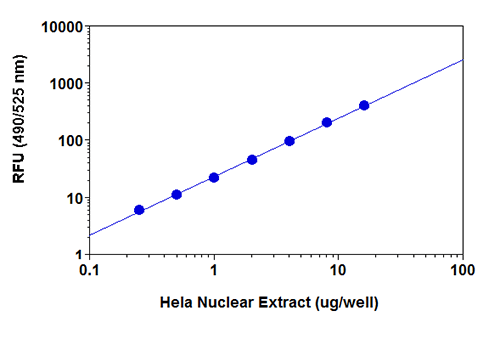
HDAC Activity Detection in HeLa Nuclear Extract. HeLa nuclear extract (NE) in various amounts (50 µL/well) on 96-well black plate was measured with the Amplite® Fluorimetric HDAC Activity Assay Kit using a Gemini microplate reader at Ex/Em = 490/525 nm. As low as 0.25 µg/well of NE can be detected in 30 min incubation time.
Fig. 4
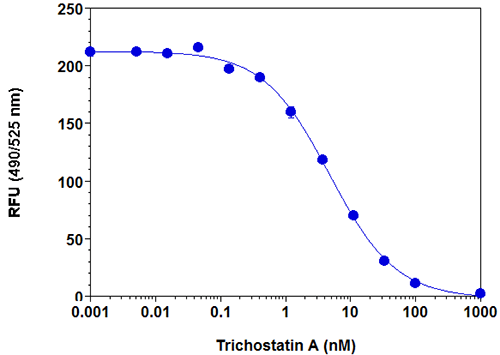
Dose Response of Trichostatin A inhibitory effect in HeLa Nuclear Extract. HeLa nuclear extract (40 µL/well) was incubated with 10 µL/well of various dose of Trichostatin A in a 96-well black plate for 10 minutes. Then 50 µL/well of HDAC Green™ substrate working solution (50 µL) were added, and incubated at room temperature for 30 minutes. The HDAC Activity was measured at Ex/Em = 490/525 nm.
Fig. 5
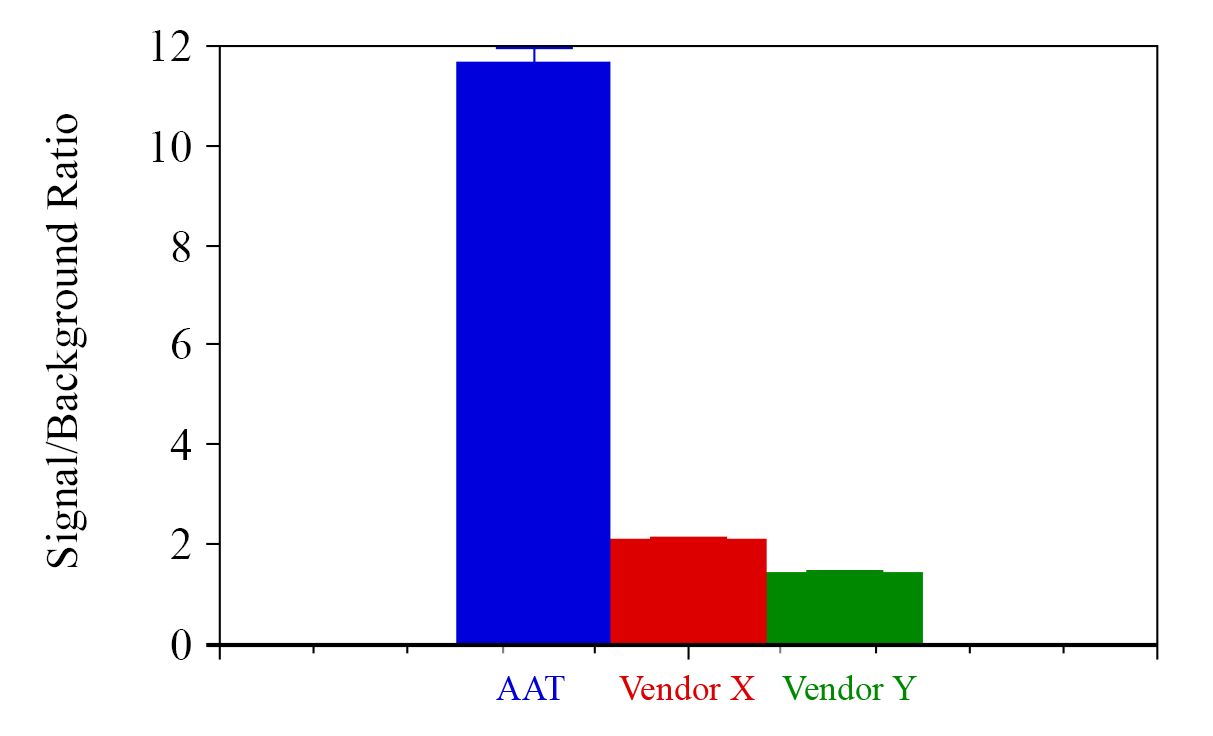
HDAC Assay Kit Comparison. HeLa nuclear extract HDAC activity measured with Amplite® Fluorimetric HDAC Activity Assay Kit (in blue) compared with Vendor X (in red) and Vendor Y (in green), both of which use Ac-RGK(Ac)-R110 peptide substrate. The HDAC activity measured with Amplite® Fluorimetric HDAC Activity Assay Kit has the ratio of signal/background more than 10 times higher than those of Vendors X and Y.
- HDAC Green™ substrate is much more sensitive than the other peptide-based HDAC substrates.
- HDAC Green™ substrate produces signal-to-background ratios ∼10 times greater than other commercially available HDAC substrates.
- The long wavelength emission and higher extinction coefficient of the HDAC Green™ substrate provides less interference from compounds and cell components.
- The Amplite® HDAC Assay is the only one-step homogeneous assay in the market.
- The assay can be performed in a convenient 96-well or 384-well microtiter-plate format and easily adapted to automation with no separation required.
The Amplite® HDAC Activity Assay is a quick, convenient and sensitive method for measuring HDAC activity.
This document (02.0163.200715r1) was last updated on Mon Nov 03 2025. All trademarks and registered trademarks mentioned herein are the property of their respective owners.
A Homogeneous Fluorimetric HDAC Activity Assay Using Non-Peptide HDAC Green Substrate