
Products
Services
Resources
Selection Guides
About
Cy3 NHS Ester
Cy3 is a yellow fluorescent dye belonging to the cyanine dyes family, which itself is a subset of the methine dyes (polymethine dyes) family. It is commonly used in immunocytochemistry and molecular biology applications.
Fig. 1
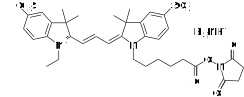
Chemical structure for Cy3 NHS Ester
Cy3 is readily supplied as a red powder. When excited by a suitable light source, such as a 532 nm or 555 nm laser, it will emit yellow fluorescence.
The wavelength of a fluorescent dye commonly refers to its maximal excitation and emission values (λmax). Cy3 has an excitation peak at 555 nm and an emission peak at 569 nm.
Fig. 2
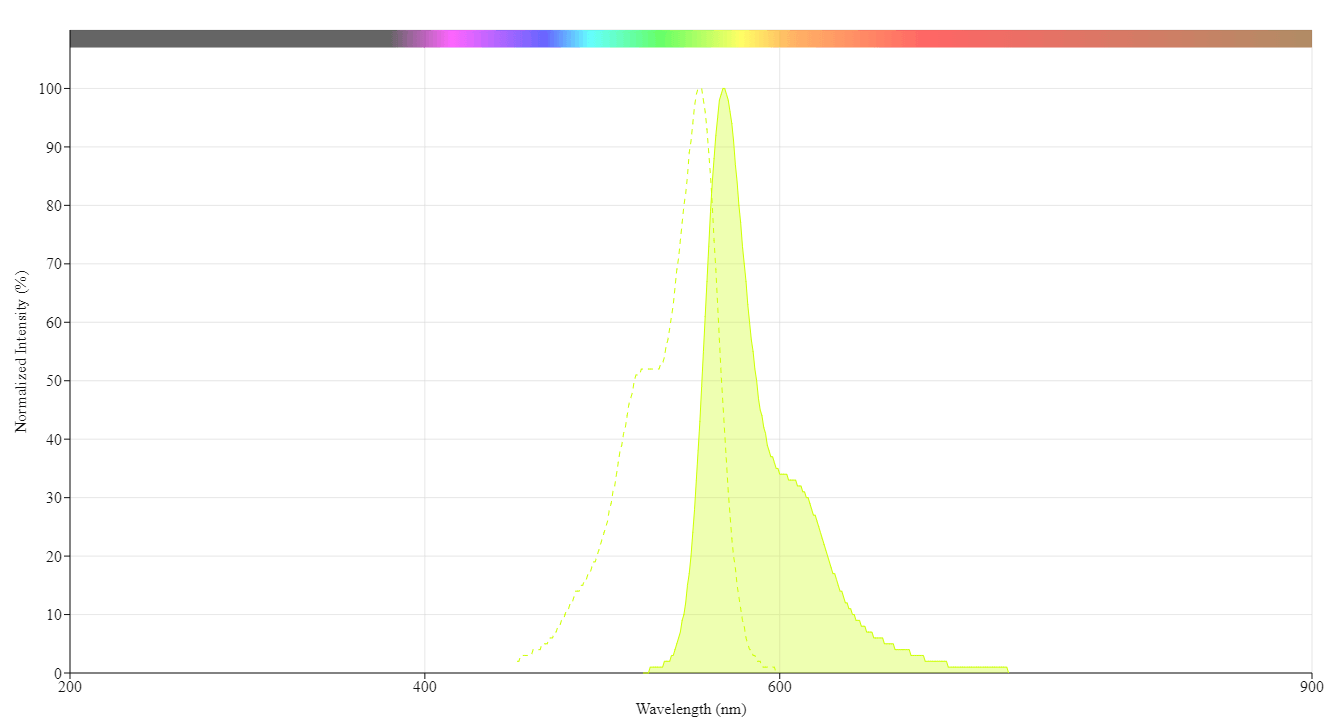
Fluorescence spectrum for Cy3 NHS Ester
Fluorescence lifetime information provided in the table below[1]:
| Lifetime (ns) | Location |
| 0.86 ns ± 0.052 | periphery of cell |
| 0.17 ns ± 0.012 | center of the cell |
| 0.18 ns ± 0.0029 | in a bulk solution |
Cy3 can be conjugated to antibodies and used for immunofluorescence (IF) and immunocytochemistry (ICC) applications. For example, cells treated with mouse anti-tubulin primary antibodies, followed by Cy3 goat anti-mouse IgG secondary antibodies, can be used to visualize cytoskeletal structures. A second application is the use of Cy3 to label oligonucleotides. In fluorescence in situ hybridization (FISH), Cy3-oligo probes allow for spatial mapping of genetic material in cells. Combined with a quencher, Cy3-oligo conjugates can be used as TaqMan probes (or molecular beacons) for real-time PCR techniques.
A channel in fluorometric studies commonly refers to the range of wavelengths across which an emitted fluorescence signal is collected by a photosensitive detector. Cy3, when excited by an appropriate excitation light source, emits maximally at 569 nm. While the specific channel is instrument dependent, this wavelength typically falls within the “Cy3 channel” or “TRITC channel” configuration.
There are two common methods of labeling Cy3 to antibodies and proteins: NHS esters (also known as succinimidyl esters) and maleimides. NHS esters specifically and efficiently react with primary amines, such as those found on the side chains of lysine residues in proteins or on aminosilane-coated surfaces (under neutral or slightly basic conditions). This reaction forms a stable covalent bond between the NHS ester group of Cy3 and the primary amine group, resulting in the attachment of Cy3 to the target molecule or surface. Maleimide groups selectively react to sulfhydryl groups (also known as thiol groups), such as those found on cysteine side chains. This reaction occurs when the pH of the reaction mixture is maintained between 6.5 and 7.5, and this chemical reaction creates a permanent thioether linkage between the maleimide group of Cy3 and the thiol group of the target molecule.
NHS esters work by forming a stable amide bond between the NHS ester group of the Cy3 compound and the primary amines (-NH2) on proteins or other target biomolecules. This reaction is pH dependent and best occurs under basic conditions (pH = 8.5 ± 0.5). After labeling, it is recommended to calculate the Degree of Labeling (DOL), which quantifies the average number of dye molecules per molecule of the target. Too few labeling events can lead to weak fluorescence signals. Too many labeling events can interfere with target function; for instance, over-labeling of an antibody can potentially block the binding site or lead to self-quenching of the Cy3 fluorophore.
Cy3 NHS ester is commonly shipped in powder format. It can be stored safely for 12 months when kept in temperatures of -20 °C, protected from light. Once reconstituted, stock solutions should be used promptly, as extended storage in solution may result in reduced by activity. Once labeled to a target, the resulting amide bond is very stable.
If an oligonucleotide is modified with a primary amine, NHS ester chemistry can be used to attach Cy3 to the target sequence.
Alternatively, Cy3 phosphoramidite can be used to incorporate the fluorophore into an oligonucleotide during chemical synthesis. In this process of oligo synthesis, phosphoramidites are added from the 3’ to 5’ direction.
Because Cy3 is part of the cyanine dyes family, it is also commonly referred to as “cyanine 3”.
Due to the presence of sulfo-groups, Cy3 is also sometimes called Sulfo-Cy3. Note, however, that “non-sulfonated Cy3” is a different chemical compound.
Cy3B and Cy5 have also been on occasion used interchangeably with Cy3. These are incorrect, however, as Cy3B and Cy5 are chemically distinct compounds, and therefore not alternative names for Cy3.
Cy3 and Sulfo-Cy3 are equivalent. In contrast, non-sulfonated Cy3 does not have any SO3-groups. This results in lower water solubility and increased likelihood of forming aggregates in aqueous solutions. As such, using non-sulfonated Cy3 often requires organic co-solvents like dimethylformamide (DMF) or dimethyl sulfoxide (DMSO) to achieve effective labeling reactions in aqueous environments. For these reasons, sulfo-Cy3 and Cy3 are much more common than non-sulfonated Cy3.
Cy3 and Cy3B are two distinct chemical compounds, with Cy3B developed later as an attempt to improve upon Cy3. Owing to changes in its chemical structure, Cy3B is more resistant to internal de-excitation, thus resulting in a measured increase in fluorescence signal and improved photostability.[2] Additional, the differences in chemical structure result in a slight red-shifting of both excitation and emission maximums for Cy3B (ex = 560 nm, em = 571 nm) compared to Cy3 (ex = 555 nm, em = 569 nm).
While both are fluorophores in the cyanine dye family, Cy3 and Cy5 differ in the length of the methine chain connecting the indole rings. This change results in a red-shifting of spectral properties for Cy5 (ex = 651 nm, em = 670 nm) compared to Cy3 (ex = 555 nm, em = 569 nm). Additionally, Cy5 has both a higher extinction coefficient as well as quantum yield compared to Cy3.
While Cy3 has seen long use historically, it has several issues including poor water solubility, suboptimal brightness, ease of photobleaching and high cost. Because of this, several dyes have been developed to replace it, including Alexa Fluor 555 and iFluor® 555. Additionally, for oligonucleotide and peptide applications, Tide Fluor™ 3WS serves as a lower cost, better water soluble alternative.
- Kang, Jooyoun, et al. “Restricted Intramolecular Rotation of Fluorescent Molecular Rotors at the Periphery of Aqueous Microdroplets in Oil.” Scientific Reports, U.S. National Library of Medicine, 8 Oct. 2020, www.ncbi.nlm.nih.gov/pmc/articles/PMC7545199/. 2. Klotzsch, Enrico, et al. “Supplementary Information - Royal Society of Chemistry.” Conformational Distribution of Surface-Adsorbed Fibronectin Molecules Explored by Single Molecule Localization Microscopy, www.rsc.org/suppdata/bm/c3/c3bm60262a/c3bm60262a.pdf.
This document (02.0231.240724r1) was last updated on Fri Dec 19 2025. All trademarks and registered trademarks mentioned herein are the property of their respective owners.
Cy3 NHS Ester