Adenosine diphosphate (ADP) is a central metabolite generated during ATP hydrolysis and serves as a key indicator of enzymatic phosphotransfer activity and cellular energy turnover. The reversible interconversion between ATP and ADP underlies numerous metabolic and signaling processes, making ADP quantification a valuable readout for kinase activity, enzyme kinetics, and biochemical assay development.
PhosphoWorks™ Fluorimetric ADP Assay Kits provide a sensitive, enzyme-coupled method for monitoring ADP generation as a direct readout of kinase and phosphotransferase activity in biochemical and high-throughput screening formats. In this enzyme-coupled assay, ADP formation is measured by monitoring kinase activity due to their proportional relationship. The concentration of ADP produced is directly proportional to enzyme phosphotransferase activity. Kinase activity is monitored using our proprietary ADP sensor and measured fluorimetrically. This assay can detect as little 0.3 μM of ADP using a fluorescence microplate reader at Ex/Em = 540/590 nm. It has a broad ATP tolerance of 1-300 μM making it ideal for determining Michaelis-Menten kinetics, and for screening and identifying kinase inhibitors. It is convenient for 96-well or 384-well microtiter plate format and its optimized “mix and read” format is suitable for HTS applications. Since this assay is continuous and requires no separation step, it can be readily adapted for automation.
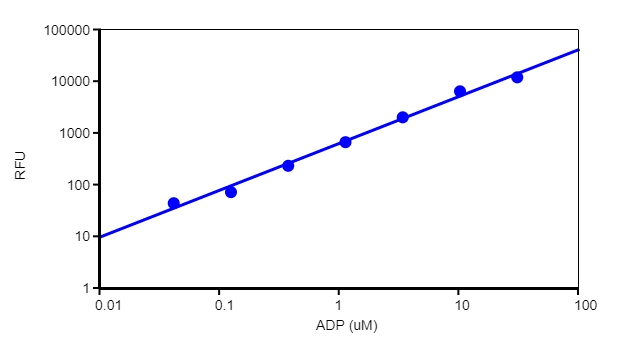
Fig. 1
ADP dose response was measured with the PhosphoWorks™
Fluorimetric ADP Assay Kit (Catalog Number 21655) in a solid black 384-well plate using a Gemini fluorescence microplate reader (Molecular Devices). As low as 0.3 µM ADP can be detected with 15, 30 minutes and 1 hour incubation (Z’ factor =0.65).
Adenosine Triphosphate Assays (ATP)
Adenosine triphosphate (ATP) is a complex organic molecule that participates in cellular energenics, metabolic regulation and cellular signaling. It is present in all living organisms as the primary energy currency and rapidly degrades in the absence
of viable organisms. As such, ATP determination is a useful tool utilized in a variety of research applications to identify the presence of viable organisms. Common applications include cell viability and cytotoxicity, detection of bacterial on surfaces,
quantification of bacteria in water, somatic cells in culture, and in food quality and contamination tests.
Our PhosphoWorks™ Luminometric ATP assays provide a fast, simple and homogenous bioluminescence method that can be used for the determination of cell viability, cytotoxicity and proliferation in mammalian cells by ATP detection. The kits employ two components: firefly luciferase and its substrate luciferin. Firefly luciferase is an enzyme that catalyzes the two-step oxidation of luciferin. In the presence of magnesium, luciferase catalyzes the reaction of luciferin, ATP and oxygen to yield an emission of light at 560 nm. When ATP is the limiting component, the intensity of light is proportional to the concentration of ATP. This assay is highly sensitive with the capacity to detect as little as 3 pmol of ATP using a luminescence microplate reader. It can be performed in a convenient 96- well or 384-well microtiter-plate format, and since this assay is continuous and requires no separation step, it can be readily adapted for automation.
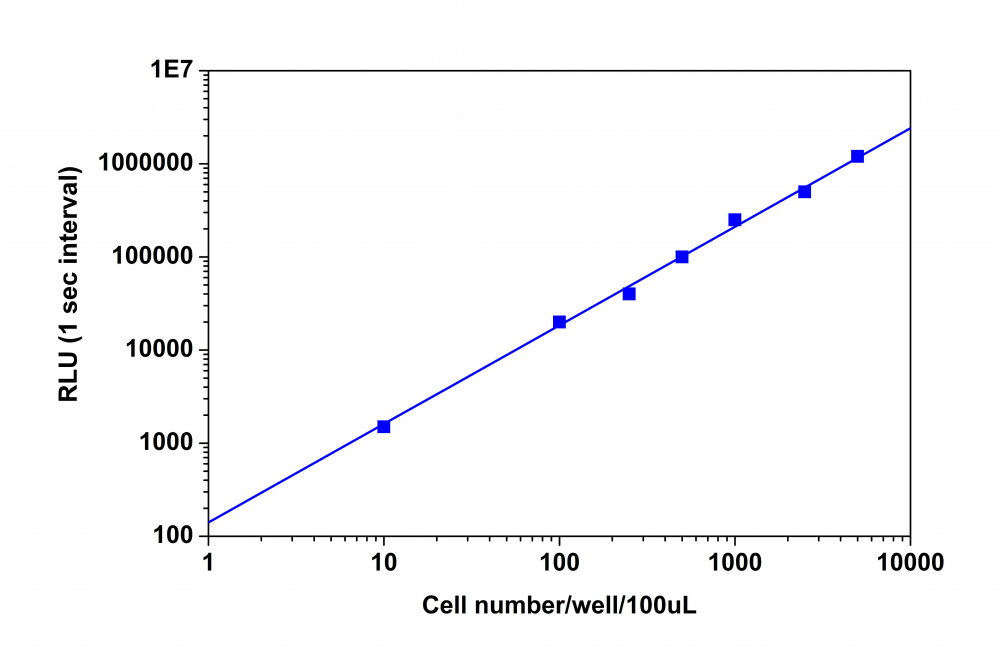
Fig. 2
CHO-K1 cell number was measured with the PhosphoWorks™ Luminescence ATP Assay Kit (Catalog Number 21610) on a 96-well white plate using a NOVOstar plate reader (BMG Labtech). The kit can detect as low as 10
cells/well (Z’ factor= 0.6). The integration time was 1 sec.
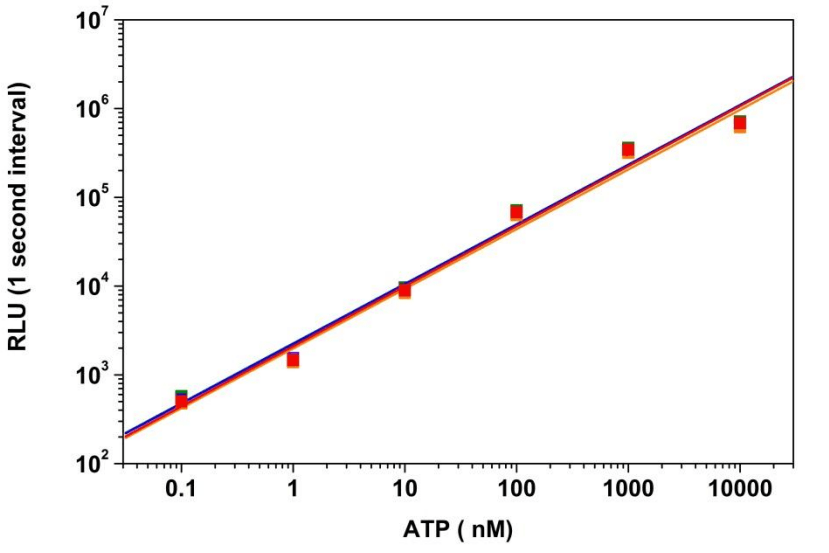
Fig. 3
ATP dose response was measured with the PhosphoWorks™
Luminescence ATP Assay Kit (Catalog Number 21609) on a 96-well white plate using a NOVOstar plate reader (BMG Labtech). The linear luminescence signal for ATP concentrations from 100 μM to 0.1 nM was monitored for up to 5 hours (Z’ factor = 0.7) without signal decay (above figure shows 20 minutes, 1, 2, 3, 4, and 5 hour signal). The integrated time was 1 second.
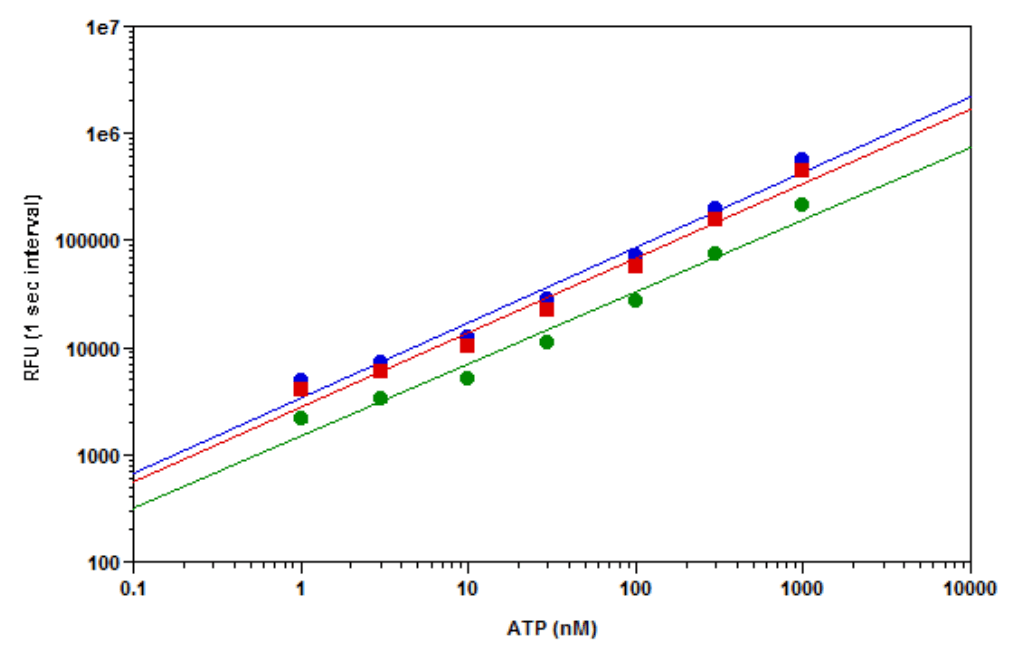
Fig. 4
ATP dose response was measured with the PhosphoWorks™
Luminescence ATP Assay Kit (Catalog Number 21610) on a 96-well white plate using a NOVOstar plate reader (BMG Labtech). The kit can detect 3 pmol ATP with 2 hours incubation (Z’ factor = 0.6, blue 30 minutes, red 1 hour, and green 2 hours). The integration time was 1 sec. The half life is more than 1.5 hours.
This document (01.0244.251203r1) was last updated on Sat Feb 28 2026. All trademarks and registered trademarks mentioned herein are the property of their respective owners.