
Products
Services
Resources
Selection Guides
About
Bacterial Nucleic Acid Detection
AAT Bioquest offers a comprehensive portfolio of bacterial nucleic acid detection reagents designed for visualizing, quantifying, and assessing the viability of bacterial populations. These products include membrane-permeable nucleic acid stains for live cell imaging, selective dyes for gram-positive versus gram-negative differentiation, and innovative viability assessment tools for both fluorescence microscopy and molecular biology applications. The MycoLight™ series represents AAT Bioquest's proprietary technology for superior bacterial detection with minimal cytotoxicity.
I want to... | Try using... |
|---|---|
Stain bacterial nucleic acid | MycoLight™ Green, MycoLight™ Red |
Stain gram-positive bacteria | Hexidium Iodide |
Distinguish live versus dead bacteria | MycoLight™ Bacterial Viability Assay Kit |
Perform viability PCR | MycoLight™ vPCR Star |
Staining Bacterial Nucleic Acids
MycoLight™ Green Nucleic Acid Stains
MycoLight™ Green nucleic acid stains are membrane-permeable dyes that penetrate both prokaryotic and eukaryotic cells to bind DNA and RNA with high fluorescence enhancement upon binding. These stains are optimized for the FITC channel (Ex/Em = 482/512 nm), making them compatible with standard fluorescence microscopy and flow cytometry configurations.
- Excellent membrane permeability – Rapidly penetrates intact bacterial membranes without fixation
- High fluorescence enhancement – Minimal background fluorescence in unbound state
- Low cytotoxicity – Suitable for live cell imaging with reduced impact on bacterial growth
- Universal bacterial staining – Effective for both gram-positive and gram-negative species
- FITC-compatible – Standard green channel detection on all fluorescence instruments
Fig. 1
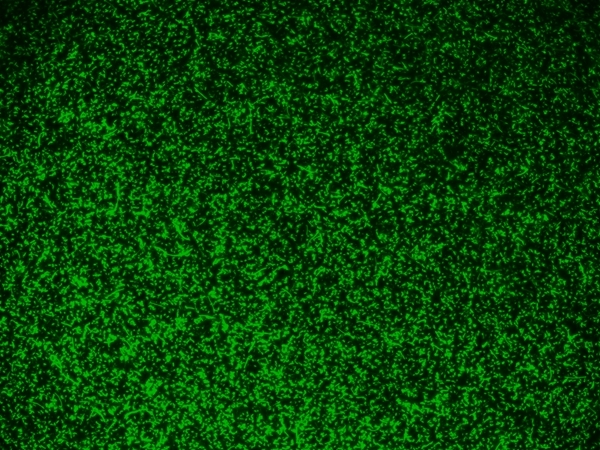
E.Coli were stained with 5 uM of MycoLight™ Green JJ98 for 30 minutes and imaged with FITC channel.
MycoLight™ Red JJ94 Nucleic Acid Stain
MycoLight™ Red JJ94 is a red-fluorescent nucleic acid stain specifically designed for compatibility with GFP-expressing bacteria and multiplexed imaging experiments. This dye enables simultaneous visualization of bacterial nucleic acids alongside green fluorescent protein reporters without spectral overlap.
- GFP-compatible – Red emission enables multiplexing with green fluorescent reporters
- Minimal growth inhibition – Lower cytotoxicity compared to SYTO-9™ in growth assays
- Broad bacterial compatibility – Stains both gram-positive and gram-negative species
- Excellent signal-to-noise – High fluorescence enhancement upon nucleic acid binding
Fig. 2
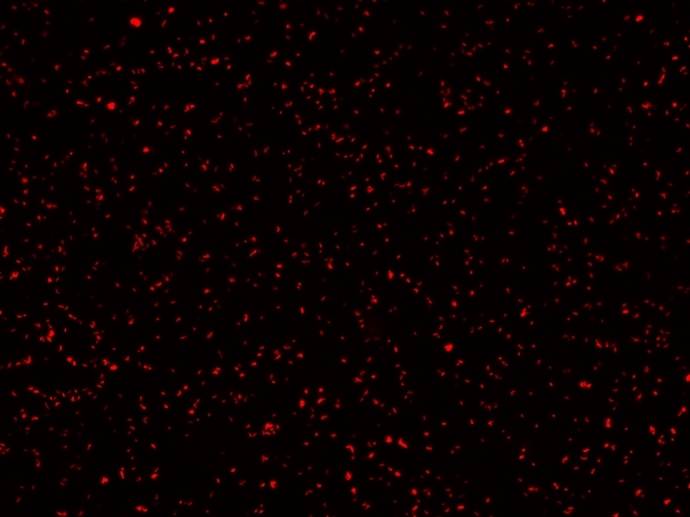
Rhodococcus qingshengii was stained with 2.5 µM of MycoLight™ Red JJ94 for 20 minutes. Image was taken by Keyence florescent microscope with Cy5 filter set.
Staining Gram-Positive Bacteria
Hexidium iodide is a membrane-permeable nucleic acid stain that selectively labels gram-positive bacteria in the presence of gram-negative species. This selectivity arises from differential membrane permeability, enabling rapid identification of bacterial populations in mixed cultures without complex sample preparation.
- Gram-positive selective – Preferentially stains gram-positive bacteria in mixed populations
- Mammalian cell permeable – Can be used in co-culture experiments
- Simple workflow – No fixation or permeabilization required
Distinguishing Live Versus Dead Bacteria (Bacterial Viability)
MycoLight™ Bacterial Viability Assay Kit
The MycoLight™ Bacterial Viability Assay Kit provides a two-color fluorescence method for discriminating live and dead bacteria in both gram-positive and gram-negative species. Live bacteria with intact cell membranes exhibit green fluorescence, while bacteria with compromised membranes display red fluorescence, enabling rapid viability assessment using fluorescence microscopy or flow cytometry.
- Universal compatibility – Works with both gram-positive and gram-negative bacteria
- Two-color discrimination – Green (live) and red (dead) signals for clear viability assessment
- FITC/Texas Red detection – Compatible with standard dual-channel imaging setups
- Complete kit format – Includes all reagents for immediate use
- Rapid workflow – Results in 15-30 minutes without fixation
Fig. 3
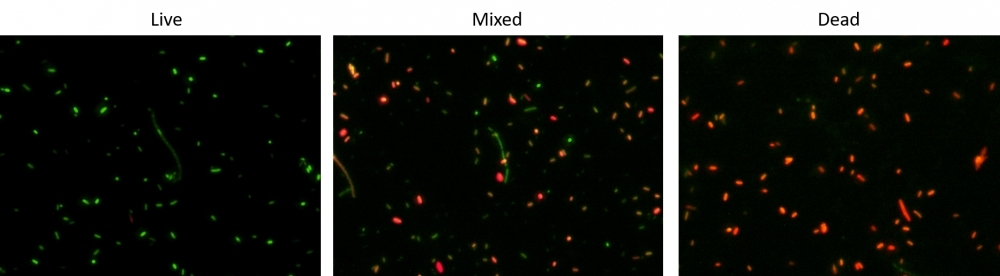
Fluorescence images of E. coli HST08 stained with MycoLight™ Bacterial Viability Assay Kit (Catalog Number 22400). Live bacteria with intact cell membranes showed green fluorescence (Left), while 70% alcohol-killed dead bacteria (Right) with compromised membranes showed red fluorescence. Live and dead E.coli bacterial cells were also visualized in a mixed population (Middle).
Performing Viability PCR (vPCR)
Viability PCR (vPCR) enables selective detection of live microorganisms by treating samples with membrane-impermeable dyes that covalently modify DNA in dead cells, preventing PCR amplification. These photo-reactive dyes selectively penetrate cells with compromised membranes and, upon light exposure, covalently cross-link to DNA to inhibit amplification. AAT Bioquest offers three vPCR options: MycoLight™ vPCR350 provides enhanced specificity over traditional PMA with room light compatibility; MycoLight™ PMA is the established industry standard; and MycoLight™ vPCR Star eliminates photoactivation entirely for the simplest workflow.
- Selective dead cell penetration – Membrane-impermeable dyes only enter cells with compromised membranes
- PCR-compatible DNA modification – Covalent cross-linking prevents amplification of dead cell DNA
- Accurate viability quantification – Enables true live cell enumeration by qPCR
- Broad organism coverage – Effective for bacteria, fungi, viruses, and eukaryotes
- Multiple workflow options – Choose between light-activated (PMA, vPCR350) or no-activation (vPCR Star) formats
Fig. 4
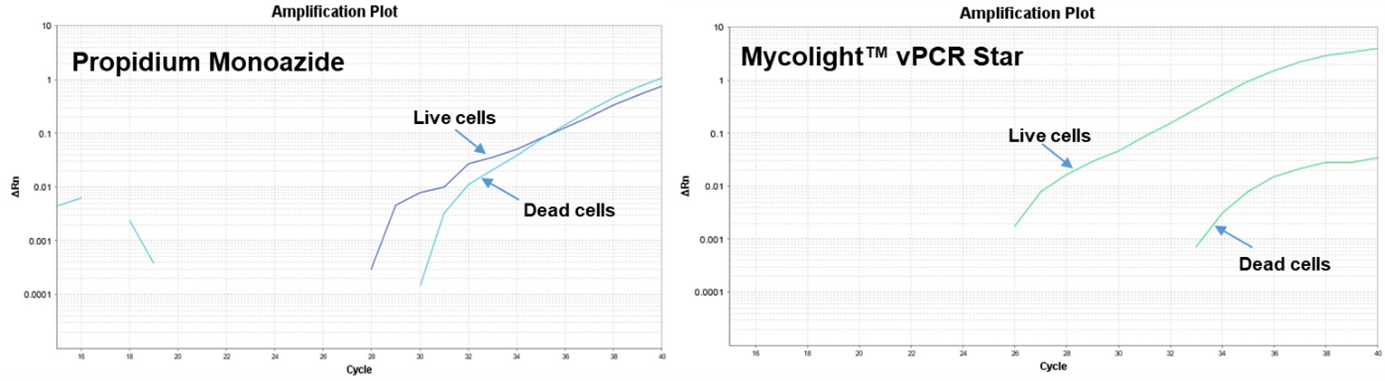
Normalized qPCR curves from a viability PCR experiment in which live and heat-inactivated E. coli were treated with MycoLight™ vPCR Star. qPCR was performed using primers against a region of the uidA gene. MycoLight™ vPCR Star treatment had no effect on amplification of DNA from live E. coli, but caused a significant delay in amplification of DNA from heat-killed E. coli. Propidium Monoazide did not work in the absence of light exposure.
This document (01.0313.251203r1) was last updated on Sat Feb 28 2026. All trademarks and registered trademarks mentioned herein are the property of their respective owners.
Bacterial Nucleic Acid Detection