
Products
Services
Resources
Selection Guides
About
Cal-520® and Other Cal™ Indicators
AAT Bioquest's Cal-520® and Cal™ indicator family represents the next generation of fluorescent calcium probes, engineered for superior brightness, enhanced signal-to-noise ratio, and excellent cellular retention. The Cal™ indicator series includes probes spanning from ultraviolet to near-infrared excitation and emission wavelengths (approximately 388–783 nm), enabling multiplexed calcium imaging. From the flagship Cal-520® with FITC-compatible excitation to far-red Cal-770™ for deep tissue imaging, these indicators are available in multiple forms including cell-permeable AM esters, membrane-impermeable salts, dextran conjugates, and reactive derivatives for custom bioconjugation.
Indicator | Ex/Em (nm) | Ca²⁺ Affinity | Best For | Available Forms |
|---|---|---|---|---|
Cal-500™ | 388/482 | Standard | UV excitation, DAPI channel | AM, K⁺ salt |
Cal-520® | 492/515 | Standard (Kd ~320 nM) | General calcium imaging, FITC channel | AM, salts, dextran, reactive |
Cal-520FF™ | 492/515 | Low (Kd ~9.8 µM) | High [Ca²⁺] transients, presynaptic terminals | AM, K⁺ salt |
Cal-520N™ | 492/515 | High (Kd ~70 nM) | Low [Ca²⁺] changes, resting calcium | AM, K⁺ salt |
Cal-520ER™ | 492/515 | Very Low (ER-optimized) | Endoplasmic reticulum calcium | AM, K⁺ salt |
Cal-590™ | 574/588 | Standard | Orange-red channel, multiplexing with GFP | AM, salts, dextran |
Cal-630™ | 609/626 | Standard | Far-red channel, reduced autofluorescence | AM, salts, dextran |
Cal-670™ | 667/680 | Standard | Deep tissue, Cy5 channel compatible | K⁺ salt, dextran |
Cal-770™ | 758/783 | Standard | Near-IR imaging, deep tissue penetration | K⁺ salt, dextran |
Cal-520® is AAT Bioquest's flagship green-fluorescent calcium indicator, designed to overcome limitations of traditional probes like Fluo-3 and Fluo-4. With FITC-compatible excitation/emission (492/515 nm), Cal-520® delivers dramatically higher signal-to-noise ratio through increased fluorescence intensity upon calcium binding, enhanced cellular retention for longer imaging sessions, and reduced background fluorescence. The indicator is available in multiple affinity variants to match different physiological calcium ranges.
- Superior brightness: 2-3× brighter fluorescence response than Fluo-4 AM upon calcium binding
- Enhanced cellular retention: Improved cytoplasmic localization with reduced organelle compartmentalization
- Excellent signal-to-noise: Low background fluorescence in absence of calcium maximizes dynamic range
- Two-photon compatible: Validated for multiphoton microscopy applications
- Multiple affinity options: Cal-520® (Kd ~320 nM), Cal-520FF™ (Kd ~9.8 µM), and Cal-520N™ (Kd ~70 nM) for different [Ca²⁺] ranges
Fig. 1
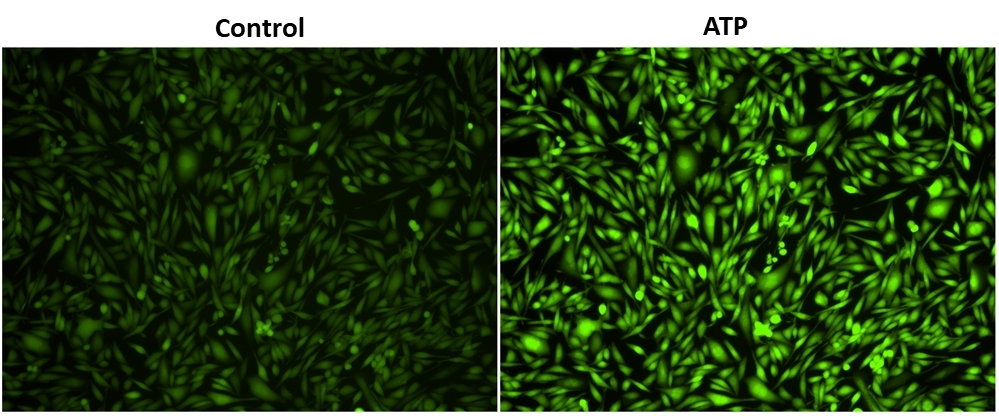
Response of endogenous P2Y receptor to ATP in CHO-K1 cells. CHO-K1 cells were seeded overnight at 40,000 cells per 100 µL per well in a 96-well black wall/clear bottom costar plate. 100 µl of 4 µM Cal 520® AM in HHBS with 1 mM probenecid were added into the wells, and the cells were incubated at 37 °C for 1 hour. The dye loading mediums were replaced with 100 µl HHBS and 1 mM probenecid , then imaged with a fluorescence microscope (Olympus IX71) using FITC channel before and after adding 50 µl of 300 µM ATP.
Cal-590™ provides bright orange-red fluorescence (Ex/Em = 574/588 nm), making it compatible with TRITC/Cy3 filter sets and an excellent replacement for Rhod-2.
- Orange-red emission: Spectrally distinct from GFP/FITC channel for multiplexing
- Two-photon compatible: Validated for multiphoton microscopy with excellent two-photon cross-section
- Multiple formats: Available as AM ester for live cell loading or dextran conjugates for microinjection
Fig. 2
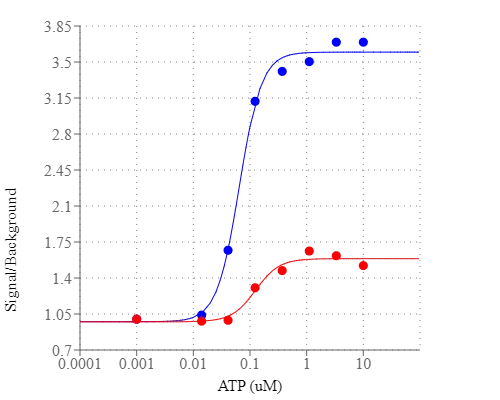
ATP-stimulated calcium response of endogenous P2Y receptor in CHO-K1 cells incubated with Cal-590® AM or Rhod-2 AM under the same conditions. CHO-K1 cells were seeded overnight at 50,000 cells per 100 µL per well in a 96-well black wall/clear bottom Costar plate. 100 µL of 5 µg/mL Cal-590® AM or Rhod-2 AM with 2.5 mM probenecid was added into the cells, and the cells were incubated at 37 °C for 1 hour. ATP (50 µL/well) was added by FlexStation (Molecular Devices) to achieve the final indicated concentrations.
Cal-630™ offers far-red fluorescence (Ex/Em = 609/626 nm), making it compatible with Texas Red filter sets. It is an excellent replacement for x-Rhod-1 and for calcium imaging applications requiring minimal cellular autofluorescence.
- Far-red emission: Reduced autofluorescence background for improved signal-to-noise
- Spectral versatility: Compatible with 594 nm or 633 nm laser excitation
- Deep tissue imaging: Longer wavelengths penetrate tissue more effectively
Cal-500™ is a UV-excitable calcium indicator (Ex/Em = 388/482 nm) compatible with DAPI filter sets and UV laser lines. This blue-fluorescent indicator enables calcium imaging in systems where visible light excitation interferes with optogenetic tools or other fluorescent proteins, and is ideal for multiplexing with green, orange, and red fluorescent probes.
- UV excitation: Compatible with 355-405 nm laser lines and DAPI/Hoechst filter sets
- Blue emission: Enables multiplexing with longer-wavelength calcium indicators or fluorescent proteins
- Standard calcium affinity: Suitable for typical cytosolic calcium transients
Cal-670™ (Ex/Em = 667/680 nm) and Cal-770™ (Ex/Em = 758/783 nm) extend calcium imaging into the near-infrared spectrum. These long-wavelength indicators provide maximum tissue penetration depth, minimal autofluorescence interference, and compatibility with Cy5 and Cy7 filter sets for deep tissue and in vivo calcium imaging applications.
- Near-infrared emission: Maximum tissue penetration for deep imaging
- Minimal autofluorescence: Near-IR wavelengths avoid most biological background fluorescence
- Cy5/Cy7 compatible: Works with common far-red and near-IR filter sets and laser lines
RatioWorks™ dual-dye dextran conjugates combine a calcium-sensitive Cal™ indicator with a calcium-insensitive reference fluorophore (Cy5 or zFluor 647™) on the same dextran backbone. This enables true ratiometric calcium measurements that are independent of indicator concentration, dye loading variability, photobleaching, and motion artifacts—essential for quantitative calcium imaging.
- Built-in reference: Calcium-insensitive dye provides internal normalization
- Quantitative measurements: Ratio signal eliminates artifacts from uneven loading or photobleaching
- Motion artifact correction: Ratiometric readout compensates for focal plane shifts
- Single excitation option: Cal-590L®/Cy5 conjugate allows dual emission with single excitation wavelength
This document (01.0235.251203r1) was last updated on Sat Feb 28 2026. All trademarks and registered trademarks mentioned herein are the property of their respective owners.
Featured products
| Name | Excitation (nm) | Emission (nm) |
|---|---|---|
| Cal-520®, AM | 492 | 515 |
| Cal-590™ AM | 574 | 588 |
| Cal-630™ AM | 609 | 626 |