
Products
Services
Resources
Selection Guides
About
Calbryte™ Indicators
AAT Bioquest's Calbryte™ indicators are fluorescent calcium probes engineered to deliver higher brightness, improved signal-to-noise ratios, and enhanced photostability compared to earlier-generation fluorescein-based calcium indicators. The Calbryte™ family spans multiple wavelengths (green, orange, and far-red) and calcium affinities, providing tools for monitoring intracellular calcium dynamics in live cells, with specific formats optimized for high-throughput screening or flow cytometry.
Indicator Series | Ex/Em (nm) | Kd (Ca²⁺ Affinity) | Best For |
|---|---|---|---|
Calbryte™ 520 | 493/515 (Green) | ~1.2 µM (Medium) | General calcium flux, GPCR screening, HTS |
Calbryte™ 520L | 493/515 (Green) | ~91 µM (Low) | Higher calcium concentrations, reduced buffering |
Calbryte™ 520XL | 493/515 (Green) | ~300 µM (Low) | ER calcium, high [Ca²⁺] environments |
Calbryte™ 590 | 581/593 (Orange) | ~1.4 µM (Medium) | Multiplexing with green probes, reduced autofluorescence |
Calbryte™ 630 | 607/624 (Far-Red) | ~1.2 µM (Medium) | Deep tissue imaging, multicolor experiments |
The Calbryte™ 520 series provides bright green fluorescence (Ex/Em = 493/515 nm) compatible with standard FITC filter sets. These indicators are available in three calcium affinity variants to match different experimental requirements: standard (Kd ~1.2 µM), low affinity "L" (Kd ~91 µM), and extremely low affinity "XL" (Kd ~300 µM).
- 2-3× brighter signal than Fluo-4 AM with significantly improved signal-to-noise ratio
- Superior photostability for extended time-lapse imaging and kinetic studies
- Excellent cell permeability with AM ester forms for easy live cell loading
- Multiple affinity options to match physiological calcium ranges from cytosolic (nM) to ER/organellar (µM-mM)
- Compatible with standard FITC/GFP filter sets and plate readers
Fig. 1
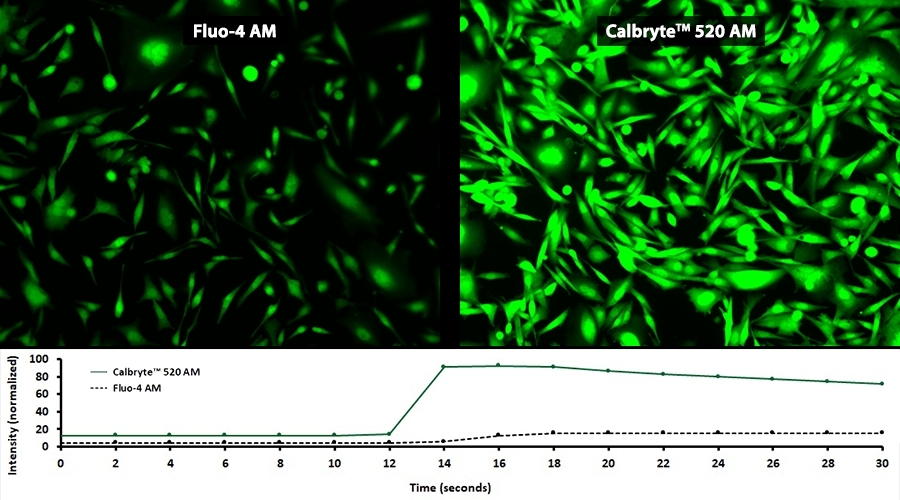
ATP response was measured in CHO-K1 cells using Calbryte™ 520 AM (Catalog Number 20653) and Fluo-4, AM (Catalog Number 20550). CHO-K1 cells were seeded overnight at 50,000 cells/100 µL/well in a 96-well black wall/clear bottom costar plate. 100 µL of either 10 µg/mL Calbryte™ 520 AM in HH Buffer with probenecid or 10 µg/mL Fluo-4, AM in HH Buffer with probenecid was added to the wells and incubated for 45 minutes at 37°C. Both dye loading solutions were removed and replaced with 200 µL HH Buffer/well. ATP (50 µL/well) was added to achieve the final indicated concentration of 10 µM. Images were acquired on a Keyence microscope in the FITC channel.
For multiplexing experiments or applications requiring reduced autofluorescence interference, Calbryte™ 590 (orange, Ex/Em = 581/593 nm) and Calbryte™ 630 (far-red, Ex/Em = 607/624 nm) provide excellent alternatives to green indicators. These longer-wavelength indicators are particularly useful for multicolor imaging with GFP-expressing cells or other green fluorescent probes due to minimal spectral overlap with the FITC/GFP emission range.
- Orange and far-red emission enables multiplexing with green fluorescent proteins and probes
- Reduced cellular autofluorescence compared to green indicators
- Better tissue penetration for deeper imaging applications (especially Calbryte™ 630)
- Moderate calcium affinity (Kd ~1.1-1.4 µM) suitable for most cytosolic measurements
- Available as both AM esters and potassium salts for flexible experimental design
For streamlined workflows in high-throughput screening and flow cytometry applications, AAT Bioquest offers ready-to-use calcium assay kits featuring Calbryte™ indicators. These optimized formulations eliminate the need for probenecid (an organic anion transporter inhibitor) and wash steps, enabling simpler protocols with excellent performance.
- Probenecid-free formulation eliminates potential interference with cellular physiology
- No-wash protocol simplifies workflow and reduces hands-on time
- Optimized for HTS with consistent well-to-well performance in microplate formats
- Screen Quest™ kits include all necessary reagents and buffers for immediate use
- Cell Meter™ kit specifically optimized for flow cytometry applications
This document (01.0237.251203r1) was last updated on Tue Sep 15 2026. All trademarks and registered trademarks mentioned herein are the property of their respective owners.
Featured products
| Name | Excitation (nm) | Emission (nm) |
|---|---|---|
| Calbryte™ 520 AM | 493 | 515 |
| Calbryte™ 590 AM | 581 | 593 |
| Calbryte™ 630 AM | 607 | 624 |