
Products
Services
Resources
Selection Guides
About
Fluorescent Labeling Proteins
Phycobiliproteins are photosynthetic accessory pigments isolated from cyanobacteria and red algae. Their exceptional fluorescence properties—high extinction coefficients, excellent quantum yields, and broad absorption spectra—make them ideal labels for detecting rare cell populations and weakly expressed markers in flow cytometry and immunoassay applications.
The three major phycobiliproteins—PE, APC, and PerCP—offer distinct spectral properties optimized for different laser configurations and panel designs. Extinction coefficient (ε) and quantum yield (QY) together contribute to fluorophore brightness; their product (ε × QY) provides a commonly used relative brightness metric for comparing detection sensitivity under similar optical conditions.
- High extinction coefficients (up to ~1,960,000 cm⁻¹M⁻¹ for PE) for maximum light absorption
- Excellent quantum yields for efficient photon conversion
- Multiple excitation options spanning common 488 nm, 561 nm, and 633–640 nm laser lines
- Tandem conjugates extending emission to 820 nm for expanded panel design
- Available as raw proteins, preactivated formats, and complete labeling kits
Protein | Ex (nm) | Em (nm) | ε (cm⁻¹M⁻¹) | QY | Relative Brightness | Laser Lines |
|---|---|---|---|---|---|---|
R-Phycoerythrin (PE) | 565 | 574 | 1,960,000 | 0.82 | 1,607,200 | 488, 561 nm |
Allophycocyanin (APC) | 651 | 660 | 700,000 | 0.68 | 476,000 | 633, 640 nm |
PerCP | 477 | 678 | 406,000 | 0.40 | 162,400 | 488 nm |
PE delivers ~3.4× greater brightness than APC and ~10× greater than PerCP, making it the preferred choice for detecting low-abundance antigens. However, PerCP's exceptionally large Stokes shift (~200 nm) enables far-red emission from blue laser excitation, a unique capability for single-laser multicolor panels.
Tandem dyes combine a phycobiliprotein donor with an organic dye acceptor via FRET, extending emission wavelengths while maintaining the donor's excitation properties. The extinction coefficient of each tandem equals that of its phycobiliprotein donor, since the donor is responsible for light absorption.
The table below provides an overview of the available tandem dyes. Please click the category links to learn more about a particular phycobiliprotein tandem series.
Category | Example Tandems | Emission Range (nm) | ε (cm⁻¹M⁻¹) | Laser |
|---|---|---|---|---|
| PE Tandems | PE-Texas Red, PE-Cy5, PE-Cy5.5, PE-Cy7, PE-iFluor® 594 to PE-iFluor® 780 | 606–800 | 1,960,000 | 488, 561 nm |
| APC Tandems | APC-Cy5.5, APC-Cy7, APC-iFluor® 700 to APC-iFluor® 800 | 700–819 | 700,000 | 633, 640 nm |
| PerCP Tandems | PerCP-Cy5.5, PerCP-Cy7, PerCP-iFluor® 700 to PerCP-iFluor® 780 | 695–806 | 350,000 | 488 nm |
Preactivated phycobiliproteins are ready for direct conjugation to antibodies without additional crosslinker chemistry. These are provided in three variations. Amine-reactive formats target lysine residues and N-termini, affording higher yield than SMCC chemistry, while bypassing the need for antibody reduction. Thiol-reactive (maleimide) formats target free sulfhydryl groups in the hinge region of antibodies for site-directed conjugation. Finally, ammonium sulfate-free proteins benefit from being ready for immediate labeling without dialysis.
Buccutite™ technology uses two unique crosslinkers—Buccutite™ MTA and Buccutite™ FOL—that rapidly react upon mixing, achieving 100% conjugation yield without purification. This approach reduces the risk of antibody aggregation and activity loss that can occur with traditional SMCC-based conjugation under suboptimal conditions.
- Add Buccutite™ MTA linker to antibody → Incubate 30 min
- Add FOL-activated PE, APC, PerCP, or tandem dye → Incubate 60 min
- Conjugate ready to use in less than 2 hours—no purification needed
Fig. 1
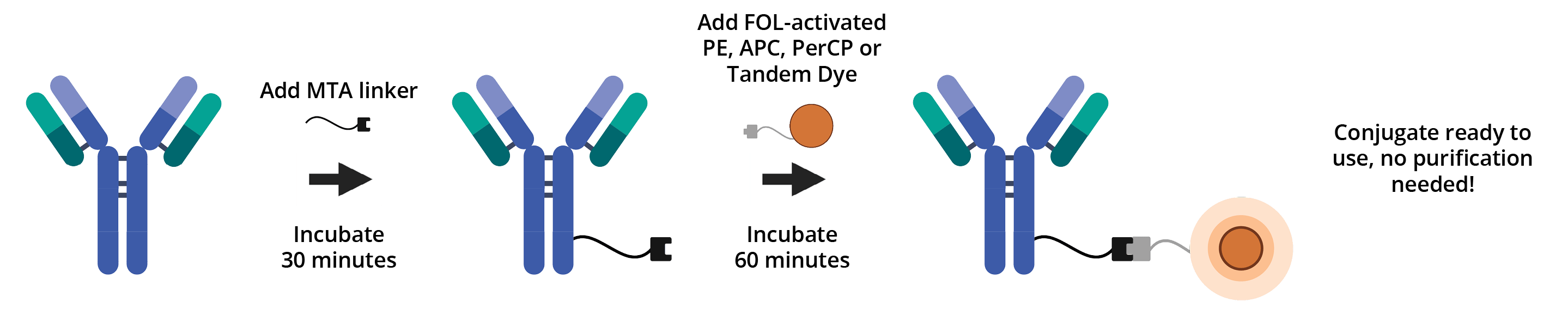
Buccutite™ Rapid Antibody Labeling Kit workflow
The following tables offer selection guides that can assist in selecting the optimal phycobiliproteins for a given experiment.
This document (01.0201.251203r1) was last updated on Sat Feb 28 2026. All trademarks and registered trademarks mentioned herein are the property of their respective owners.