
Products
Services
Resources
Selection Guides
About
Goat Anti-Mouse Secondary Antibodies
Goat anti-mouse secondary antibodies are essential reagents for detecting mouse primary antibodies in immunoassays. AAT Bioquest offers a comprehensive selection of goat anti-mouse secondary antibodies designed for sensitive and specific detection of mouse immunoglobulins in research applications. This collection includes iFluor® dye conjugates, trFluor™ time-resolved fluorescence conjugates, enzyme conjugates, biotinylated antibodies, and innovative PSA (Power Styramide™ Signal Amplification) imaging kits for ultrasensitive immunofluorescence detection. All conjugates are available in standard, cross-adsorbed, and highly cross-adsorbed formats to minimize background in multi-species experiments.
Detection Method | Product Types | Best For | Key Advantage |
|---|---|---|---|
Direct fluorescence | iFluor®, trFluor™ conjugates | Flow cytometry, IF microscopy, multiplexing | Simple protocol, wide spectral range |
Enzymatic amplification | HRP, ALP conjugates | ELISA, Western blot, IHC | Signal amplification, versatile substrates |
Biotin-streptavidin systems | Biotinylated conjugates | Signal amplification, flexible detection | Compatible with any streptavidin conjugate |
Power Styramide™ Signal Amplification | PSA imaging kits | Low-abundance targets, IHC | 10-100× signal enhancement |
Direct fluorescence detection uses fluorophore-conjugated secondary antibodies for immediate visualization without additional amplification steps. AAT Bioquest offers iFluor® dyes spanning the full visible spectrum for standard fluorescence applications, as well as trFluor™ lanthanide conjugates for time-resolved fluorescence detection that eliminates autofluorescence interference.
iFluor® dyes represent AAT Bioquest's next-generation fluorophores, offering superior brightness and photostability compared to traditional dyes. Goat anti-mouse IgG antibodies conjugated to iFluor® dyes are ideal for demanding applications requiring maximum signal intensity. Available in standard, cross-adsorbed, and highly cross-adsorbed formats.
- Superior brightness – Up to 2× brighter than comparable Alexa Fluor® dyes
- Enhanced photostability – Extended imaging without significant signal loss
- Full spectral coverage – Options from UV to near-infrared
- Cross-adsorbed options – Standard, cross-adsorbed, and highly cross-adsorbed formats available
- Optimized F/P ratios – Consistent lot-to-lot performance
XFD dyes are spectrally equivalent to Alexa Fluor® dyes, providing a cost-effective alternative with identical excitation/emission profiles.
mFluor™ dyes are optimized for flow cytometry applications, providing bright signals with minimal spectral overlap. The absorbance maxima of mFluor™ dyes are designed to be optimally excited by one of the major laser lines commonly equipped in flow cytometers, such as the 350 nm, 405 nm, 488 nm, 532 nm, 561-568 nm, or 633-647 nm laser lines. This enables more choices and flexibility for multicolor panel design.
trFluor™ Tb conjugates utilize terbium-based lanthanide labels for time-resolved fluorescence detection, eliminating background autofluorescence that can interfere with conventional fluorophores. The long fluorescence lifetime of terbium complexes (milliseconds vs. nanoseconds) enables gated detection that dramatically improves signal-to-noise ratios, making these conjugates ideal for TR-FRET assays and high-throughput screening applications.
- Eliminates autofluorescence – Time-gated detection removes short-lived background signals
- Large Stokes shift – Large separation between excitation (333 nm) and emission (544 nm) wavelengths
- TR-FRET compatible – Excellent energy donor for time-resolved FRET-based assays
- High-throughput compatible – Superior performance in plate-based screening assays
Enzyme-conjugated goat anti-mouse secondary antibodies provide versatile detection when paired with appropriate substrates. HRP conjugates are the most widely used enzyme labels for Western blotting, ELISA, and immunohistochemistry, while ALP conjugates offer an alternative for applications where peroxidase activity may interfere.
- Signal amplification – Enzymatic turnover generates intense detectable signal
- Versatile detection – Compatible with colorimetric, fluorescent, and chemiluminescent substrates
- ELISA optimized – Validated for quantitative immunoassays
- IHC/ICC compatible – Suitable for tissue and cell staining applications
Fig. 1
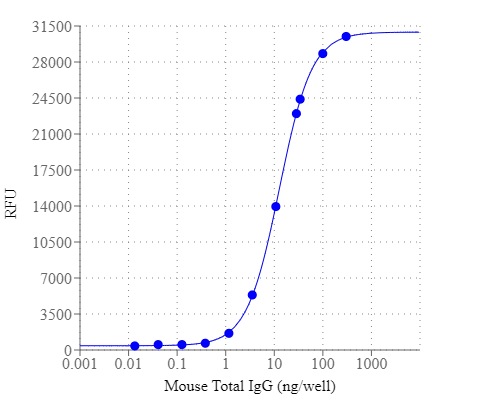
Detection of mouse total IgG using the Amplite® Fluorimetric Goat Anti-Mouse IgG-HRP ELISA Kit. Mouse IgG was diluted into 3 µg/mL and made 1 to 3 serial dilutions in 0.2 M sodium bicarbonate buffer, pH 9.4. 100 µL/well serial dilutions were coated into a solid black 96-well plate at 4 °C overnight, and blocked with 3% milk in PBS and 0.02% Tween-20 at 4 °C overnight. The wells were washed and assayed by using the reagents. 1 to 5000 dilutions of goat anti-mouse IgG-HRP conjugate were used. The reactions were incubated for 10 to 60 minutes and then measured for fluorescence at Ex/Em = 540/590 nm using Gemini fluorescence microplate reader (Molecular Devices).
Biotinylated secondary antibodies leverage the high-affinity biotin-streptavidin interaction for flexible, amplifiable detection. These conjugates can be paired with any streptavidin-conjugated reporter for customized detection workflows.
- Flexible detection – Compatible with any streptavidin conjugate
- Signal amplification – Multiple biotin molecules per antibody enhance sensitivity
- Multiplexing compatible – Supports flexible and amplifiable detection strategies
- Universal platform – Works across ELISA, IHC, IF, and flow cytometry
Power Styramide™ Signal Amplification (PSA) delivers up to 50x greater sensitivity than traditional tyramide signal amplification (TSA), enabling detection of low-abundance targets that conventional immunofluorescence methods often miss. PSA combines two key innovations: Styramide™ substrates with significantly higher reactivity than tyramide, and iFluor® dyes with exceptional brightness and photostability. The result is dramatically enhanced fluorescent signals that remain stable through extended imaging sessions, stringent washes, and multiplex protocols.
- Broad application compatibility: Optimized for IHC (including FFPE tissues), ICC, and in situ hybridization (ISH)
- Multiplex-ready: Sequential staining with spectrally distinct PSA kits enables multi-target detection, even with same-species primary antibodies
- Complete kit format: Each kit includes HRP-conjugated goat anti-mouse IgG secondary antibody and iFluor®-labeled Styramide™ reagent for ~100 tests
- Drop-in workflow: Uses the same HRP conjugates, buffers, and protocol steps as traditional TSA
Fig. 2
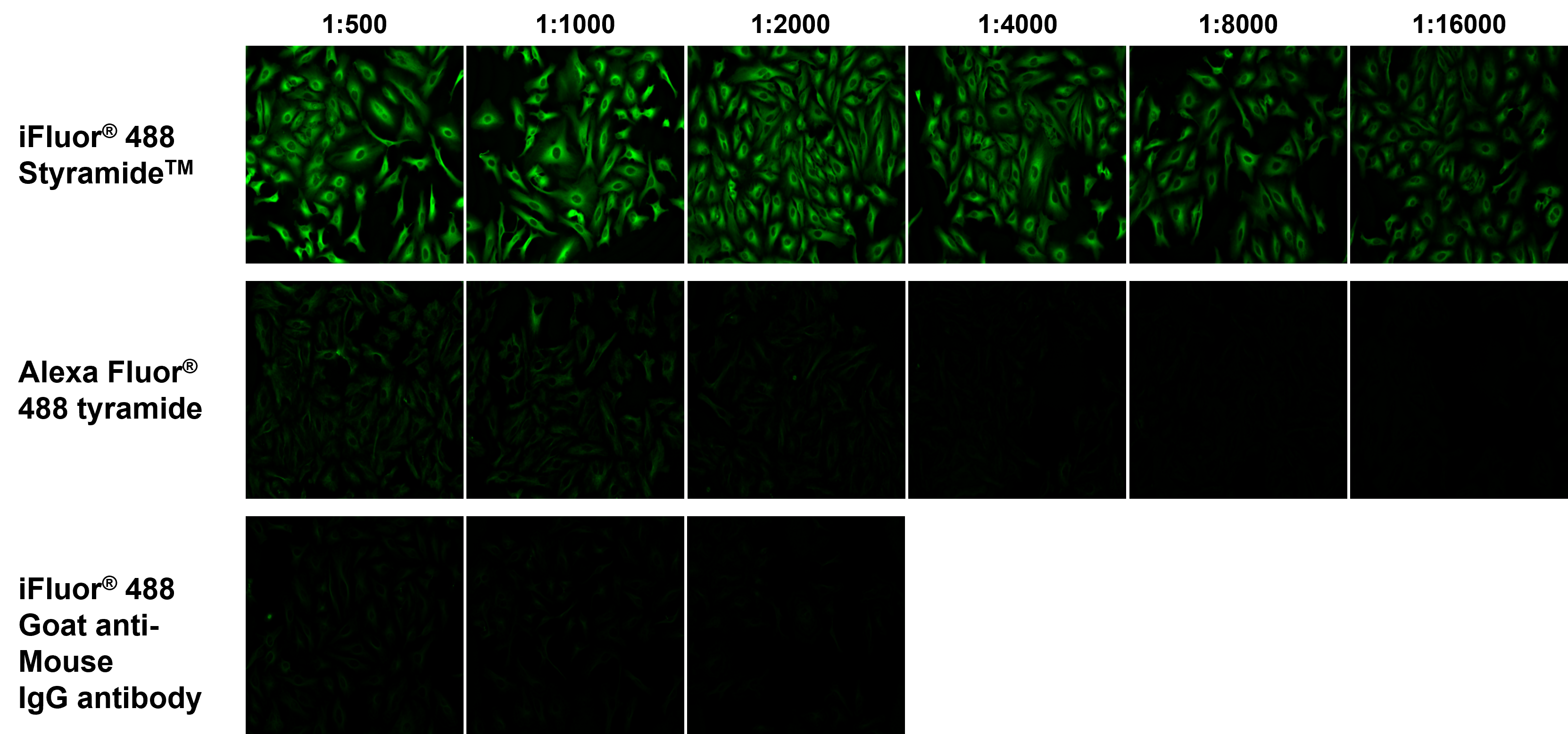
Sensitivity comparison of Styramide™ Super Signal Amplification Kits. HeLa cells were fixed, permeabilized, and labeled with varying concentrations of mouse anti-tubulin primary antibody. The manufacturer-recommended dilution was 1:500 (2 µg/ml). Cells were then stained using one of three methods: (1) Goat anti-Mouse IgG secondary antibody conjugated directly with iFluor® 488, (2) HRP-labeled Goat anti-Mouse IgG secondary antibody followed by Alexa Fluor® 488 tyramide amplification, or (3) HRP-labeled Goat anti-Mouse IgG secondary antibody followed by iFluor® 488 Styramide™ (Catalog Number 45260) amplification. Fluorescence images were captured using a FITC filter set with identical exposure times for all conditions.
Feature | PSA (Power Styramide™) | Traditional TSA |
|---|---|---|
Sensitivity | Up to 50x greater signal | Baseline |
Substrate reactivity | Styramide™ radicals—faster, more efficient covalent deposition | Tyramide radicals |
Fluorophore performance | iFluor® dyes—superior brightness, photostability, and thermal resistance | Alexa Fluor or equivalent |
Primary antibody usage | 10-50x lower concentrations | Standard concentrations |
Protocol compatibility | Drop-in replacement—same HRP conjugates, buffers, and workflow | — |
This document (01.0288.251203r1) was last updated on Sat Feb 28 2026. All trademarks and registered trademarks mentioned herein are the property of their respective owners.
Goat Anti-Mouse Secondary Antibodies