
Products
Services
Resources
Selection Guides
About
Streptavidin Conjugates
AAT Bioquest offers a comprehensive selection of streptavidin conjugates for detecting biotinylated targets across diverse applications including flow cytometry, immunohistochemistry, Western blotting, ELISA, and fluorescence microscopy. Our portfolio features proprietary iFluor® and mFluor™ fluorescent dyes optimized for superior brightness and photostability, alongside classic fluorophores, phycobiliproteins, enzyme conjugates, and time-resolved FRET probes. With streptavidin's exceptional biotin-binding affinity (Kd ~10⁻¹⁵ M), these conjugates provide highly sensitive and specific detection in biotin-streptavidin systems.
Product Type | Detection Principle | Best For | Key Products |
|---|---|---|---|
iFluor® conjugates | Fluorescence (350-860 nm) | Microscopy, flow cytometry, multiplexing | iFluor® 488, 555, 594, 647 |
mFluor™ conjugates | Fluorescence (UV/Violet-excited) | Flow cytometry with violet laser | mFluor™ Violet 450, 510, UV420 |
Phycobiliprotein conjugates | Fluorescence (high brightness) | Flow cytometry, low-abundance targets | RPE, APC, PerCP, tandem dyes |
Enzyme conjugates | Colorimetric/Chemiluminescent | ELISA, Western blot, IHC | HRP, ALP, MegaWox™ polyHRP |
trFluor™ conjugates | Time-resolved fluorescence | TR-FRET assays, HTS | trFluor™ Eu, Tb, XL665 |
Preactivated reagents and kits | Custom conjugation | Creating custom streptavidin conjugates | ReadiUse™, Buccutite™ |
iFluor® streptavidin conjugates combine AAT Bioquest's proprietary iFluor® fluorescent dyes with high-purity streptavidin for superior detection of biotinylated targets. The iFluor® dye series spans the full visible and near-infrared spectrum, enabling flexible multicolor experimental designs for microscopy, flow cytometry, and imaging applications.
- Superior brightness — iFluor® dyes provide higher fluorescence intensity than traditional dyes (e.g., iFluor® 488 is brighter than FITC and Alexa Fluor® 488)
- Enhanced photostability — resist photobleaching for extended imaging sessions
- Minimal self-quenching — optimized conjugation chemistry preserves fluorescence even at high labeling densities
- Full spectral coverage — 20+ options from UV (350 nm) to NIR (860 nm) for multiplexing
- Xtra™ versions available — ultra-high brightness variants for demanding applications
mFluor™ streptavidin conjugates are specifically designed for flow cytometry applications. These fluorescent dye conjugates fall under several different groups based on their optimal excitation source, such as mFluor™ Blue or mFluor™ Violet. Dyes within the same group are well excited by a shared laser (e.g., 405 nm violet laser) while emitting at various wavelengths. This enables detection across a wide emission range from a single excitation source, expanding color options in multicolor panels.
- Optimized for single excitation laser — ideal for exciting multiple fluorophores from a common laser
- Extended Stokes shifts — facilitates spectral separation in multicolor panels
- Consistent lot-to-lot performance — quality-controlled for reproducible results
- xtraFluor™ variant — enhanced brightness version available for demanding applications
Phycobiliprotein streptavidin conjugates leverage the exceptional brightness of R-phycoerythrin (RPE), allophycocyanin (APC), and peridinin-chlorophyll-protein (PerCP) for highly sensitive detection in flow cytometry. Tandem conjugates extend the emission range while maintaining single-laser excitation, enabling detection of low-abundance targets with exceptional signal-to-noise ratios.
- Exceptional brightness — phycobiliproteins contain multiple fluorophore units per molecule for intense signal
- Ideal for flow cytometry — standard reagents for immunophenotyping and rare cell detection
- Tandem dyes available — RPE-Cy5, RPE-Cy7, RPE-iFluor® 647/750, APC-iFluor® 750 expand spectral options
- Efficient energy transfer — optimized FRET between donor phycobiliprotein and acceptor dye produces strong emission
Fig. 1
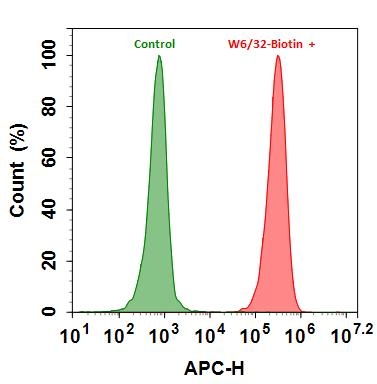
Flow cytometry analysis of HL-60 cells stained with (Red) or without (Green) 1ug/ml Anti-Human HLA-ABC-Biotin and then followed by APC-streptavidin conjugate (Catalog Number 16902). The fluorescence signal was monitored using ACEA NovoCyte flow cytometer in the APC channel.
Classic fluorophore streptavidin conjugates include well-established dyes such as FITC, Texas Red®, and Cy® dyes that are compatible with standard filter sets on most fluorescence instruments. XFD dyes offer Alexa Fluor®-equivalent spectral properties with reliable performance for microscopy and flow cytometry applications.
Fig. 2
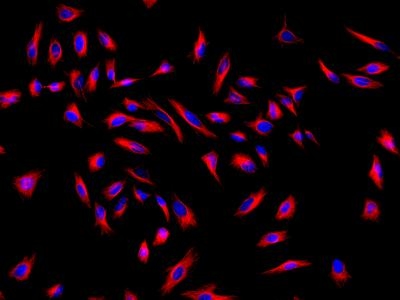
HeLa cells were incubated with mouse anti-tubulin and biotin goat anti-mouse IgG followed by AAT's Cy3®-streptavidin conjugate (Red). Cell nuclei were stained with Hoechst 33342 (Blue, Catalog Number 17530).
Enzyme streptavidin conjugates enable colorimetric or chemiluminescent detection of biotinylated targets in ELISA, Western blotting, and immunohistochemistry. HRP (horseradish peroxidase) and ALP (alkaline phosphatase) conjugates generate signal through enzymatic substrate conversion, providing high sensitivity through signal amplification.
- Signal amplification — enzymatic turnover generates strong, detectable signals
- MegaWox™ polyHRP — multiple HRP molecules per streptavidin increases signal output (up to 100x greater than standard HRP conjugates)
- Versatile detection — compatible with colorimetric, fluorescent, and chemiluminescent substrates
- Stable conjugates — optimized formulations for consistent performance
Fig. 3
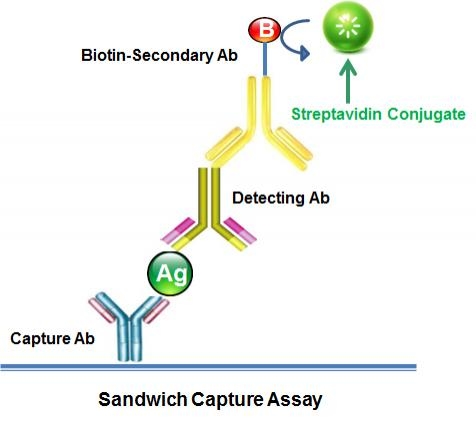
An example diagram of a Sandwich Capture Assay (Sandwich ELISA) using a biotin-streptavidin detection system.
trFluor™ streptavidin conjugates utilize lanthanide chelates (europium or terbium) for time-resolved fluorescence detection, eliminating background interference from short-lived autofluorescence. These conjugates are ideal for TR-FRET assays and high-throughput screening applications requiring exceptional sensitivity.
- Long fluorescence lifetime — millisecond decay enables time-gated detection after background fluorescence subsides
- Minimal background interference — eliminates autofluorescence from biological samples and plastics
- TR-FRET compatible — trFluor™ Eu pairs with XL665 acceptor for homogeneous assays
- High-throughput screening — ideal for drug discovery and binding assays
ReadiUse™ preactivated streptavidin reagents contain reactive functional groups for creating custom streptavidin conjugates with biomolecules of interest. Buccutite™ conjugation kits provide a streamlined workflow for labeling antibodies with streptavidin using click chemistry—no purification required.
- Multiple reactive chemistries — NHS ester (amines), maleimide (thiols), azide and alkyne (click chemistry)
- ReadiUse™ format — pre-activated and ready to use, minimizing preparation steps
- Buccutite™ technology — rapid, efficient conjugation without purification using click chemistry
- Scalable options — kits available for 25 µg, 100 µg, or 1 mg protein labeling
This document (01.0292.251203r1) was last updated on Sat Feb 28 2026. All trademarks and registered trademarks mentioned herein are the property of their respective owners.
Streptavidin Conjugates