
Products
Services
Resources
Selection Guides
About
Luciferase
AAT Bioquest offers a comprehensive portfolio of luciferase substrates, reporter gene assay kits, and related reagents for bioluminescence-based detection. Our luciferase products support applications ranging from reporter gene assays and in vivo imaging to enzyme activity measurements and ATP quantification. The collection includes substrates for firefly, Gaussia, and Renilla luciferases, as well as specialized aminoluciferin-based probes for detecting specific enzyme activities such as caspases, proteases, and phosphatases.
Product Type | Detection Principle | Best For | Featured Products |
|---|---|---|---|
Reporter Gene Assay Kits | Luciferase-catalyzed luminescence | Gene expression, promoter studies | Amplite® Firefly, Gaussia, and Renilla Kits |
D-Luciferin Substrates | Firefly luciferase oxidation | In vivo imaging, ATP detection | D-Luciferin free acid, potassium salt, and sodium salt |
Caged D-Luciferin Derivatives | Enzyme-triggered luciferin release | Phosphatase, β-galactosidase detection | D-Luciferin phosphate and galactoside |
Aminoluciferin Probes | Protease-triggered luminescence | Caspase activity, apoptosis | Z-DEVD-, Z-LEHD-, Z-IETD-aminoluciferin |
Coelenterazines | Renilla/Gaussia luciferase, aequorin | Calcium imaging, BRET, reporter assays | Coelenterazine h, f, cp, and 400a |
ATP Assay Kits | ATP-dependent luciferase activity | Cell viability, metabolic studies | ReadiUse™ Rapid Luminometric ATP Kit |
The Amplite® Reporter Gene Assay Kits provide optimized, ready-to-use solutions for measuring luciferase activity in live cells or cell extracts. These kits utilize proprietary buffer formulations that maximize luminescence signal intensity and stability, enabling sensitive detection of firefly, Gaussia, or Renilla luciferase expression in transfected cells.
- Maximized luminescence output — Optimized substrate concentrations and buffer compositions deliver stronger signals than standard formulations
- Extended signal stability — Glow-type luminescence enables flexible read times without rapid signal decay
- Simple workflow — Add-and-read format requires minimal sample preparation
- High sensitivity — Detect as low as 0.1 pg/well firefly luciferase
- Plate reader compatible — Validated for standard luminescence microplate readers
Fig. 1
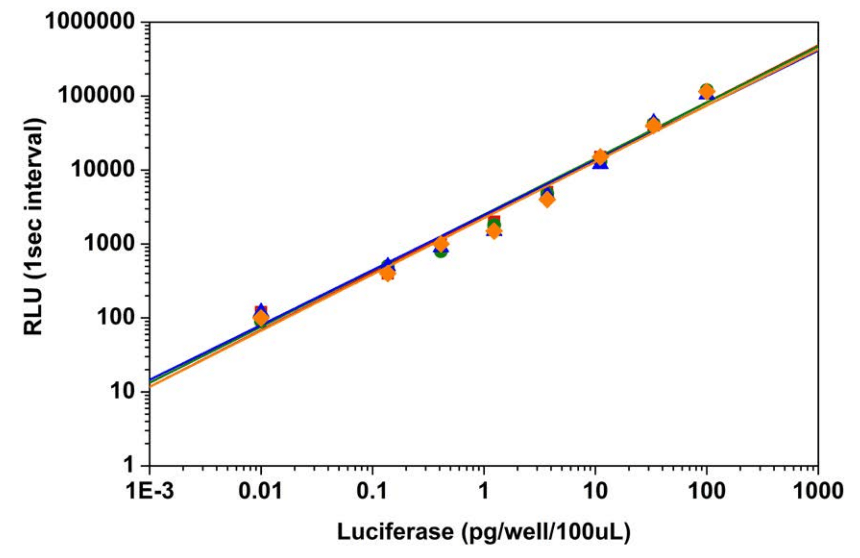
Luciferase dose-response was measured with Amplite® Luciferase Reporter Gene Assay Kit in a white 96-well plate with a NOVOstar plate reader (BMG Labtech). The kit can detect as low as 0.1pg/well luciferase with 20 minutes to 5 hours incubation without losing signal intensity. The integration time was 1 second. The half-life is more than 4 hours.
D-Luciferin is the natural substrate for firefly luciferase (Photinus pyralis), producing yellow-green bioluminescence (λmax ~560 nm) through an ATP-dependent oxidation reaction. This highly sensitive detection system is widely used for in vivo bioluminescence imaging, ATP quantification, and reporter gene assays. AAT Bioquest offers D-luciferin in multiple salt forms for different solubility requirements, as well as caged derivatives that enable detection of specific enzyme activities.
- High purity — Rigorous quality control ensures consistent lot-to-lot performance
- Multiple formats — Free acid, potassium salt, and sodium salt for flexible buffer compatibility
- Caged derivatives — Enzyme-cleavable protecting groups for phosphatase, β-galactosidase, and esterase detection
- In vivo compatible — Potassium and sodium salts offer excellent water solubility for animal studies
Aminoluciferin derivatives are luminogenic substrates designed for detecting specific protease activities. These probes consist of a peptide sequence recognized by the target protease linked to aminoluciferin. Upon proteolytic cleavage, free aminoluciferin is released and oxidized by firefly luciferase to generate a luminescent signal. This coupled enzyme system provides exceptional sensitivity for measuring caspase activities in apoptotic cells and other protease activities.
- High sensitivity — Bioluminescent detection offers superior dynamic range compared to fluorogenic substrates
- Caspase-specific sequences — Optimized peptide motifs ensure selectivity for individual caspases
- Live cell compatible — Suitable for real-time monitoring of apoptosis in cell cultures
- Broad caspase coverage — Substrates available for caspases-2, -3, -6, -7, -8, -9, and -12
Coelenterazines are luminescent substrates used with Renilla and Gaussia luciferases, as well as the calcium-sensitive photoprotein aequorin. Different coelenterazine analogs offer varied spectral properties and kinetic characteristics for specific applications including BRET (bioluminescence resonance energy transfer), calcium imaging, and dual-reporter assays. AAT Bioquest provides multiple coelenterazine variants, including UltraPure grades for demanding applications.
- UltraPure grades available — High-purity preparations minimize background and improve signal-to-noise
- Multiple analogs — Different spectral properties and kinetic profiles for specific applications
- Aequorin compatible — Essential cofactor for reconstituting functional aequorin calcium indicators
- BRET applications — Suitable coelenterazine variants for bioluminescence resonance energy transfer studies
AAT Bioquest offers additional luciferase-based tools for specialized applications including ATP quantification, calcium signaling assays, and advanced in vivo imaging. The ReadiUse™ product line provides convenient, ready-to-use formats that simplify experimental workflows.
- ReadiUse™ convenience — Pre-formulated solutions eliminate reconstitution steps and reduce preparation time
- High sensitivity ATP detection — Luminometric assay enables detection of low ATP concentrations
- Validated standards — ATP reference standards ensure accurate quantification
- Extended spectral range — Cyluc1 provides red-shifted emission for improved tissue penetration in vivo
Fig. 2
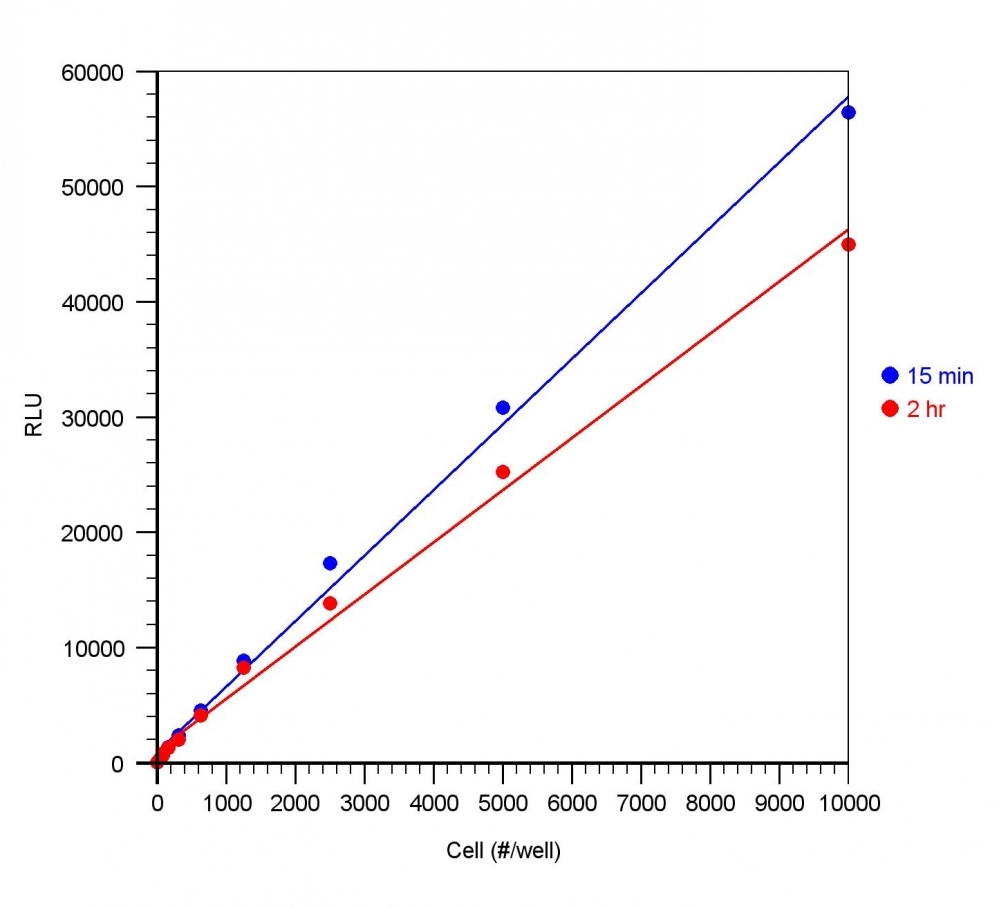
Cell number correlates with the luminescent signal. Different Jurkat cell number (2-fold dilution) was measured using the ReadiUse™ Rapid Luminometric ATP Assay Kit in a 96-well white plate using a ClarioStar plate reader (BMG Labtech). The kit can detect as low as 50 cells. There is a linear relationship (r2 >0.99) between the luminescent signal and cell number after 15 minutes or 2 hours incubation. The half-life of luminescent signal is more than 2 hours.
This document (01.0267.251203r1) was last updated on Sat Feb 28 2026. All trademarks and registered trademarks mentioned herein are the property of their respective owners.