
Products
Services
Resources
Selection Guides
About
mFluor™ Multicolor Dyes
mFluor™ dyes are a series of superior fluorescent labeling dyes that span the UV to near-infrared (NIR) spectrum. Developed exclusively by AAT Bioquest, mFluor™ dyes exhibit excellent aqueous solubility and large Stokes shifts, and their hydrophilic property minimizes the use of organic solvents. mFluor™ dyes have been extensively used to label antibodies, proteins, and other biomolecules for multicolor flow cytometry applications. The absorbance maxima of mFluor™ dyes are designed to be optimally excited by one of the major laser lines commonly equipped in flow cytometers, such as the 350 nm, 405 nm, 488 nm, 532 nm, 561-568 nm, or 633-647 nm laser lines. Compared to phycobiliproteins PE, APC, and their tandems, mFluor™ dyes are excellent alternatives for immunophenotyping, FACS, and other flow-based applications. mFluor™ dyes are available in a wide selection of products, including reactive dyes and antibody labeling kits, as well as mFluor™ streptavidin conjugates for signal amplification and Annexin V-mFluor™ conjugates for apoptosis detection.
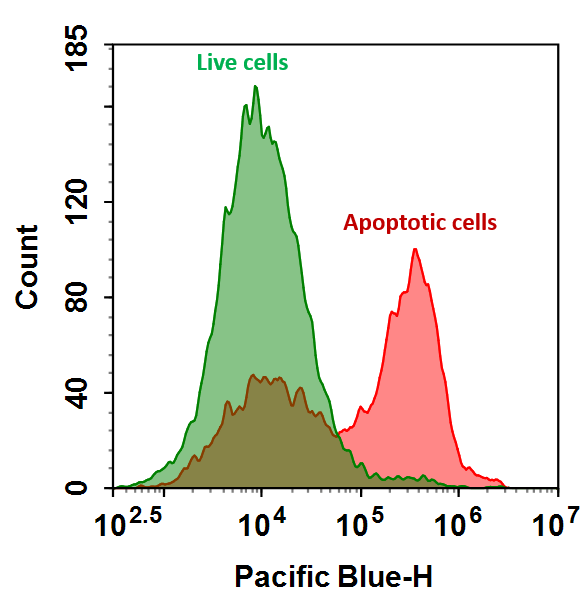
mFluor™ reactive dyes can be covalently conjugated to biomolecules without self-quenching, resulting in intensely bright fluorescent conjugates. mFluor™ reactive dye formats include amine-reactive succinimidyl esters (SE) and thiol-reactive maleimides for labeling antibodies and proteins. mFluor™ dyes are also available in acid forms for labeling proteins, peptides, amine-modified oligonucleotides, and other amine-containing biomolecules by carbodiimide conjugation chemistry (EDC).
- Simple, quick, and robust labeling of biomolecules with high conjugation yields
- Superior brightness, photostability, and solubility
- Strong fluorescence emission over a broad pH range with little pH sensitivity
- Low spillover into most detectors
- More choices and flexibility for multicolor panel design
Fig. 2
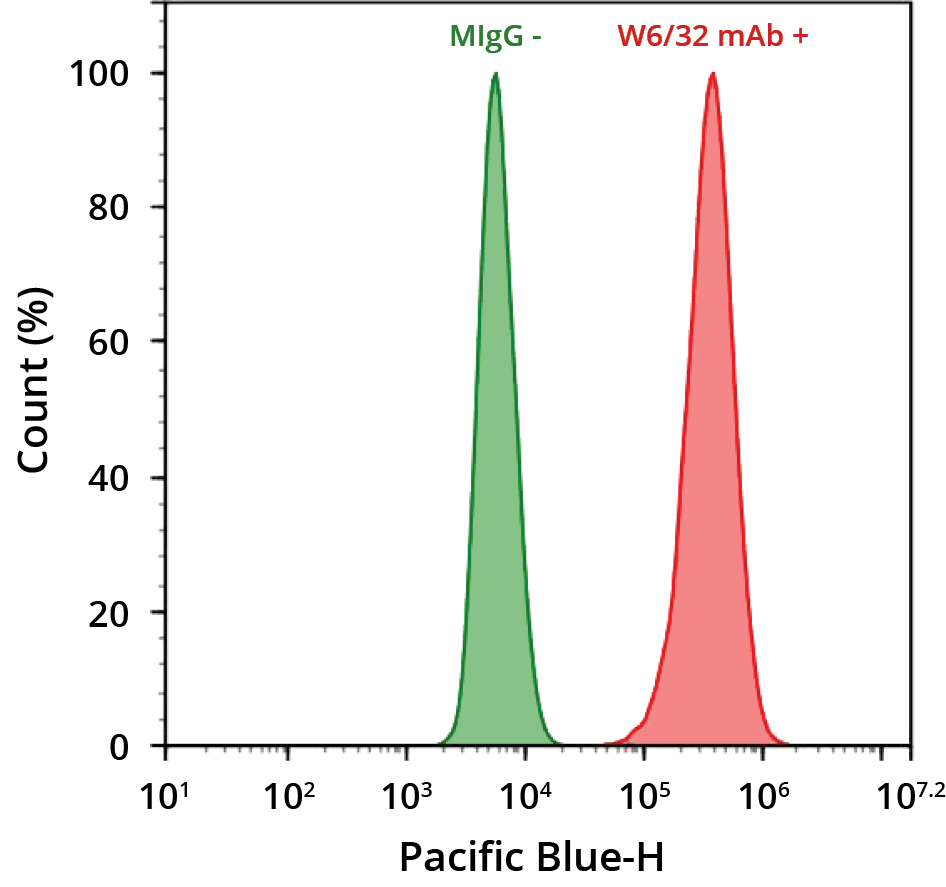
Flow cytometry analysis of HL-60 cells stained with 1 µg/mL mouse IgG control (Green) or with 1 µg/mL mouse anti-human HLA-ABC (W6/32 mAb) (Red) and then followed by goat anti-mouse IgG-mFluor™ Violet 450 conjugate. The fluorescence signal was monitored using an ACEA NovoCyte flow cytometer in the Pacific Blue detection channel.
The table below shows the range of available mFluor™ reactive dyes, their excitation and emission maxima, and their fluorophore equivalents to assist you in selecting the best fluorophore for labeling proteins, antibodies, and other biopolymers, as well as derivatizing low molecular weight molecules. For general antibody and protein labeling, use mFluor™ SE dyes which target primary amines (-NH2). For site-specific cysteine-directed conjugation, use mFluor™ maleimides.
ReadiLink™ Rapid mFluor™ Antibody Labeling Kits from AAT Bioquest provide a convenient method for labeling microscale volumes of antibodies with our superior mFluor™ dyes. The unique chemistry of ReadiLink™ kits enables researchers to effortlessly label and recover nearly 100% of their antibodies without a purification step. Since ReadiLink™ mFluor™ conjugates are covalently labeled, they are stable for long-term storage, and they are ideal for demanding applications including immunophenotyping, multiplex flow cytometry, FACS, and other flow-based applications. Also available are ReadiLink™ Rapid and xtra Rapid Antibody Labeling kits for conjugation of mFluor™ dyes, Alexa Fluor® dyes, other fluorescent dyes, biotin, BSA, and KLH.
- Label monoclonal antibodies, polyclonal antibodies, or other proteins
- Quick and simple two-step labeling protocol, no chemistry or conjugation experience necessary
- Useful for labeling up to 100 µg of antibody (two separate labeling reactions of 50 µg antibody)
- Near 100% antibody recovery, NO purification of the product is required
- Conjugates ready to use in 1 hr, with as little as ~10 minutes of hands-on time
- Avoid using any amine-containing buffers (e.g., Tris or glycine)
- Stabilizing proteins (e.g., BSA or gelatin) must be removed before labeling; for antibody labeling kits compatible with BSA, use ReadiLink™ xtra Rapid Antibody Labeling Kits
Fig. 3
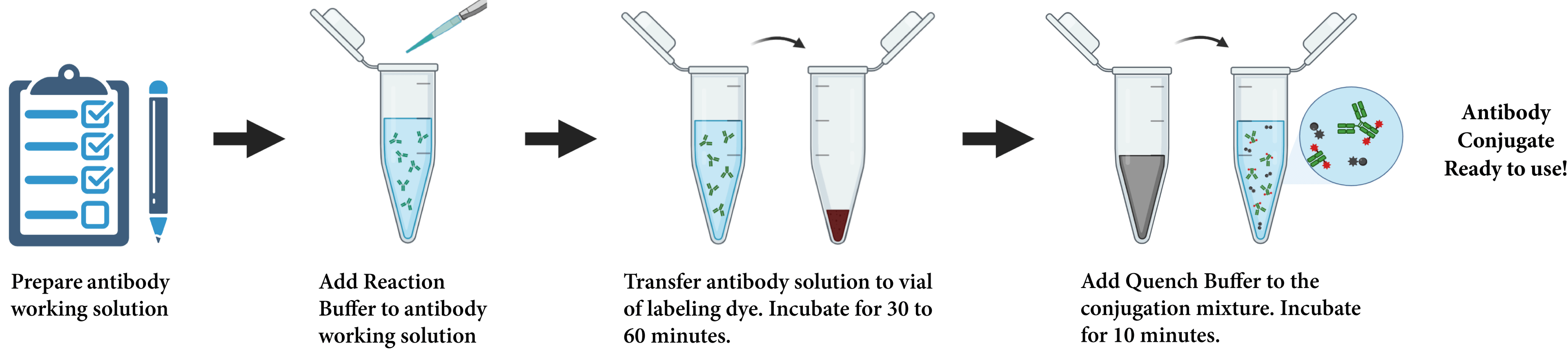
ReadiLink™ Rapid mFluor™ Antibody Labeling Kit workflow (figure drawn in BioRender).
Fluorescently labeled mFluor™ streptavidin conjugates have been widely used in fluorescence imaging to detect biotinylated antibodies, ligands, and DNA probes for in situ hybridization techniques, immunohistochemistry, multicolor flow cytometry, and other applications that require high sensitivity. mFluor™ streptavidin conjugates exhibit minimal self-quenching, producing exceptionally bright and photostable fluorescence signals outperforming Alexa Fluor® and other spectrally similar conjugates. In addition, the large Stokes shifts of mFluor™ dyes minimize cross-talk between the laser and emission filter and allow for cellular imaging with high signal-to-noise ratios. mFluor™ streptavidin conjugates are designed for optimal excitation by one of the major laser lines commonly equipped in flow cytometers, such as the 405 nm, 488 nm, 532 nm, 561 nm, or 633 nm laser lines.
Fig. 4
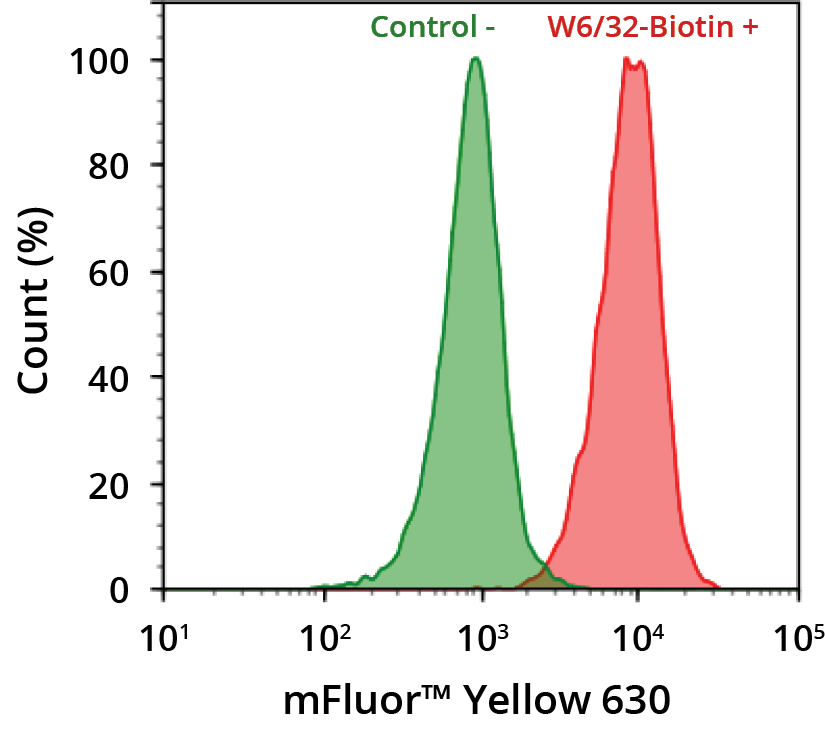
Flow cytometry analysis of HL-60 cells stained with (Red) or without (Green) 1 µg/ml Anti-Human HLA-ABC-Biotin and then followed by mFluor™ Yellow 630-streptavidin conjugate.
Need assistance selecting the best fluorophore for your experiment? Use our Fluorescence Spectrum Viewer to:
- View and compare fluorophores and fluorescent proteins for biological applications
- Check spectral compatibility
- Add multiple excitation and emission filters
- Save spectra configuration as a PNG or hyperlink
This document (01.0103.211211r2) was last updated on Sat Feb 28 2026. All trademarks and registered trademarks mentioned herein are the property of their respective owners.
Featured products
| Name | Excitation (nm) | Emission (nm) |
|---|---|---|
| mFluor™ UVB 370 SE | 322 | 368 |
| mFluor™ UVB 460 SE | 325 | 459 |
| mFluor™ Violet 450 SE | 406 | 445 |