
Products
Services
Resources
Selection Guides
About
Reactive Cyanines
Cyanine is the non-systematic name for a synthetic dye family belonging to the polymethine group. The word "cyanin" stems from the English word "cyan", which conventionally refers to a shade of blue-green. Cyanine dyes exhibit large molar absorptivities (~150,000 to 300,000 M-1cm-1) and moderate quantum yields, resulting in extremely bright fluorescence signals. Cyanines have proven useful in several fields including photography, biology, laser technology and analytical chemistry. AAT Bioquest offers a broad collection of cyanine dyes that are useful as molecular probes for a variety of biological applications. For certain biological applications, cyanines can advantageously replace other conventional dyes such as fluoresceins and rhodamines.
Among cyanine dyes, Cy3® which fluoresces greenish yellow (~550 nm excitation, ~570 nm emission) and Cy5® which fluoresces in the red region (~650 nm excitation, ~670 nm emission) are the most popular. Because of their minimal spectral overlap, Cy3® and Cy5® are typically combined for 2 color detection. Cy3® can be detected by various fluorometers, imagers, and microscopes using standard TRITC filter sets. Due to its high molar extinction coefficient, Cy3® dye can also be detected visually on electrophoresis gels, and in solution. Cy5® became a popular replacement for far red fluorescent dyes because of its high extinction coefficient and its fluorophore emission maximum in the red region, where many CCD detectors have maximum sensitivity and biological objects give low background interference.
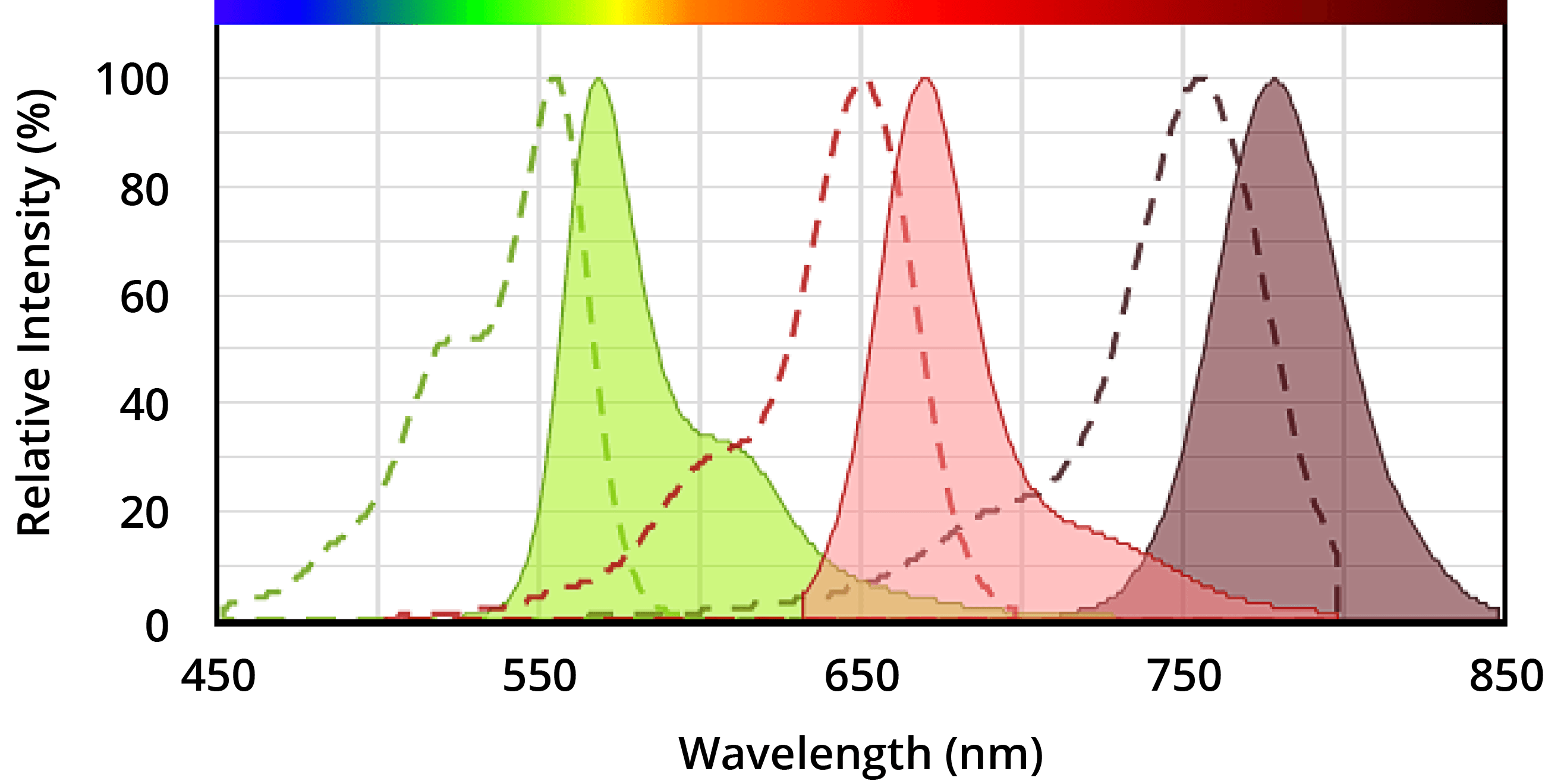
Sulfonated and non-sulfonated cyanine dyes exhibit very similar fluorescent characteristics and for many applications they can be used interchangeably. The difference between the dyes is mainly in their solubility. Non-sulfonated cyanines must be dissolved in an organic co-solvent, such as DMF or DMSO, prior to labeling of a biomolecule, while sulfonated cyanines can be used in aqueous conditions (the charged sulfonate groups decrease dye and conjugate aggregation). For purification by dialysis against water or an aqueous buffer, sulfonated cyanines must be used for efficient removal of any unreacted dye. Purification by gel filtration, chromatography, or electrophoresis is adequate for both sulfonated and non-sulfonated cyanines.
We offer a broad selection of cyanine products including reactive dyes and conjugation kits for labeling biomolecules, conjugates, indicators and more.
- Cyanine antibody and protein labeling kits
- Cyanine annexin V conjugates for apoptosis detection
- Cyanine tandem dyes
- Cyanine dyes for 2-D Fluorescence Difference Gel Electrophoresis (DIGE)
- Cyanine labeled tyramide
Select a dye-labeling chemistry for modifying the following reactive groups.
Amine | Thiol | Carbonyl | Click Chemistry |
|---|---|---|---|
Succinimidyl Ester |
This document (01.0010.211015r2) was last updated on Sat Feb 28 2026. All trademarks and registered trademarks mentioned herein are the property of their respective owners.
Featured products
| Name | Excitation (nm) | Emission (nm) |
|---|---|---|
| Cyanine 3 monosuccinimidyl ester [equivalent to Cy3® NHS ester] | 555 | 569 |
| Cyanine 5 monosuccinimidyl ester [equivalent to Cy5® NHS ester] | 651 | 670 |
| Cyanine 7 monosuccinimidyl ester [equivalent to Cy7® NHS ester] | 756 | 779 |