
Products
Services
Resources
Selection Guides
About
Sodium and Potassium Indicators
AAT Bioquest offers a focused selection of fluorescent indicators and assay kits for detecting and quantifying sodium and potassium ions in biological samples. These tools are essential for studying ion homeostasis, membrane transport, and channel function in cellular physiology research. Our SoNa™ indicator dyes provide excellent sodium selectivity over potassium, while our Screen Quest™ platform enables convenient potassium channel screening without wash steps.
Ion Target | Application | Recommended Products |
|---|---|---|
Na⁺ | Solution-based quantification | Amplite® Kit, Portelite™ Kit |
Na⁺ | Cell-based imaging | SoNa™ 520 |
K⁺ | Potassium channel screening | Screen Quest™ Kit |
SoNa™ 520 is AAT Bioquest's proprietary sodium-sensitive fluorescent indicator that exhibits strong fluorescence enhancement upon sodium binding. With excitation/emission at 491/511 nm, it is compatible with standard FITC filter sets. The indicator demonstrates excellent selectivity for sodium over potassium, making it ideal for accurate sodium measurements in biological samples where both ions are present. In live cell experiments under similar conditions, it has also demonstrated significantly brighter fluorescence responses compared to other sodium indicators such as SBFI.
- High sodium selectivity — Minimal response to potassium ions ensures accurate sodium-specific detection
- Bright green fluorescence — Ex/Em 491/511 nm compatible with standard FITC/GFP filter sets
- Cell-permeable AM ester available — SoNa™ 520 AM enables intracellular sodium monitoring in live cells
- Large dynamic range — Strong fluorescence intensity increase upon sodium binding
Fig. 1
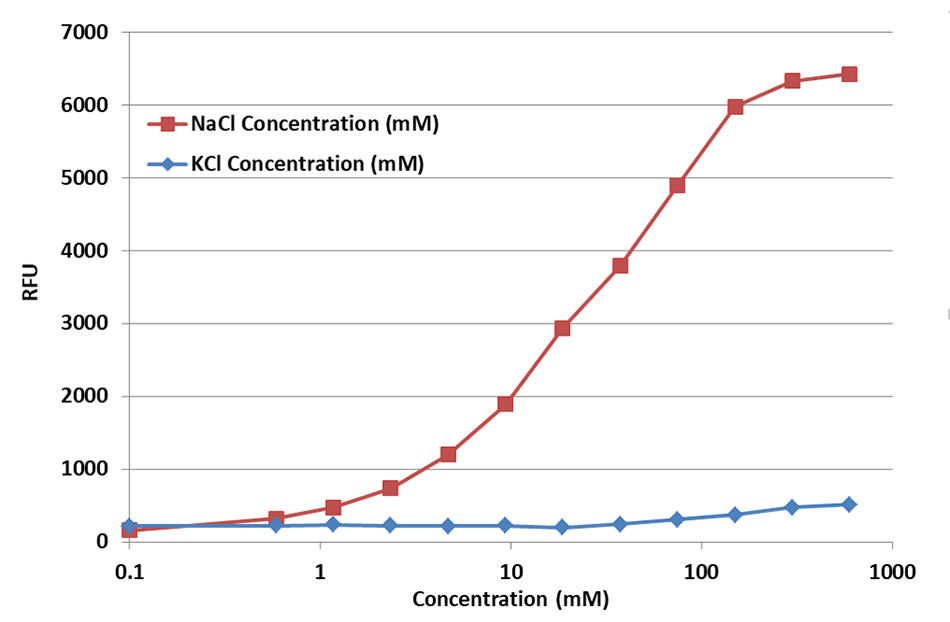
The fluorescence intensity of SoNa™-520 was measured at 525 nm (excitation at 490 nm) in the presence of Na+ (red) or K+ (blue) ranging from 0.59 to 600 mM in 100 mM Tris buffer (pH=7.5).
For convenient and accurate sodium quantification, AAT Bioquest offers complete assay kits with optimized reagents and standards. These fluorimetric kits utilize our SoNa™ 520 indicator technology and are suitable for microplate reader-based measurements in 96-well or 384-well formats.
- Amplite® platform — Robust, optimized formulations for reliable quantitative results
- Portelite™ format — Portable, ready-to-use kit design for streamlined workflows
- High sensitivity — Fluorimetric detection enables low sodium concentration measurements
- Excellent selectivity — Minimal interference from potassium and other common ions
- Microplate compatible — Suitable for 96-well and 384-well plate formats
Fig. 2
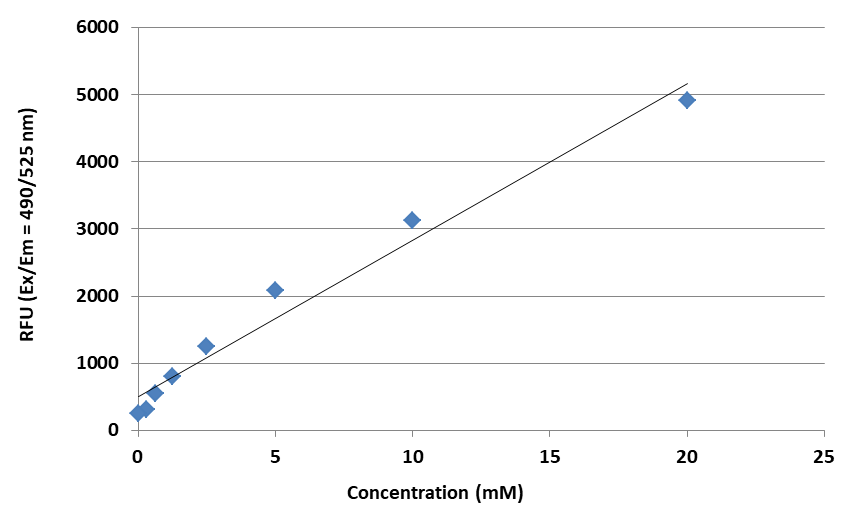
Sodium dose response was measured with Amplite® Fluorimetric Sodium Ion Kit in a 96-well solid black plate.
The Screen Quest™ No Wash Potassium Channel Assay Kit enables functional screening of potassium channels in cell-based assays. This homogeneous, no-wash format is ideal for high-throughput screening applications in drug discovery, particularly for hERG channel safety screening. The kit detects thallium (Tl⁺) influx through open potassium channels as a functional surrogate for potassium conductance and does not directly measure intracellular potassium concentration.
- No-wash protocol — Homogeneous assay format reduces handling steps and improves throughput
- HTS-compatible — Optimized for 96-well and 384-well microplate formats
- hERG screening ready — Validated for cardiac safety screening of potassium channel modulators
- Robust signal — Strong fluorescence response enables reliable detection of channel activity
- Flexible applications — Compatible with various potassium channel subtypes
Fig. 3
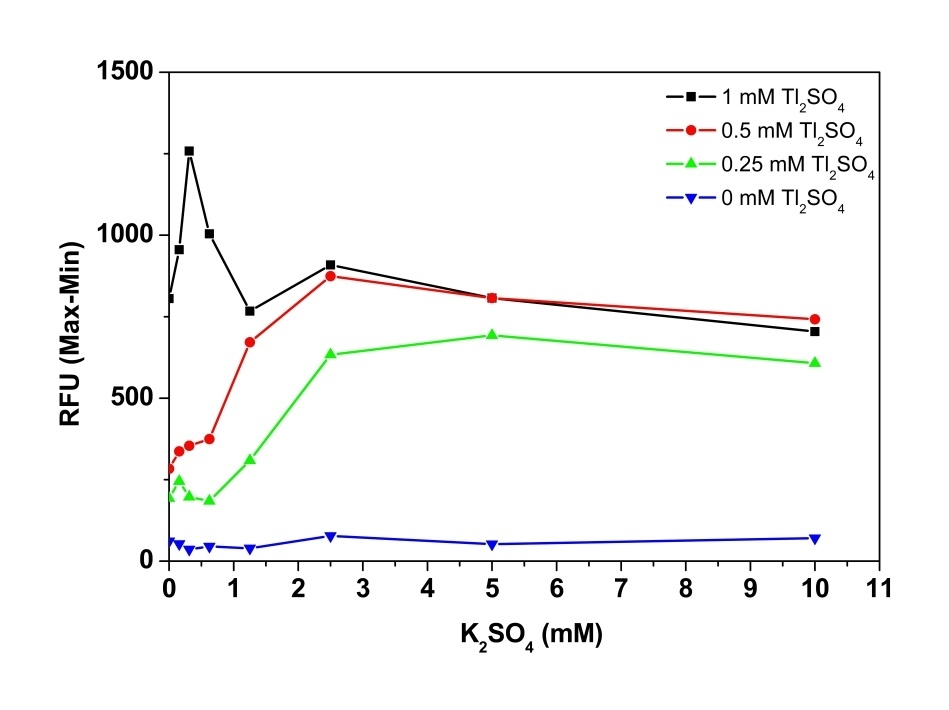
K2SO4 dose dependent hERG channel activity was measured in HEK293-KCNH2 cells with Screen Quest™ Potassium Ion Channel Kit. The cells were seeded overnight at 20,000 cells/100 µL/well in a Costar black wall/clear bottom 96-well poly-D-lysine plate. The cells were incubated with 100 µL of dye-loading solution for 1 hour at 37°C. Final concentration of 1 mM , 0.5 mM, 0.25 mM or 0 mM Tl2SO4 and different concentration of K2SO4 containing stimulus solution was injected in each well by FlexStation and the plate was read every 1-2 sec for 3 minutes at excitation/emission=490/525nm.
This document (01.0240.251203r1) was last updated on Sat Feb 28 2026. All trademarks and registered trademarks mentioned herein are the property of their respective owners.
Sodium and Potassium Indicators