
Products
Services
Resources
Selection Guides
About
Protonex™ Red 600 PEG12 maleimide
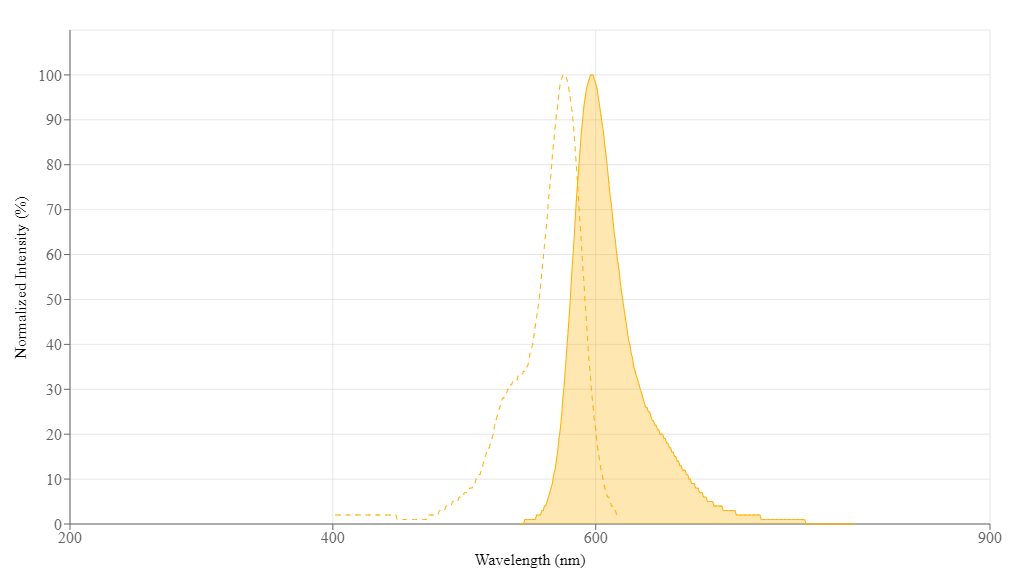
Protonex™ Red 600 PEG12 maleimide is a thiol-reactive, pH-sensitive dye that has been specifically engineered for use in developing fluorescent pH probes applicable to live cell assays focusing on processes such as antibody internalization, endocytosis, and phagocytosis. The incorporation of a polyethylene glycol (PEG12) spacer arm significantly increases the water-solubility of the dye, effectively reducing the propensity for bioconjugate aggregation without adversely affecting their biological activities. Protonex™ Red 600 PEG12 maleimide is characterized by its pH-dependent fluorescence properties, which increase significantly under acidic conditions, contrary to the common behavior of fluorescent dyes that exhibit greater brightness at elevated pH levels. The increase in fluorescence as the pH transitions from neutral to acidic reduces the need for extensive washing steps due to its lack of fluorescence in typical extracellular environments. Protonex™ Red 600 PEG12 maleimide is particularly effective in monitoring acidic cellular compartments such as endosomes and lysosomes. It excels in environments like phagosomes, lysosomes, and endosomes, where its fluorescence is enhanced significantly, offering precise detection of these acidic sites. This reduces signal variability and enhances the accuracy of imaging or flow cytometry applications. Spectrally comparable to Texas Red, Protonex™ Red 600 PEG12 maleimide is compatible with imaging systems that employ Texas Red filter sets, facilitating multiplexed assays with green fluorescent dyes such as GFP, Fluo-8®, calcein, or FITC-conjugated antibodies. The maleimide functionality allows for specific conjugation to thiol groups on proteins, oligonucleotide thiophosphates, or small molecular ligands, enhancing assay specificity and reproducibility. Such bioconjugates are crucial for targeted detection and analysis of cellular processes like phagocytosis and endocytosis, and support comprehensive multiplexed analyses of cellular functions, enabling detailed investigations into cellular dynamics.


| Catalog | Size | Price | Quantity |
|---|---|---|---|
| 21239 | 1 mg | Price |
Physical properties
| Molecular weight | 1577.83 |
| Solvent | DMSO |
Spectral properties
| Excitation (nm) | 576 |
| Emission (nm) | 597 |
Usage and storage
| Intended use | Research Use Only (RUO) |
| Storage | Freeze (< -15 °C); Minimize light exposure |
Contact us
| Telephone | |
| Fax | |
| sales@aatbio.com | |
| International | See distributors |
| Bulk request | Inquire |
| Custom size | Inquire |
| Technical support | Contact us |
| Request quotation | Request |
| Purchase order | Send to sales@aatbio.com |
| Shipping | Standard overnight for United States, inquire for international |
Page updated on October 26, 2026