
Products
Services
Resources
Selection Guides
About
Buffers
AAT Bioquest offers a comprehensive selection of application-specific buffers designed for optimal performance in biochemical assays, immunodetection, calcium signaling studies, and cell-based research. Our ReadiUse™, Signal Guard™, FastClick™, Screen Quest™, and CytoWatch™ buffer lines provide pre-optimized, ready-to-use formulations that ensure reproducibility and save valuable preparation time.
Stopping buffers terminate enzymatic reactions at precise endpoints, enabling accurate quantification and consistent results across experiments. Proper reaction termination is critical for kinetic assays, endpoint measurements, and high-throughput screening applications.
Horseradish peroxidase (HRP) reactions require rapid and complete termination to prevent signal overdevelopment and ensure accurate quantification. Signal Guard™ HRP stopping solutions are optimized for both chromogenic (TMB) and fluorogenic (Amplex Red, Amplite™) substrate systems, providing stable endpoint signals while maintaining compatibility with standard plate reader detection.
- Rapid HRP deactivation — Disrupts the HRP redox cycle for immediate reaction termination
- Signal stabilization — Fluorescence and colorimetric signals remain stable after addition
- Dual compatibility — Works with both chromogenic (TMB, ABTS) and fluorogenic substrates
- Outperforms competitors — Superior to Amplex Red/UltraRed Stop Reagent
Fig. 1
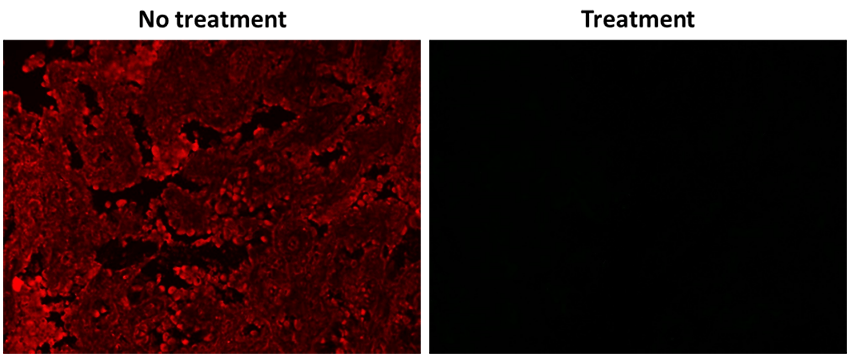
Formalin-fixed, paraffin-embedded (FFPE) human lung tissue sections were immunolabeled with CD4-XFD488 mAb, followed by incubation with HRP-conjugated goat anti-XFD488 IgG. To inhibit HRP enzymatic activity, sections were treated with Signal Guard™ 10X Rapid HRP Reaction Stopping Solution. Fluorescence was then developed using iFluor® 647 styramide (Cat. 45045) and visualized using a Cy5 filter set. Tissue sections pre-treated with Signal Guard™ prior to styramide application exhibited no detectable signal (Right), in contrast to untreated sections (Left), demonstrating effective inhibition of HRP activity by the stopping solution.
Kinase reactions require precise termination to ensure accurate activity measurements. The ReadiUse™ Universal Kinase Reaction Stopping Buffer chelates essential divalent metal ions (Mg²⁺ and Mn²⁺) that serve as kinase cofactors, effectively halting all kinase activity for consistent endpoint measurements.
- Universal compatibility — Works with any kinase regardless of substrate specificity
- EDTA-based chelation — Effectively sequesters Mg²⁺ and Mn²⁺ cofactors
- Pre-optimized pH — Adjusted to pH 8.0 with sodium hydroxide
- Sterile-filtered — Ready for immediate use without further preparation
Reaction buffers provide optimized conditions for specific chemical and enzymatic reactions, ensuring efficient conversion and minimal side reactions. Our FastClick™ and PCR buffer formulations are pre-tested for consistent performance across diverse applications.
FastClick™ buffers are specifically formulated for copper-catalyzed azide-alkyne cycloaddition (CuAAC) click chemistry. These buffers contain copper-stabilizing ligands that protect biomolecules from copper-mediated oxidative damage while maintaining rapid reaction kinetics, making them ideal for bioconjugation, metabolic labeling, and surface functionalization.
- Copper stabilization — Protects proteins and nucleic acids from copper-mediated damage
- Fast reaction kinetics — Efficient click conjugation with minimal incubation time
- Biocompatible — Performs at room temperature and optimized to minimize copper-mediated oxidative damage
- Versatile solvent compatibility — Works in organic, aqueous, and mixed-phase reaction systems
For FastClick™ fluorescent probes (azides and alkynes), see our Click Chemistry Building Blocks catalog.
ReadiUse™ PCR Reaction Buffer provides all essential components for DNA amplification including optimized pH buffering, salt concentrations for DNA integrity, and MgCl₂ cofactor for polymerase activity.
- Complete formulation — Contains pH buffer, salts, and MgCl₂ for immediate use
- Stable pH — Maintains optimal reaction conditions throughout thermal cycling
- qPCR compatible — Works with Helixyte™ Green and Low ROX reference dyes
Fig. 2
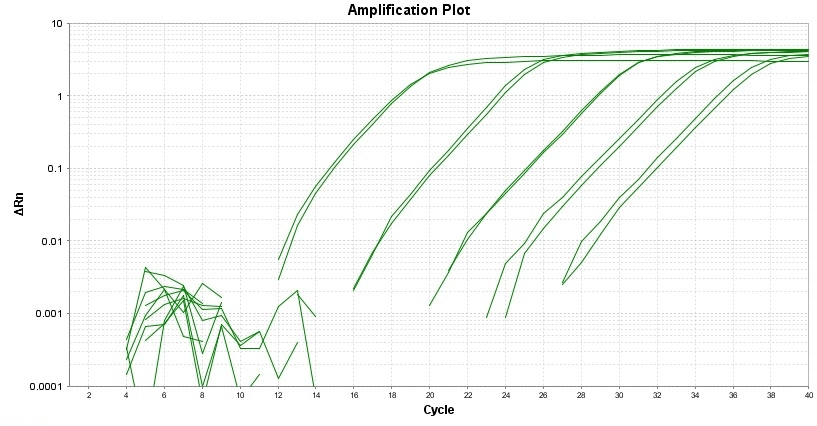
Amplification plot for a dilution series of HeLa cells cDNA amplified in replicate reactions to detect GAPDH using ReadiUse™ PCR Reaction Buffer with Helixyte™ Green and Low ROX.
Successful bioconjugation requires precise control over reaction conditions and timing. The ReadiLink™ Protein Conjugation Stop Buffer terminates NHS ester, sulfonyl chloride, and isothiocyanate labeling reactions at user-determined endpoints. TCEP (Tris(2-carboxyethyl)phosphine) is a powerful reducing agent for cleaving disulfide bonds prior to maleimide-thiol conjugation, and unlike DTT, does not interfere with downstream maleimide chemistry.
- Conjugation stop buffer — Terminates NHS ester, sulfonyl chloride, and isothiocyanate reactions
- TCEP reducing agent — Thiol-free, odorless alternative to DTT for disulfide reduction
- Maleimide compatible — TCEP does not require removal prior to maleimide conjugation
- TCEP removal — Pre-formulated solution for eliminating residual TCEP when needed
For ReadiLink™ protein labeling kits, see our ReadiLink™ Protein Labeling Kits catalog.
Physiological assay buffers are designed to maintain ionic strength, osmolarity, and pH conditions that closely mimic extracellular environments while supporting optimal probe and enzyme performance. Our HHBS and Screen Quest™ buffer formulations provide stable baseline signals and reproducible assay conditions for calcium flux measurements, and other live-cell functional assays.
HHBS is a physiological buffer containing Hanks' balanced salts with 20 mM HEPES for pH stability without CO₂ supplementation. Formulations containing calcium and magnesium are ideal for calcium assay buffer preparation, cell transport, and membrane potential measurements.
- HEPES buffered — Maintains stable pH without CO₂ incubation
- Physiological osmolarity — Compatible with live cell applications
- Contains Ca²⁺/Mg²⁺ — Ready for calcium and membrane potential assays
- Multi-purpose — Cell washing, transport, and reagent dilution
Screen Quest™ calcium assay buffers are specifically optimized for high-throughput screening (HTS) applications. The Phenol Red Plus™ formulation significantly increases assay windows by reducing background fluorescence, improving signal-to-noise ratios in plate reader-based calcium flux measurements.
- Phenol Red Plus™ technology — Reduces background and enhances detection sensitivity
- Increased assay window — Significantly improves signal-to-background ratios
- HTS optimized — Consistent performance in 96-well and 384-well formats
- 10X concentrate — Convenient dilution for large-scale screening campaigns
Fig. 3
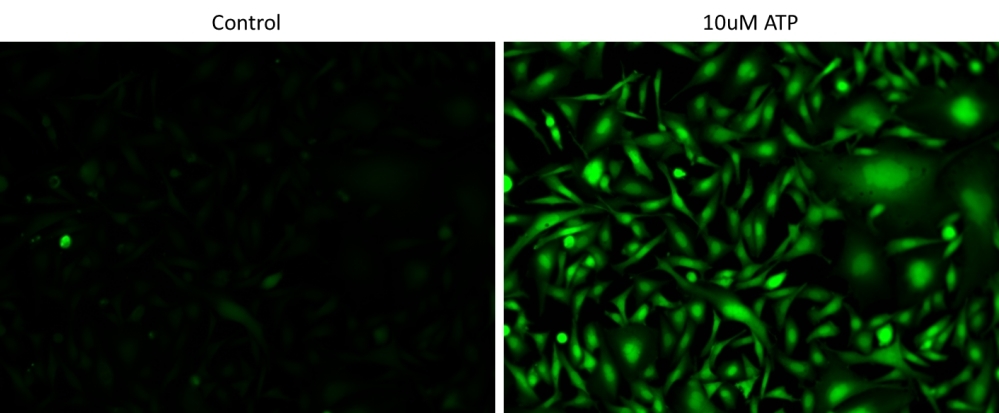
ATP dose response was measured in CHO-M1 cells with Cal-520 ™AM. CHO-M1 cells were seeded overnight at 50,000 cells/100 µL/well in a 96-well black wall/clear bottom costar plate. 100 µL of 10ug/ml Cal-520 ™AM in HH Buffer with 1X Phenol Red Plus™ cell staining buffer was added and incubated for 60 min at 37oC. ATP (50µL/well) was added to achieve the final indicated concentrations.
For complete Screen Quest™ calcium assay kits (Fluo-8®, Calbryte™, Rhod-4), see our Calcium Assays catalog.
Immunoassay buffers are optimized for specific steps in immunohistochemistry (IHC), Western blotting, and signal amplification workflows. These specialized formulations address common challenges including antigen masking, non-specific binding, and signal enhancement.
Heat-induced epitope retrieval (HIER) is essential for restoring antigenicity in formalin-fixed, paraffin-embedded (FFPE) tissue sections. The 10X Citrate Buffer reduces aldehyde crosslinks formed during fixation, exposing masked epitopes for improved antibody binding and detection sensitivity.
- pH 6.0 optimized — Buffering range (pH 3.0-6.2) suitable for most epitope retrieval protocols
- Reduces crosslinks — Reverses formaldehyde-induced protein modifications
- HIER compatible — Withstands pressure cooker and microwave retrieval methods
- FISH compatible — Also effective for fluorescence in situ hybridization sample preparation
Western blot stripping buffers enable membrane reprobing by gently removing bound primary and secondary antibodies without compromising transferred proteins. This allows detection of multiple targets on the same blot, conserving precious samples and ensuring accurate molecular weight comparisons.
- Gentle stripping — Removes antibodies without protein loss
- Membrane compatible — Works with PVDF and nitrocellulose
- Ready-to-use — No dilution or preparation required
- Efficient reprobing — Enables detection of multiple targets per blot
Tyramide Signal Amplification (TSA) and Power Styramide™ Signal Amplification (PSA) are HRP-mediated signal enhancement methods that dramatically increase detection sensitivity in IHC, IF, and ISH applications. The ReadiUse™ TSA/PSA Reaction Buffer is optimized with precise hydrogen peroxide concentrations for consistent radical generation and tyramide/Styramide™ deposition.
- Optimized H₂O₂ concentration — Pre-calibrated for consistent HRP radical generation
- TSA and PSA compatible — Works with both tyramide and Styramide™ conjugates
- Signal enhancement — 10-100x sensitivity improvement over standard detection
- Multiplexing ready — Sequential TSA enables multicolor labeling on single samples
For TSA/PSA fluorescent tyramide and Styramide™ conjugates, see our TSA and Styramide™ Imaging catalog.
AAT Bioquest offers specialized buffers for diverse research applications including apoptosis detection, fluorescence imaging, flow cytometry, and cell lysis.
Fig. 4
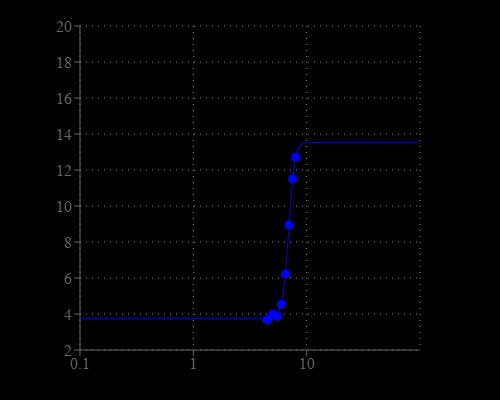
Standard curve created using BCFL, AM with Spexyte™ Intracellular pH Calibration Buffer Kit. Hela cells were incubated with 5µM BCFL, AM for 30 minutes at room temperature. The Intracellular pH Calibration Buffer Kit ( Cat#21235) was used to clamp the intracellular pH with extracellular buffers at pH 4.5 to 8.0. Intracellular pH vs. relative fluorescence ratio of Ex/Em= 440/ 530 nm and 500 nm/530 nm were plotted and a 4-parameter trendline was fitted to get the pH standard curve.
For a complete selection of cell lysis buffers including bacterial, mammalian, yeast, and viral lysis solutions, see our Cell Culture and Lysis catalog.
This document (01.0338.251203r1) was last updated on Sat Feb 28 2026. All trademarks and registered trademarks mentioned herein are the property of their respective owners.
Buffers