
Products
Services
Resources
Selection Guides
About
Reactive Coumarins
Coumarin and coumarin derivatives are UV-excitable blue fluorescent dyes with short emission wavelengths ranging from ~390 to ~480 nm. The most widely used coumarins include AMCA, the derivatives of 7-aminocoumarin (AFC and AMC), 7-hydoxycoumarin and 7-methoxycoumarin for preparing blue fluorescent dye labeled peptides, proteins and other biomolecules. Compared to fluoresceins, rhodamines, and cyanines, coumarins produce moderately bright and photostable fluorescence due to their relatively low extinction coefficients.
Blue-fluorescent probes are best used for direct imaging of high-abundance targets such as cytoskeleton markers, in cell tracking applications, as substrates for detecting enzyme activity and for certain multicolor fluorescence applications - including immunofluorescence, nucleic acid and protein microarrays, in situ hybridization and neuronal tracing.
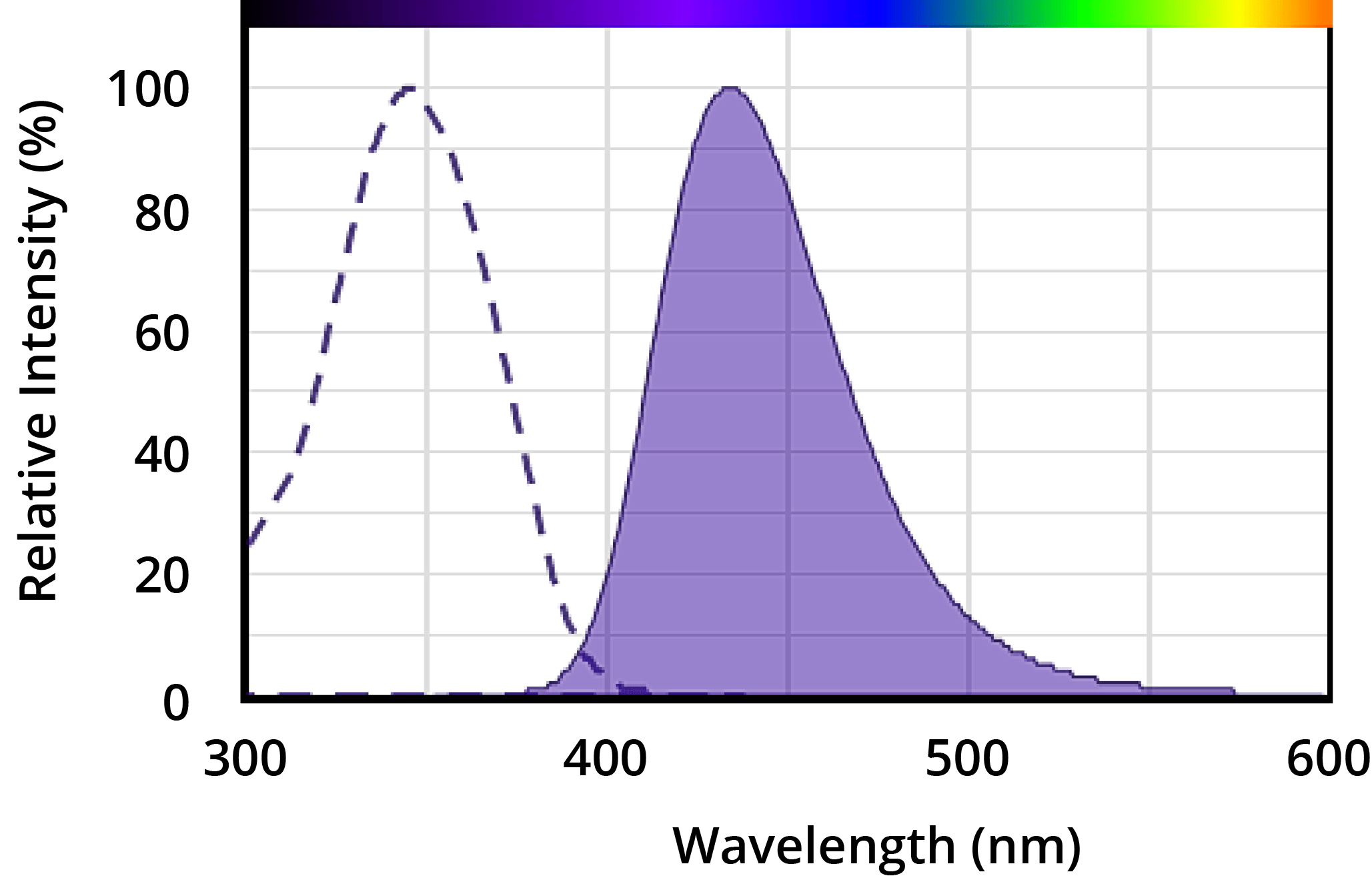
Reactive fluorescent coumarin and coumarin derivatives are widely used to covalently label biomolecules such as antibodies, carbohydrates, nucleic acids, proteins, peptides and oligonucleotides, resulting in moderately bright blue fluorescence. Coumarin conjugates are often used as substrates for detecting enzymatic activity or to provide contrast in multicolored fluorescence investigation when combined with green, yellow or red fluorescent probes. Coumarin and coumarin derivatives are readily available in a variety of dye-labeling chemistries.
The iFluor® 350 dye is a bright blue fluorescent dye spectrally similar to AMCA with improved water solubility, photostability and higher fluorescence quantum yields. iFluor® 350 conjugates are well suited for direct imaging of high-abundance targets, and is particularly useful in multicolor applications, such as flow cytometry and super-resolution fluorescence microscopy, without compromising the performance of green and red fluorescent probes.
Fig. 2
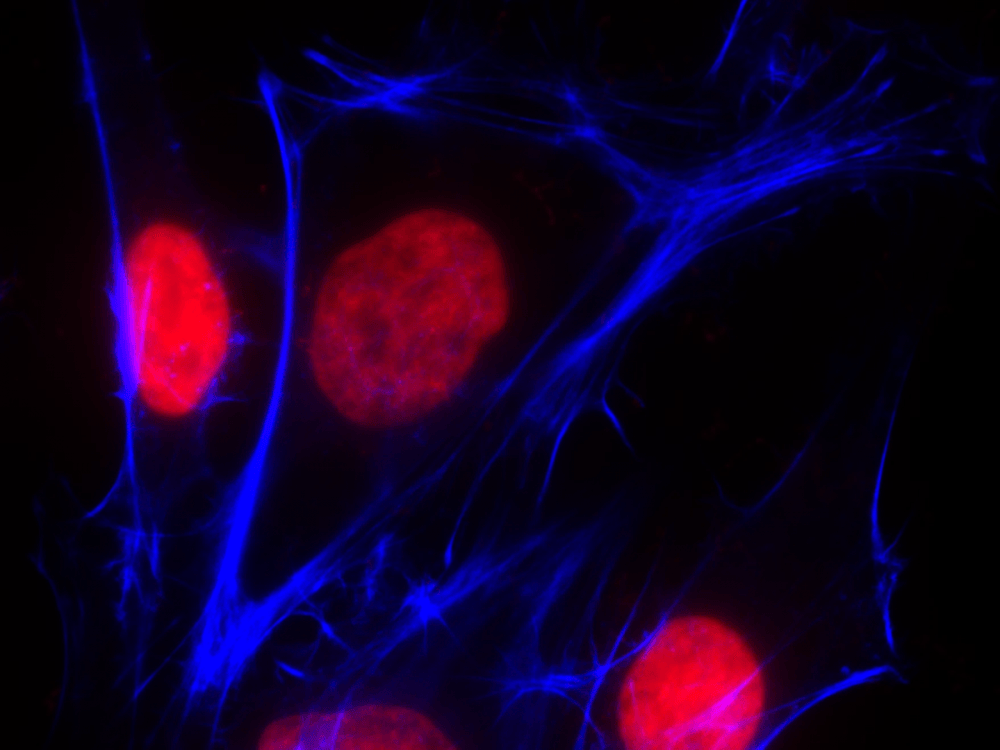
HeLa cells stained with phalloidin–iFluor® 350 conjugate. HeLa cells were fixed in 4% formaldehyde and then stained with Phalloidin iFluor® 350 conjugate and Nuclear Orange™ DCS1.
This document (01.0071.211015r2) was last updated on Sat Feb 28 2026. All trademarks and registered trademarks mentioned herein are the property of their respective owners.