
Products
Services
Resources
Selection Guides
About
Cell Signaling Probes
Cell signaling probes are essential molecular tools for investigating intracellular signaling pathways, including second messengers, gasotransmitters, and receptor ligands that regulate cellular responses to external and internal stimuli. These probes enable researchers to detect, quantify, and visualize second messengers, signaling intermediates, and gaseous transmitters that regulate processes ranging from gene expression to metabolism.
AAT Bioquest offers a comprehensive selection of cell signaling probes including cyclic nucleotide analogs (cGAMP, cAMP), nitric oxide sensors, hydrogen sulfide detectors, and specialized building blocks for developing custom signaling assays. These reagents support diverse detection platforms including fluorescence microscopy, flow cytometry, microplate-based assays, and high-content imaging.
Research Focus | Recommended Products | Detection Method |
|---|---|---|
STING/Innate Immunity | cGAMP derivates | Functional assays, imaging |
GPCR-Gαs/cAMP Pathway | cAMP derivates | Intracellular delivery, competitive assays |
GPCR-Gαq/PLC/IP3 Pathway | IP1 derivatives | Competitive binding assays |
GPCR Desensitization | Cell Meter™ Beta-Arrestin Kit | High-content imaging |
Nitric Oxide Signaling | DAX-J2™ | Microscopy, flow cytometry |
Hydrogen Sulfide Signaling | Sulfide Green™ AM, WSP-1 | Live cell imaging |
Bacterial Biofilm Signaling | MycoLight™ c-di-GMP Red Sensor | Bacterial imaging |
2',3'-cGAMP (cyclic guanosine monophosphate-adenosine monophosphate) is a critical second messenger produced by cGAS (cGAMP synthase) in response to cytosolic DNA detection. This signaling molecule activates the STING pathway, triggering innate immune responses essential for host defense against pathogens and tumor surveillance. AAT Bioquest provides cGAMP in multiple formats including the parent compound, sodium salt, fluorescent conjugates, and reactive derivatives for creating custom probes.
Reactive cGAMP derivatives enable researchers to create custom conjugates for specific research applications. These building blocks contain functional groups that facilitate covalent attachment to proteins, peptides, nucleic acids, and other biological targets.
Cyclic adenosine monophosphate (cAMP) is a ubiquitous second messenger synthesized from ATP by adenylyl cyclase in response to various extracellular signals. cAMP regulates numerous cellular processes including metabolism, gene transcription, and ion channel activity through activation of protein kinase A (PKA) and other effector proteins.
G protein-coupled receptors (GPCRs) represent the largest family of membrane receptors and are major drug targets. AAT Bioquest provides tools for studying GPCR signaling pathways including beta-arrestin translocation assays and receptor-specific probes.
Fig. 1
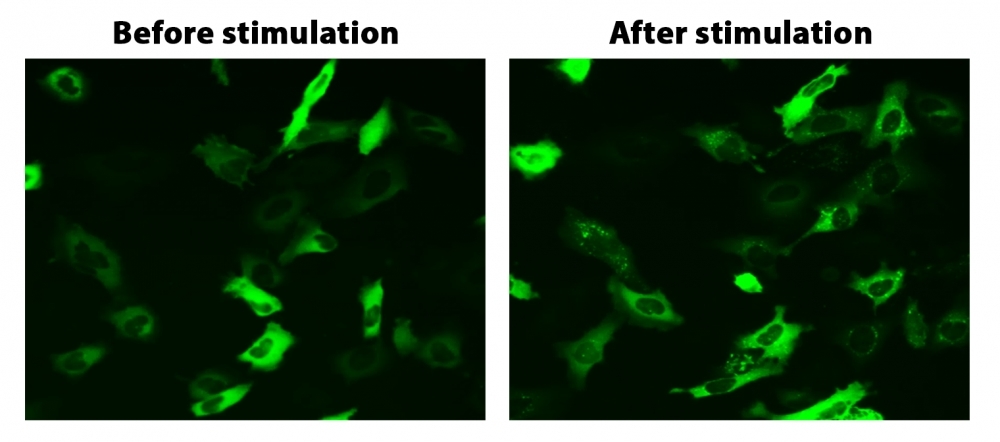
Translocation of beta-arrestin in HeLa cells. HeLa cells were transiently transfected with beta-arrestin-GFP and vasopressin receptor 2 (V2R). HeLa cells were cultured in a 6-well plate and grown to ~60% confluence. Equal amounts of beta-arrestin-GFP (1.5 µg) and V2R plasmids (1.5 µg) were transfected with 9 µL of Transfectamine™ 5000. Cells were transferred to a 96-well plate ~ 30 hours after transfection. Vasopressin (1 µM) was added to the cells ~ 48 hours after transfection to induce beta-arrestin-GFP translocation. Images were taken before and 2 hours after the vasopressin treatment under a fluorescent microscope using the FITC channel.
Medetomidine is a potent α2-adrenergic receptor agonist widely used in veterinary and clinical medicine. These modified derivatives enable bioconjugation and detection while retaining receptor binding properties.
Inositol monophosphate (IP1) is a stable downstream metabolite of the phospholipase C (PLC) signaling pathway, accumulating when Gq-coupled GPCRs are activated. IP1 serves as a reliable readout for Gq/PLC pathway activation because inhibition of inositol monophosphatase causes IP1 accumulation, providing a stable surrogate for the transient IP₃ signal.
Nitric oxide is a gaseous signaling molecule involved in vasodilation, neurotransmission, and immune responses. The DAX-J2™ series of nitric oxide sensors provides fluorogenic detection across multiple emission wavelengths, enabling flexible experimental design and multiparameter analysis.
Fig. 2
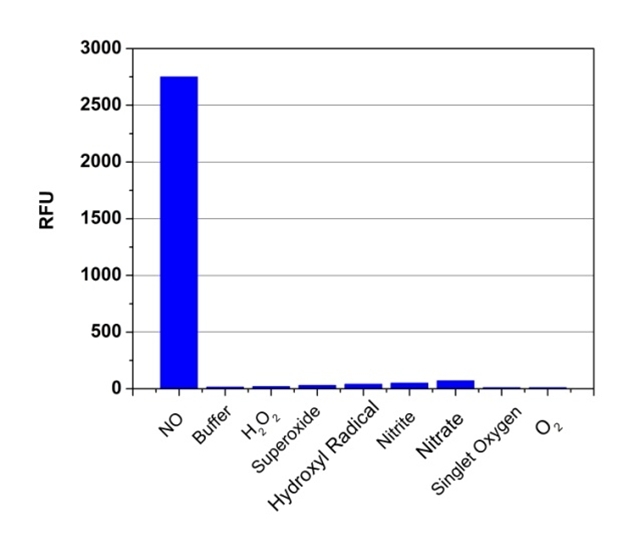
Fluorescence response of DAX-J2™ Orange (5 uM) to different reactive oxygen species (1 mM) in PBS buffer (pH 7.2). The fluorescence intensities were measured with Ex/Em = 540/570 nm.
Hydrogen sulfide is an endogenous gaseous signaling molecule with important roles in cardiovascular, neurological, and immunological systems. AAT Bioquest offers multiple probes for detecting and quantifying H₂S in biological samples.
Fig. 3
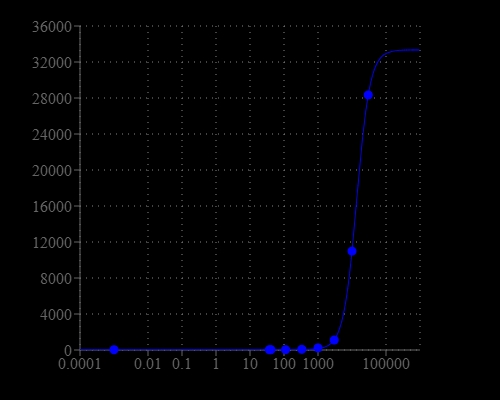
Na2S dose response was measured with Sulfide Green™ AM. Na2S standards serially diluted in 20mM HEPES buffer were added to each well to reach the final concentration of 10 µM. The assay was incubated at room temperature for 60 min, and then measure Ex/Em= 490/530nm, cutoff=515nm.
Calcium is a ubiquitous messenger impacting a number of signal transduction pathways including calcium-induced changes in protein conformation, the regulation of cytosolic and organelle calcium levels, the highly localized nature of calcium-mediated signal transduction and its specific roles in excitability, exocytosis, motility, apoptosis, and transcription. AAT Bioquest offers a diverse portfolio of specialized probes for investigating calcium, including fluorescent dyes for studying calcium flux as well as calcium mobilization agents (NAADP derivatives).
For more information on our calcium indicators, please see here.
Cyclic di-GMP (c-di-GMP) is a bacterial second messenger that regulates biofilm formation, virulence, and motility. Detecting c-di-GMP levels provides insight into bacterial signaling and behavior.
Fig. 4
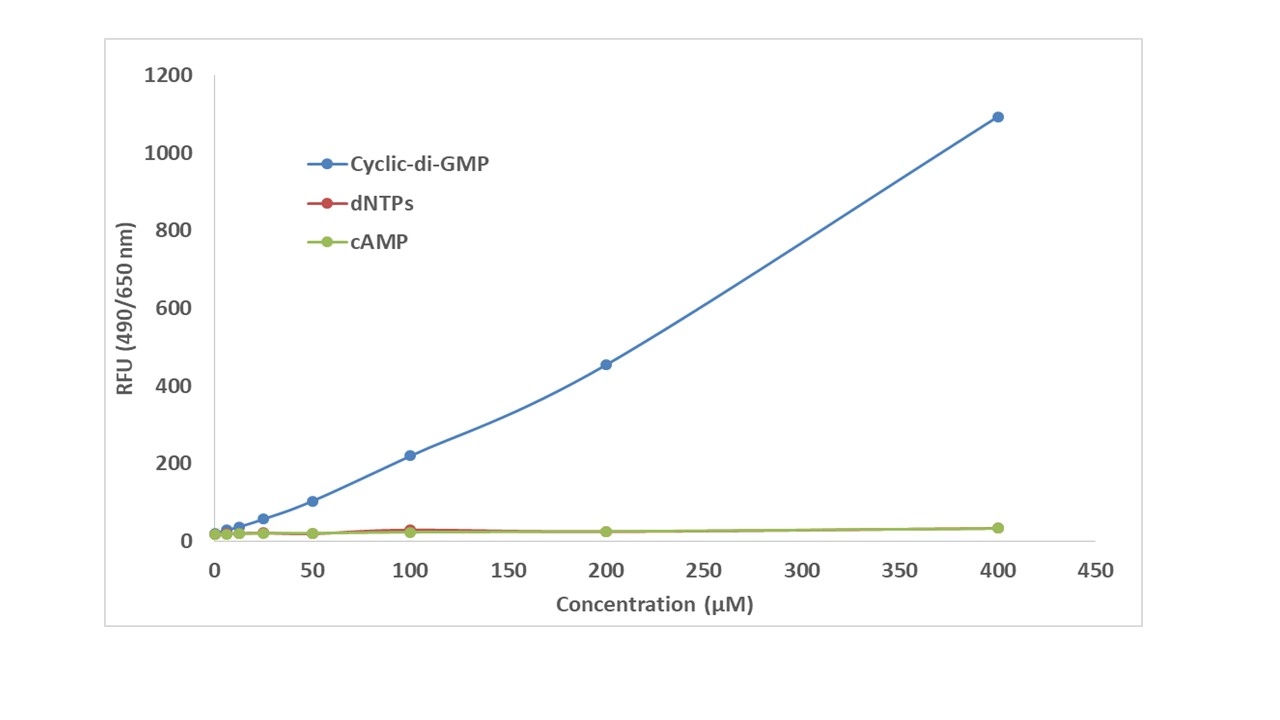
The fluorescence intensity of MycoLight™ Cyclic-di-GMP Red Sensor was measured at 650 nm (excitation at 490 nm) in the presence of Cyclic-di-GMP (Blue), dNTPs (Red) or cyclic-AMP (Green) ranging from 400 to 6.125 µM in 10 mM Tris-HCl, pH 7.5 containing 60 mM KCl buffer. MycoLight™ Cyclic-di-GMP Red Sensor is specific to Cyclic-di-GMP and has no response for dNTPs and cyclic-AMP.
This document (01.0232.251203r1) was last updated on Sat Feb 28 2026. All trademarks and registered trademarks mentioned herein are the property of their respective owners.
Cell Signaling Probes