
Products
Services
Resources
Selection Guides
About
ELISA Assays (Microplate Reader)
AAT Bioquest offers a selection of products for ELISA assay development on microplate readers. This collection includes assay development kits, drug-protein conjugates and ready-to-use substrate solutions for HRP-based ELISA workflows. With both colorimetric and fluorimetric detection options, these products provide flexibility for diverse research applications in immunology, cell signaling, and drug discovery.
Our Amplite® Fluorimetric ELISA Assay Kits contains all the essential components for developing a custom ELISA assay, including an HRP-conjugated secondary antibody, assay buffer, and HRP substrate. These kits are compatible with either mouse or rabbit primary IgGs. The kits also provide optimized assay protocols that are compatible with HTS liquid handling and enable as little as 10 pg of a monoclonal antibody/well to be detected. Signals from these assays can be easily read by either fluorescence microplate readers or absorbance microplate readers.
- High sensitivity – Proprietary red fluorescent substrate provides superior detection limits
- Stable signal – Long-lasting fluorescence enables flexible read times
- Complete kit format – Includes all necessary reagents for building custom assays
- Broad dynamic range – Accurate quantification across wide IgG concentration ranges
- Microplate compatible – Optimized for 96-well plate format
Fig. 1
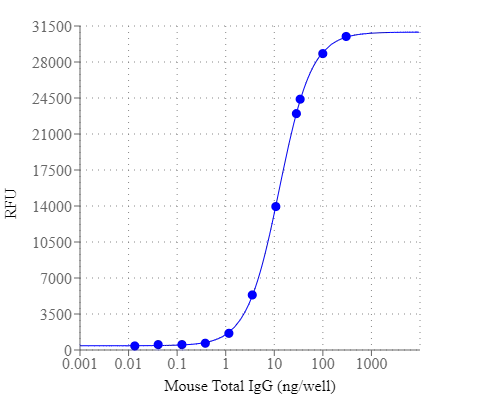
Detection of mouse total IgG using the Amplite® Fluorimetric Goat Anti-Mouse IgG-HRP ELISA Kit. Mouse IgG was diluted into 3 µg/mL and made 1 to 3 serial dilutions in 0.2 M sodium bicarbonate buffer, pH 9.4. 100 µL/well serial dilutions were coated into a solid black 96-well plate at 4 °C overnight, and blocked with 3% milk in PBS and 0.02% Tween-20 at 4 °C overnight. The wells were washed and assayed by using the reagents. 1 to 5000 dilutions of goat anti-mouse IgG-HRP conjugate were used. The reactions were incubated for 10 to 60 minutes and then measured for fluorescence at Ex/Em = 540/590 nm using Gemini fluorescence microplate reader (Molecular Devices).
AAT Bioquest offers drug–protein conjugates that support the development of competitive immunoassays for small molecule detection. The three conjugate types serve complementary roles in immunoassay workflows:
Conjugate Type | Primary Function | Key Applications |
|---|---|---|
Drug-KLH | Immunogen for antibody production | Immunize animals to generate anti-drug antibodies |
Drug-BSA | Coating antigen for ELISA plates | Plate coating, antibody screening, secondary immunization |
Drug-HRP | Tracer for competitive detection | Competitive ELISA signal generation, quantitative detection |
Drug-HRP conjugates are enzyme-labeled drug tracers for developing sensitive competitive ELISA assays. These conjugates enable quantitative detection of antibiotics, opioids, sedatives, and other pharmaceutical compounds in food safety, veterinary, and forensic applications.
- Nitrofuran metabolite conjugates (AOZ, AHD, AMOZ, SEM) for banned antibiotic detection
- Fentanyl and norfentanyl conjugates for opioid screening in toxicology
- Xylazine conjugates for detecting this emerging drug supply adulterant
- Antibiotic conjugates for fluoroquinolone, sulfonamide, and amphenicol residue testing
- Optimized drug-to-HRP ratios for maximum competitive assay sensitivity
For more information, please see here.
Drug-BSA conjugates serve as coating antigens for competitive ELISA plate preparation and can be used for immunization to generate anti-drug antibodies. BSA provides a well-characterized carrier with high solubility and multiple conjugation sites.
- Opioid conjugates including fentanyl, norfentanyl, and isotonitazene-BSA
- Veterinary antibiotic conjugates for food safety testing programs
- Reactive drug derivatives (NHS esters, maleimides) for custom conjugation
- cBSA and hBSA carriers with enhanced immunogenicity for antibody production
- ReadiLink™ BSA Conjugation Kit for preparing custom drug-carrier conjugates
For more information, please see here.
Drug-KLH conjugates are immunogens optimized for generating strong antibody responses against small molecule drugs. Keyhole Limpet Hemocyanin (KLH) is highly immunogenic due to its large size and foreign nature to mammalian immune systems.
- Antibiotic-KLH conjugates covering amphenicols, fluoroquinolones, and sulfonamides
- Nitrofuran metabolite immunogens for developing food safety screening assays
- Opioid-KLH conjugates for producing antibodies against fentanyl and analogs
- Sedative and anesthetic conjugates including xylazine, medetomidine, and diazepam
- Maleimide-activated mKLH and ReadiLink™ KLH Kit for custom conjugate preparation
For more information, please see here.
ReadiUse™ HRP Substrate Solutions are ready-to-use reagents optimized for ELISA assays employing horseradish peroxidase (HRP) conjugates. ABTS produces a blue-green colored product suitable for kinetic or endpoint measurements, while TMB generates a blue product that turns yellow upon acid addition for enhanced sensitivity. Both substrates are pre-mixed with hydrogen peroxide for immediate use, eliminating preparation steps and ensuring consistent performance.
- Ready-to-use format – No mixing or preparation required; simply add to wells
- Optimized formulation – Pre-balanced substrate and H₂O₂ concentrations for maximum signal
- Consistent lot-to-lot performance – Quality controlled for reproducible results
- Long shelf life – Stable formulations maintain activity over extended storage
- Cost-effective – Economical solutions for high-throughput ELISA workflows
Fig. 2
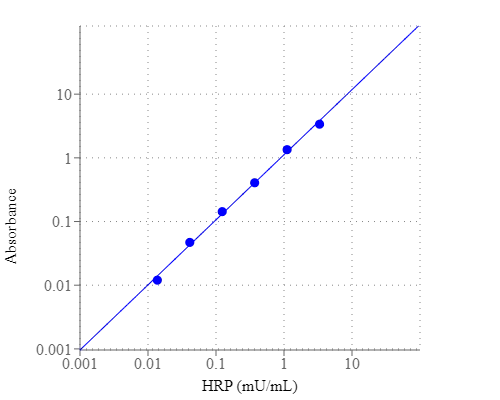
HRP dose response was measured with ReadiUse™ TMB Substrate Solution in a clear 96-well plate using a SpectraMax microplate reader (Molecular Devices).
This document (01.0252.251203r1) was last updated on Sat Feb 28 2026. All trademarks and registered trademarks mentioned herein are the property of their respective owners.