
Products
Services
Resources
Selection Guides
About
Endocytosis, Phagocytosis, and Pinocytosis
Endocytosis, phagocytosis and pinocytosis are fundamental cellular processes by which cells internalize extracellular materials, pathogens, and debris. These pathways are critical for nutrient uptake, immune surveillance, receptor regulation, and cellular homeostasis.
AAT Bioquest offers a comprehensive selection of fluorescent probes, pH-sensitive indicators, and ready-to-use assay kits for monitoring endocytic uptake, phagosome maturation, and lysosomal acidification, as well as downstream signaling events associated with vesicular trafficking in live cells.
Application | Product Type | Key Features |
|---|---|---|
Phagocytosis | Cell Meter™ Kits, Bioparticle Conjugates | pH-sensitive fluorescence, ready-to-use formats |
Pinocytosis | Fluorescent Dextrans | Multiple MW options, various fluorophores |
pH Monitoring | Protonex™ Probes | Acidification-activated fluorescence |
Calcium Signaling | Cal-Dextran Conjugates | Intracellular Ca²⁺ measurement post-uptake |
Membrane Dynamics | MM Dyes | Vesicle trafficking visualization |
The Cell Meter™ Fluorimetric Phagocytosis Assay Kits provide complete solutions for quantifying phagocytic activity in macrophages, neutrophils, and other phagocytic cells. These kits utilize pH-sensitive fluorescent bioparticles that become highly fluorescent upon phagosome maturation and acidification within phagolysosomes, enabling wash-free detection with minimal background.
Fig. 1
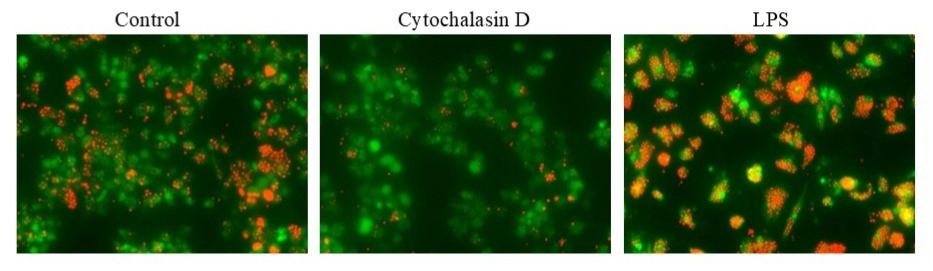
Examination of phagocytosis in RAW 264.7 cells using Cell Meter™ Fluorimetric Phagocytosis Assay Kit (Catalog Number 21233). RAW 264.7 cells were incubated with Cytochalasin D (to inhibit phagocytosis) or LPS (to induce phagocytosis) followed by incubation with Protonex™ Red 670-Zymosan Beads in growth medium for 60 minutes and then stained with CytoTrace™ Green for 30 minutes. The images were acquired using Keyence Fluorescence microscopy.
Protonex™ dyes exhibit unique pH-dependent fluorescence that increases dramatically upon acidification, making them ideal for monitoring phagosome and endosome maturation. Unlike many conventional single-intensity pH indicators that decrease fluorescence at low pH, Protonex™ probes become brighter in acidic environments, enabling sensitive detection of internalized particles.
Ready-to-use conjugates with E. coli, Zymosan A, or latex beads provide convenient tools for phagocytosis studies without additional conjugation steps.
- E. coli bioparticles: Ideal for studying bacterial phagocytosis, FcγR-independent uptake, and innate immune responses
- Zymosan A particles: Fungal cell wall model, engages dectin-1 and complement receptors, useful for studying pattern recognition
- IgG-opsonized particles: Required for FcγR-mediated phagocytosis studies
- Latex beads: Size-controlled, chemically defined surfaces for mechanistic studies
Amine-reactive (SE) and thiol-reactive (maleimide) Protonex™ dyes enable custom conjugation to antibodies, proteins, or other biomolecules for specialized endocytosis and trafficking studies.
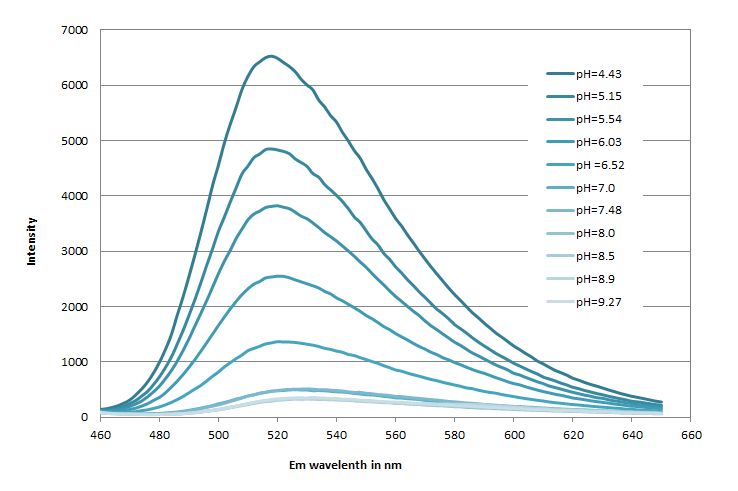
Dextran-conjugated Protonex™ probes are readily taken up by fluid-phase endocytosis (pinocytosis) and accumulate in endolysosomal compartments, providing a wash-free approach to monitor endocytic pathway acidification.
Fluorescent dextrans are widely used as fluid-phase endocytosis (pinocytosis) markers, vascular tracers, and cell permeability probes. The molecular weight of the dextran determines its uptake kinetics and cellular retention—small dextrans (10 kDa) are more readily internalized, while larger dextrans (70-150 kDa) are better retained and useful for long-term tracking.
AAT Bioquest offers both classic FITC/TRITC conjugates for standard applications and iFluor® conjugates that provide superior brightness and photostability for demanding imaging applications including deep tissue and multiplex experiments.
Dextran MW | Hydrodynamic Radius | Primary Uptake Route | Recommended Use |
|---|---|---|---|
| 3,000 Da | ~1.5 nm | Fluid-phase pinocytosis | Micropinocytosis, small vesicle tracking |
| 10,000 Da | ~2.3 nm | Fluid-phase pinocytosis | General endocytosis marker |
| 40,000 Da | ~4.5 nm | Macropinocytosis | Macropinosome labeling |
| 70,000 Da | ~6 nm | Macropinocytosis | Large vesicle studies, exclusion from clathrin pits |
| 150,000 Da | ~8.5 nm | Macropinocytosis only | Selective macropinocytosis detection |
Dextran-conjugated calcium indicators are retained within cells following microinjection or electroporation and are commonly used to study calcium dynamics within endosomal and lysosomal compartments rather than uptake kinetics. These probes avoid the compartmentalization and leakage issues common with AM ester-loaded indicators, particularly valuable for studying calcium dynamics in endosomal and lysosomal compartments.
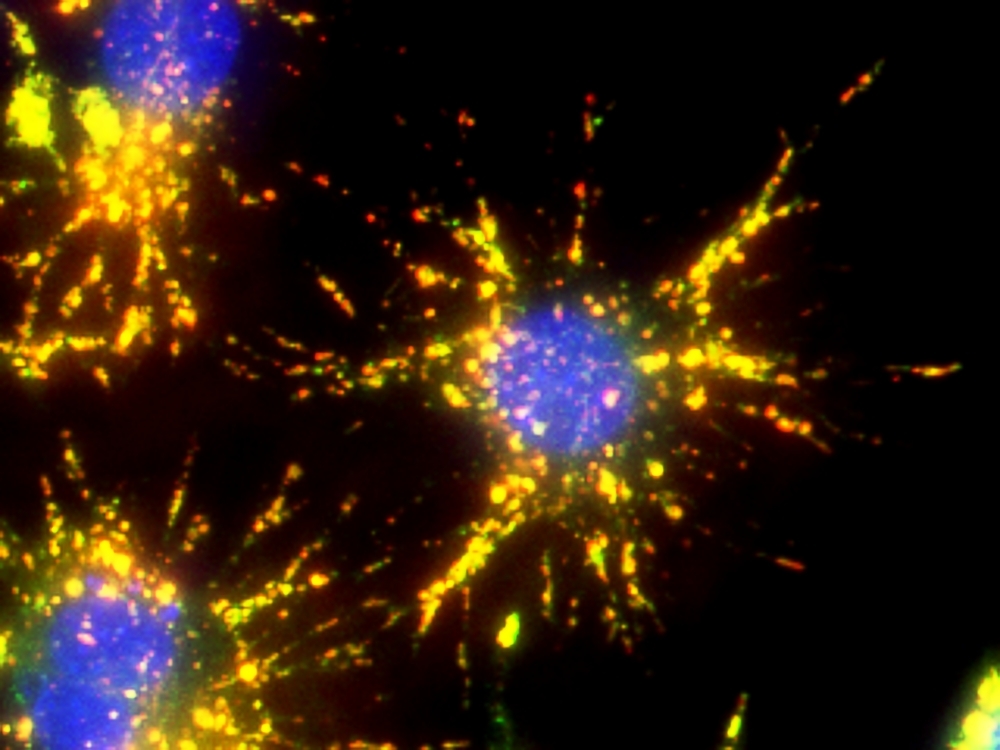
RatioWorks™ dual-wavelength calcium dextran conjugates enable quantitative calcium measurements independent of dye concentration, cell thickness, and instrument settings—critical for accurate intracellular calcium quantification.
RatioWorks™ PDMPO probes provide ratiometric pH measurements optimized for acidic organelles including lysosomes, endosomes, and phagosomes. These probes exhibit dual-excitation properties that enable quantitative pH determination in the 4.0-6.0 range.
MM (Membrane Marker) dyes label plasma membranes and endocytic vesicles, enabling visualization of membrane dynamics, vesicle trafficking, and synaptic activity.
The Cell Meter™ Glucose Uptake Imaging Kit provides a fluorescent method to monitor cellular glucose transport, useful for studying metabolic regulation and transporter trafficking that may intersect with endocytic recycling pathways.
This document (01.0230.251203r1) was last updated on Sat Feb 28 2026. All trademarks and registered trademarks mentioned herein are the property of their respective owners.
Endocytosis, Phagocytosis, and Pinocytosis