Nicotinamide adenine dinucleotide (NAD⁺) and nicotinamide adenine dinucleotide phosphate (NADP⁺) are key cofactors found in all living cells. NAD⁺ is present in two forms: an oxidized (NAD⁺) and reduced (NADH) form. It is utilized primarily in the redox reactions of metabolic processes as an electron carrier. NAD⁺ also forms NADP⁺ by the addition of a phosphate group ester linked to the 2’ position of the adenyl nucleotide. The reduced form of NADP⁺ is NADPH. Organisms use NADP⁺ in anabolic biological reactions, such as fatty acid and nucleic acid synthesis, which requires NADPH as a reducing agent.
Traditional assays for the determination of NAD⁺/NADH and NADP⁺/NADPH are based on monitoring changes in absorption of NADH or NADPH at the wavelength of 340 nm. However, when working in this short UV wavelength range, assays are less sensitive as a result of high levels of interference from autofluorescing proteins. To remedy this, AAT Bioquest has developed NAD⁺/NADH and NADP⁺/NADPH determination assays that operate in the visible wavelength range where interference is minimal, resulting in assays with wide dynamic ranges and significantly improved sensitivity. This catalog describes our comprehensive portfolio of products for the determination of NAD⁺/NADH and NADP⁺/NADPH.
NAD and NADH
NAD Assays
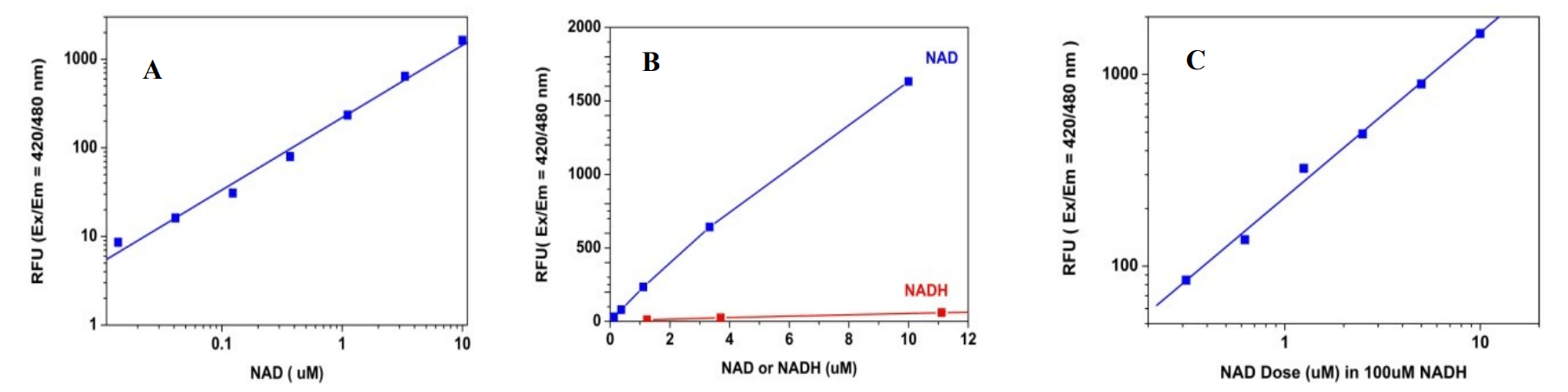
Amplite™ Fluorimetric NAD assay provides a sensitive and rapid detection of NAD⁺ in biological samples. This assay utilizes our proprietary Quest Fluor™ NAD probe to directly measure NAD⁺. Upon association with NAD⁺, Quest Fluor™ NAD generates a fluorescence signal that is measured using a fluorescence microplate reader at Ex/Em = 420/480. This assay has minimal response to NADH and as little as 30 nM NAD⁺ can be detected in samples. It is convenient for 96-well or 384-well microtiter plate format and its optimized “mix and read” format is suitable for HTS applications.
Fig. 1
NAD dose response was measured with Amplite™ Fluorimetric NAD Assay Kit (Catalog Number 15280) in a 96-well black/solid bottom plate using a Germini microplate reader (Molecular devices). A: NAD standard curve,
as low as 30 nM of NAD can be detected with 20 min incubation (n=3). B: Comparison of NAD and NADH response C: NAD standard curve with 100 µM NADH in presence in the solution. As low as 0.3% of NAD (~300
nM) converted from NADH can be detected with 20 min incubation (n=3).
NADH Assays
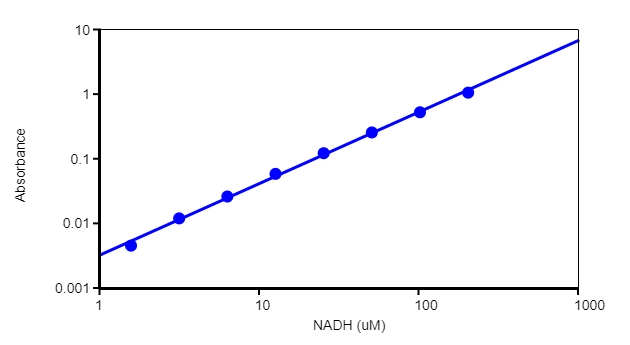
Amplite™ Colorimetric NADH assay offers a simple and robust method for the determination of NADH in biological samples. The NADH probe used in this assay is a chromogenic sensor that has a maximum absorbance at 460 nm upon NADH reduction. This assay can detect as little as 3 μM of NADH in samples using an absorbance microplate reader at 460 nm. The absorbance increase is proportional to the concentration of NADH in the solution.
Fig. 2
NADH dose response was measured with Amplite™ Colorimetric NADH Assay Kit (Catalog Number 15271) in a 96-well white/clear bottom plate using a SpectraMax microplate reader (Molecular devices). As low as 3 µM of NADH can be detected with 30min incubation (n=3) with absorbance measurement at 460 nm.
Our Amplite™ Fluorimetric NADH assay employs a system of enzymes that specifically recognize NADH via an enzyme cycling reaction. It utilizes a proprietary NADH sensor, which upon association with NADH yields a red fluorescent product. The fluorescence intensity generated is proportional to the concentration of NADH in the solution. This assay can detect as little as 1 μM of NADH in samples using either an absorbance
microplate reader at 575 nm or a fluorescence microplate reader at Ex/Em = 540/590 nm. It is convenient for 96-well or 384-well microtiter plate format, and since this assay is continuous and requires no separation step, it can be readily adapted for automation.
Total NAD and NADH Assays
Amplite™ Colorimetric Total NAD and NADH assay offers a convenient and sensitive method for the determination of NAD⁺/NADH in solutions and cell extracts. This assay employs a system of enzymes that specifically recognize NAD⁺/NADH via an enzyme cycling reaction. The NAD⁺/NADH probe used in this assay is a chromogenic sensor that has its maximum absorbance at 460 nm upon NAD⁺/NADH reduction. The absorption of the NAD⁺/NADH probe is directly proportional to the concentration of NAD⁺/NADH. This assay can detect as little as 300 nM of NAD⁺/NADH in samples using an absorbance microplate reader at 460 nm or at the absorbance ratio of A570 nm/A605 nm for improved sensitivity.
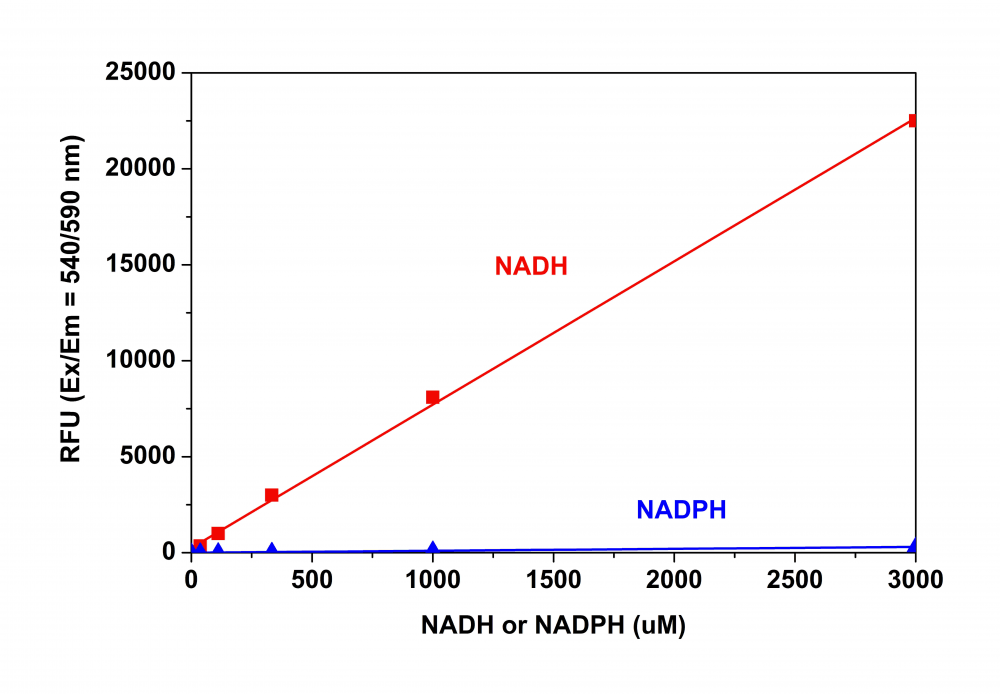
Our Amplite™ Fluorimetric Total NAD and NADH assay utilizes a similar system of enzymes that specifically recognize NAD⁺/NADH via an enzyme cycling reaction. It utilizes our proprietary NADH sensor, which upon association with NAD⁺/NADH yields a red fluorescent product. The fluorescence intensity generated is proportional to the concentration of NAD⁺/NADH in the solution. This assay can detect as little as 100
nM of NAD⁺/NADH in samples using a fluorescence microplate reader at Ex/Em = 540/590 nm. It is convenient for 96-well or 384-well microtiter plate format, and since this assay is continuous and requires no separation step, it can be readily adapted for automation.
Fig. 3
NADH dose response was measured with Amplite™ Fluorimetric Total NAD and NADH Assay Kit (Catalog Number 15257) in a solid black 96-well plate using a NOVOStar microplate reader (BMG Labtech). As low as 100 nM (10
pmol/well) of NADH can be detected with 1 hour incubation (n=3) while there is no response from NADPH.
NAD/NADH Ratio Assays
NAD⁺ and NADP⁺ function as electron carriers in many redox reactions. The balance between oxidized and reduced forms is referred to as the NAD⁺/NADH (NADP⁺/NADPH) ratio. This ratio is an important component to assess the redox state of a cell, and it is a measurement that reflects both the metabolic activities and the health of cells.
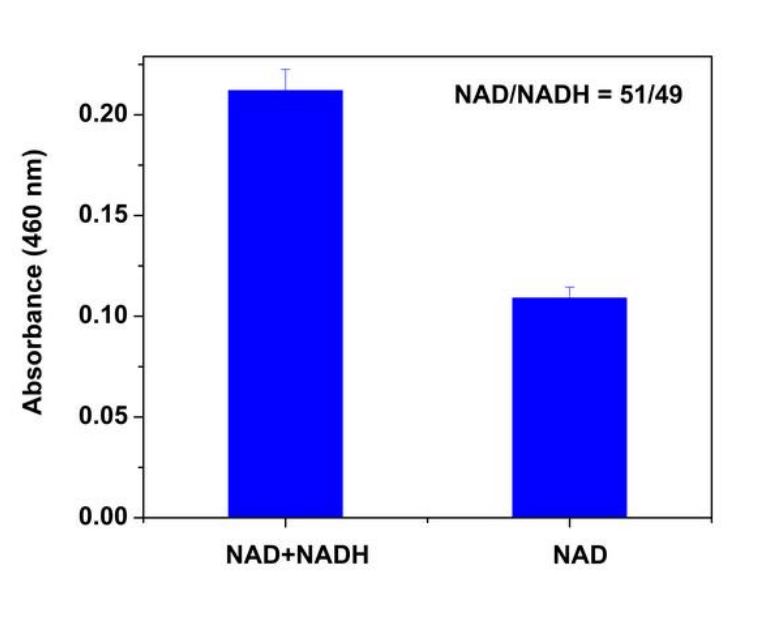
Amplite™ Colorimetric NAD/NADH Ratio assay offers a sensitive method for determining intracellular total NAD⁺/NADH amount, as well as, the NAD⁺/NADH ratio in culture cells. In this assay, NAD⁺ present in cell lysate is extracted using an NAD⁺ extraction solution and enzymatically converted to NADH. The level of NADH produced is recognized using or NADH probe to yield a yellow-color dye that is monitored with an absorbance microplate reader at 460 nm. The amount of the dye generated is directly proportional to the concentration of NAD⁺/NADH in the cell lysate and can be used as an indicator of the cellular NAD⁺/NADH concentration.
Fig. 4
Amplite™ Colorimetric NAD/NADH Ratio Assay Kit
(Catalog Number 15273) was used to measure NAD/NADH ratio in a 96-well white wall/clear bottom microplate using a SpectraMax® microplate reader (Molecular Devices). Equal amount of NAD and NADH mixtures were treated with or without NAD extraction solution for 15 minutes, and then neutralized with extraction solution at room temperature. The signal was read at 460 nm. NAD/NADH ratio was calculated based on the absorbance shown in the figure.
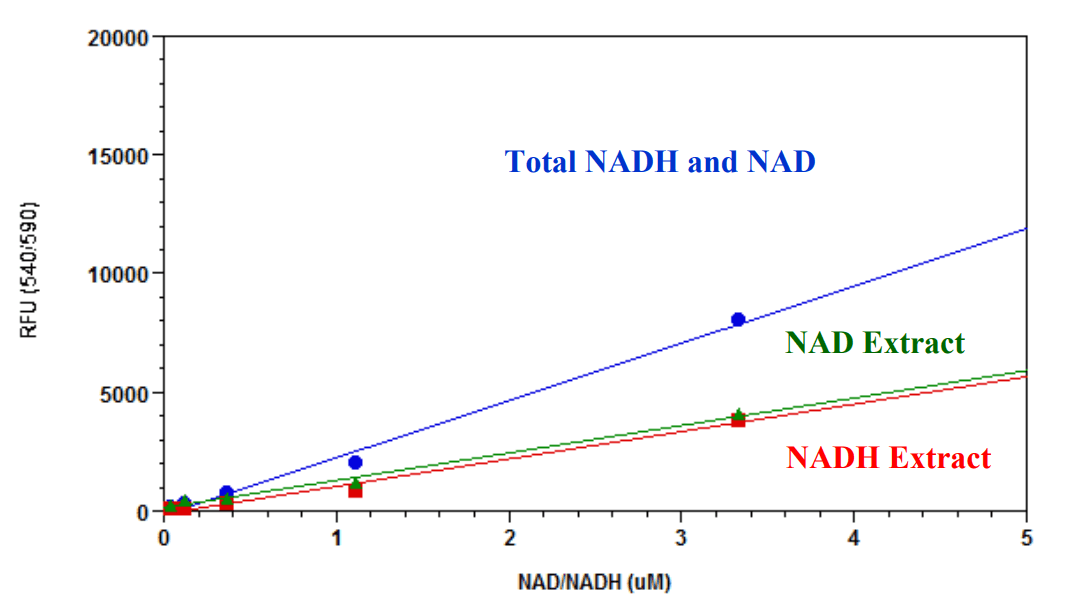
Our Amplite™ Fluorimetric NAD⁺/ NADH Ratio assay employs a system of enzymes that specifically recognize NAD⁺/NADH via an enzyme cycling reaction. Compared with other detection methods, our enzyme cycling reaction significantly increases detection sensitivity. In addition, this assay has been shown to have very low background. This is due to its spectral properties, which lie in the red visible range, significantly reducing interference from biological samples. For researchers concerned about usability, our kit is very convenient in its application. There is no need to purify NAD⁺/NADH from the sample prior to use; simply mix-and-read using a fluorescence microplate reader at Ex/Em = 540/590 nm. For convenience, this kit includes NAD⁺ and NADH extraction buffers as well as a cell lysis buffer.
Fig. 5
Total NADH/NAD, and their extract dose response were measured with Amplite™ Fluorimetric NAD/NADH Ratio Assay Kit (Catalog Number 15263) in a 96-well black plate using a Gemini microplate reader (Molecular Devices). 25 µL of equal amount of NAD and NADH was treated with or without NADH or NAD extraction solution for 15 min, and then neutralized with extraction solutions at room temperature. The signal was read at Ex/Em = 540/590 nm 30 min after adding 75 µL of NADH reaction mixture. The blank signal was subtracted from the values for those wells with the NADH reactions.
NADP and NADPH
NADP Assays
Amplite™ Fluorimetric NADP assay provides a sensitive and rapid detection of NADP⁺ in biological samples. This assay utilizes our proprietary Quest Fluor™ NADP probe to directly measure NADP⁺ with minimal response to NADPH. Upon association with NADP⁺, Quest Fluor™ NADP generates a fluorescence signal that is monitored using a fluorescence microplate reader at Ex/Em = 420/480. This assay can detect as little as 30 nM of NADP⁺, and monitor 0.3% NADP⁺ generation in the presence of excess NADPH. It is convenient for 96-well or 384-well microtiter plate format and its optimized “mix and read” format is suitable for HTS applications.
NADPH Assays
Amplite™ Colorimetric NADPH assay offers a simple and robust method for the determination of NADPH in biological samples. The NADPH probe used in this assay is a chromogenic sensor that has its maximum absorbance at 460 nm upon NADH reduction. The absorption of the NADPH probe is directly proportional to the concentration of NADPH. This assay can detect as little as 3 μM of NADPH in samples using an absorbance microplate reader at 460 nm.
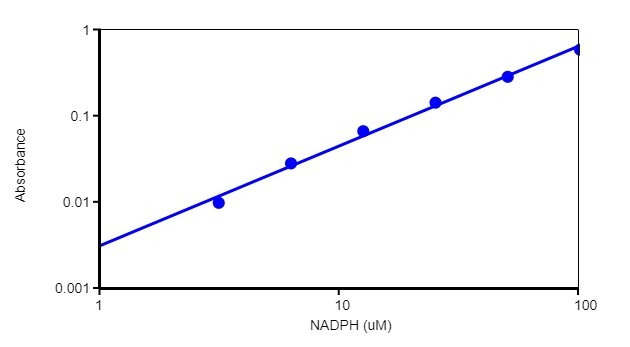
Fig. 6
NADPH dose response was measured with Amplite™
Colorimetric NADPH Assay Kit (Catalog Number 15272) in a 96-well white/clear bottom plate using a SpectraMax microplate reader (Molecular devices). As low as 3 µM of NAPDH can be detected with 30min incubation (n=3) with absorbance measurement at 460nm.
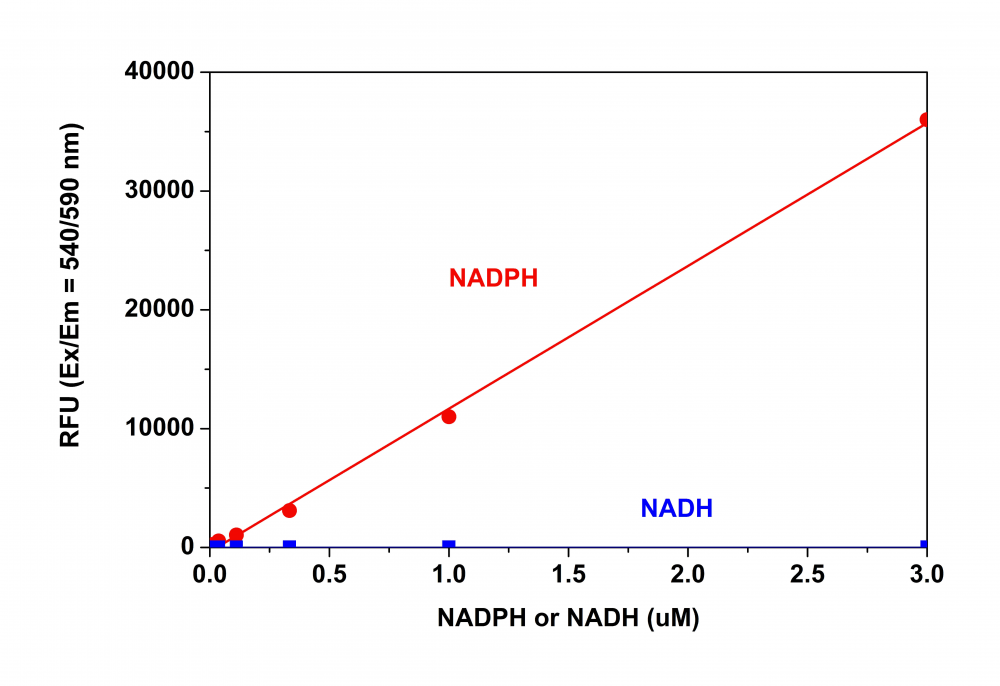
Our Amplite™ Fluorimetric NADPH assay employs a system of enzymes that specifically recognize NADPH via an enzyme cycling reaction. It utilizes a proprietary NADPH sensor, which upon association with NADPH yields a red fluorescent product. The fluorescence intensity generated is proportional to the concentration of NADPH in the solution. This assay can detect as little as 1 μM of NADPH in samples using either an absorbance microplate reader at 575 nm or a fluorescence microplate reader at Ex/Em = 540/590 nm. It is convenient for 96-well or 384-well microtiter plate format, and since this assay is continuous and requires no separation step, it can be readily adapted for automation.
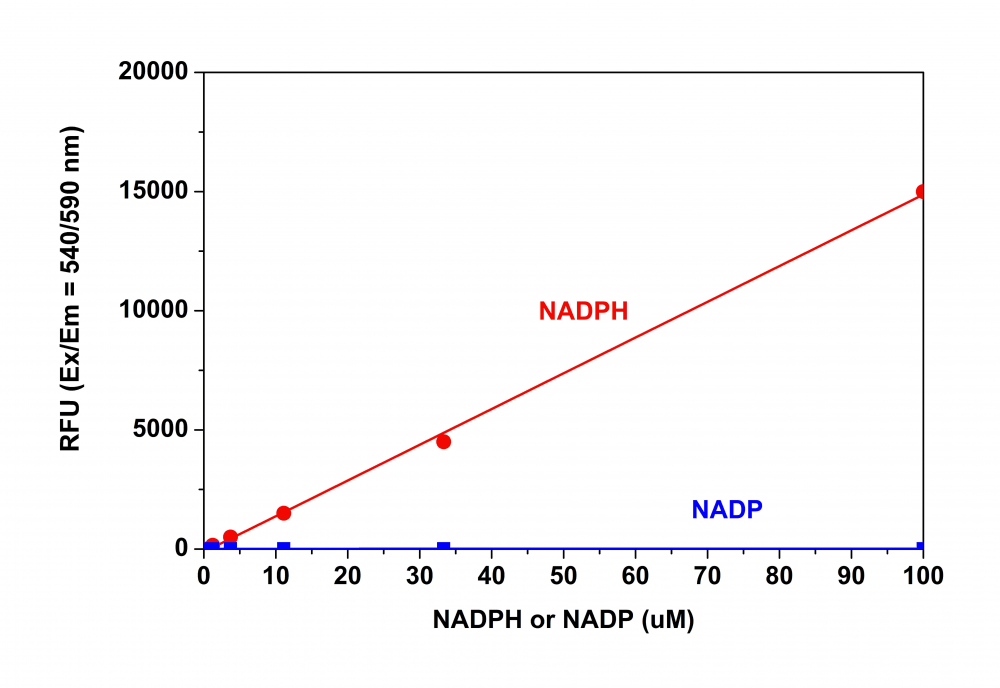
Fig. 7
NADPH dose response was measured with Amplite™
Fluorimetric NADPH Assay Kit (Catalog Number 15262) in a 96-well black plate using a NOVOStar microplate reader (BMG Labtech). As low as 1 μM of NADPH can be detected with 1 hour incubation (n=3) with no response to NADP.
Total NADP and NADPH Assays
Amplite™ Colorimetric Total NADP and NADPH assay offers a convenient and sensitive method for the determination of NADP⁺/NADPH in solutions and cell extracts. This assay employs a system of enzymes that specifically recognize NADP⁺/NADPH via an enzyme cycling reaction. The NADP⁺/NADPH probe used in this assay is a chromogenic sensor that has its maximum absorbance at 575 nm upon NADP⁺/NADPH reduction. The absorption of the NADP⁺/NADPH probe is directly proportional to the concentration of NADP⁺/NADPH. This assay can detect as little as 100 nM of NAD⁺/NADH in samples using an absorbance microplate reader at 575 ± 5 nm or at the absorbance ratio of A570 nm/A605 nm for improved sensitivity.
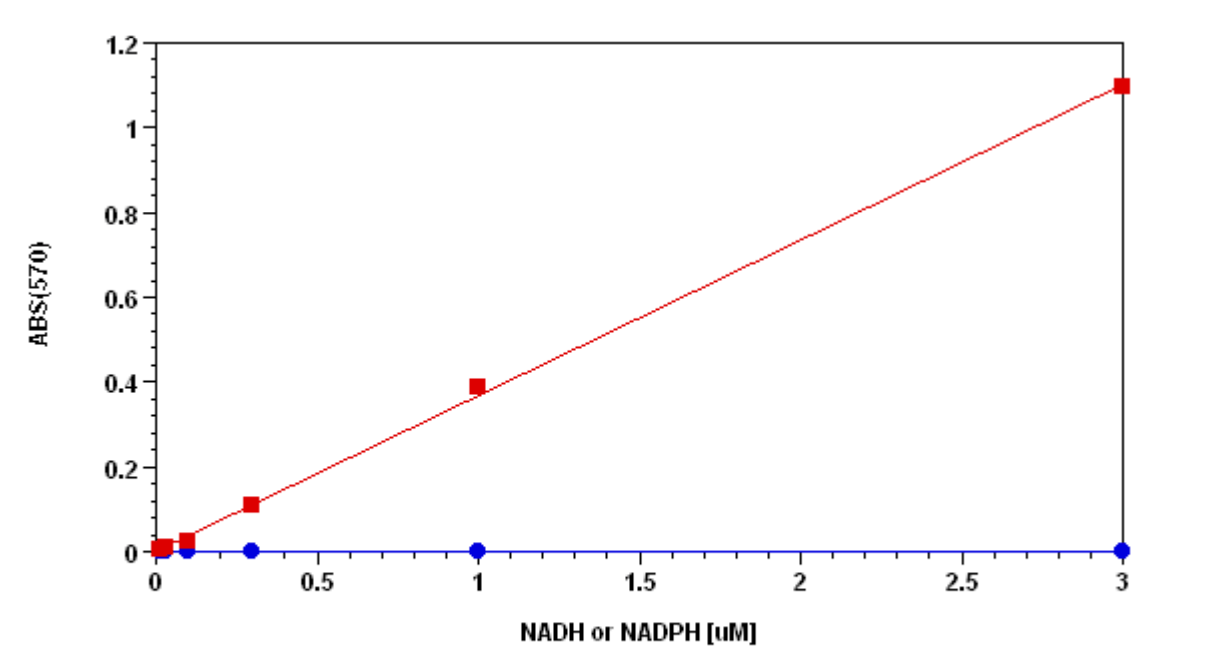
Fig. 8
NADPH dose response was measured with Amplite™
Colorimetric Total NADP and NADPH Assay Kit (Catalog Number 15260) in a white/ clear bottom 96-well plate using a NOVOStar microplate reader (BMG Labtech). As low as 100 nM (10 pmol/well) of NADPH can be detected with 1 hour incubation (n=3) while there is no response from NADH.
Our Amplite™ Fluorimetric Total NADP and NADPH assay utilizes a similar system of enzymes that specifically recognize NADP⁺/NADPH via an enzyme cycling reaction. It utilizes our proprietary NADPH sensor, which upon association with NADP⁺/NADPH yields a red fluorescent product. The fluorescence intensity generated is proportional to the concentration of NADP⁺/NADPH in the solution. This assay can detect as little as 10 nM of NADP⁺/NADPH in samples using a fluorescence microplate reader at Ex/Em = 540/590 nm. It is convenient for 96-well or 384-well microtiter plate format, and since this assay is continuous and requires no separation step, it can be readily adapted for automation.
Fig. 9
NADPH dose response was measured with Amplite™
Fluorimetric total NADP and NADPH Assay Kit (Catalog Number 15259) in a black 96-well plate using a NOVOStar microplate reader (BMG Labtech). As low as 10 nM (1 pmol/well) of NADPH can be detected with 30 minutes
incubation (n=3) while there is no response from NADH.
NADP/NADPH Ratio Assays
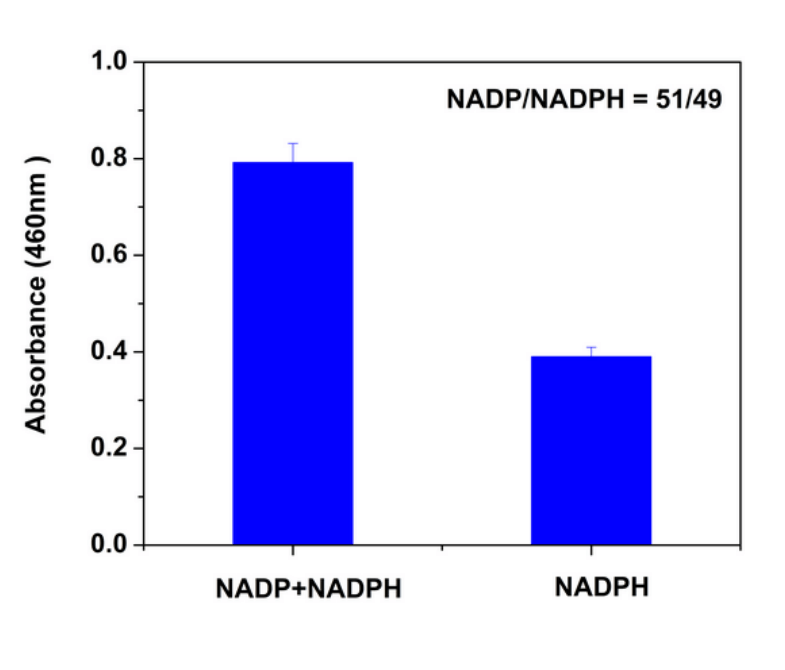
Amplite™ Colorimetric NADP/NADPH Ratio assay offers a sensitive method for determining intracellular total NADP⁺/NADPH amount, as well as, the NADP⁺/NADPH ratio in culture cells. In this assay, NADP⁺ present in cell lysate is extracted using an NADP⁺ extraction solution and enzymatically converted to NADH. The level of NADH produced is recognized using or NADPH probe to yield a yellow-color dye that is monitored with an absorbance microplate reader at 460 nm. The amount of the dye generated is directly proportional to the concentration of NADP⁺/NADPH in the cell lysate and can be used as an indicator of the cellular NADP⁺/NADPH concentration.
Fig. 10
Amplite™ Colorimetric NADP/NADPH Ratio Assay Kit (Catalog Number 15274) was used to measure NADP/NADPH ratio in a 96-well white wall/ clear bottom microplate using a SpectraMax® microplate reader (Molecular Devices). Equal amount of NADP and NADPH mixtures were treated with or without NADPH extraction solution for 15 minutes, and then neutralized with extraction solution at room temperature. The sig- nal was read at 460 nm. NADP/NADPH ratio was calculated based on the absorbance shown in the figure.
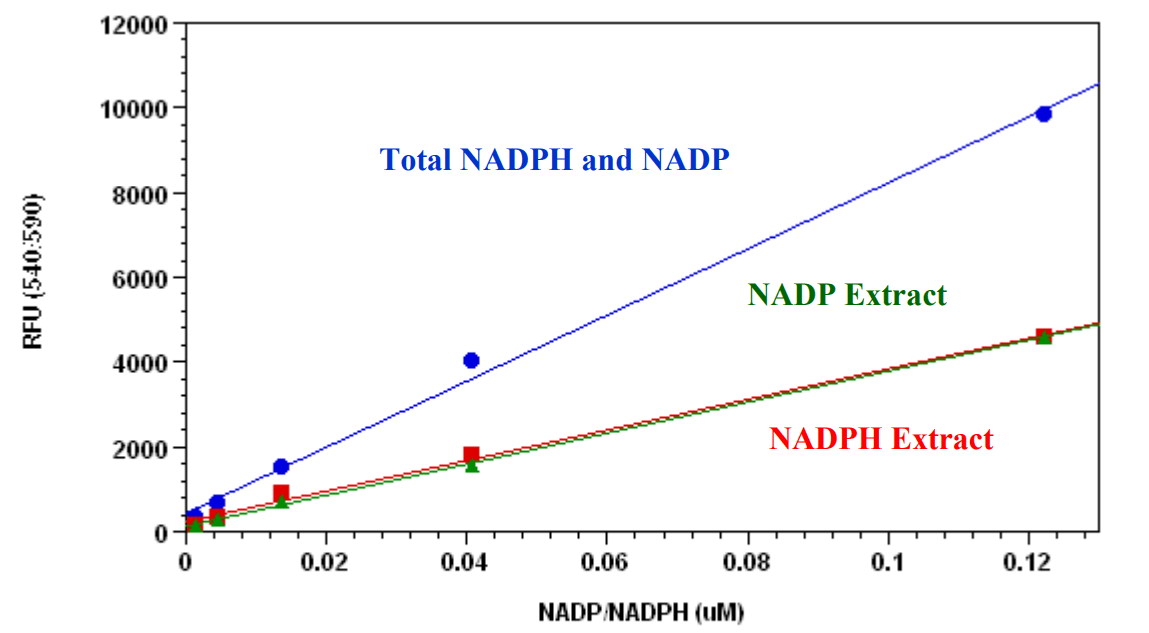
Our Amplite™ Fluorimetric NADP/NADPH Ratio assay employs a system of enzymes that specifically recognize NADP⁺/NADPH via an enzyme cycling reaction. Compared with other detection methods, our enzyme cycling reaction significantly increases detection sensitivity. In addition, this assay has been shown to have very low background. This is due to its spectral properties, which lie in the red visible range, significantly reducing interference from biological samples. For researchers concerned about usability, our kit is very convenient in its application. There is no need to purify NADP⁺/NADPH from the sample prior to use; simply mix-and-read using a fluorescence microplate reader at Ex/Em = 540/590 nm. For convenience, this kit includes NADP⁺ and NADPH extraction buffer as well as a cell lysis buffer.
Fig. 11
Total NADPH and NADP, and their extract dose response were measured with Amplite™ Fluorimetric NADP/NADPH Ratio Assay Kit (Catalog Number 15264) in a 96-well black plate using a Gemini microplate reader (Molecular Devices). 25 µL of equal amount of NADP and NADPH was treated with or without NADPH or NADP extraction solution for 15 minutes, and then neutralized with extraction solutions at room
temperature. The signal was acquired at Ex/Em = 540/590 nm (cut off at 570 nm) 30 minutes after adding 75 µL of NADPH reaction mixture. The blank signal was subtracted from the values for those wells with the NADPH reactions (Note: The fluorescence background increases with time, thus it is important to subtract the fluorescence intensity value of the blank wells for each data point).
Intracellular NADH/NADPH Detection
Measuring the intracellular concentration of dihydronicotinamide adenine dinucleotide (NADH) and its phosphate ester (NADPH) is a useful tool in disease diagnostic and as a therapeutic target. In organisms, the redox couples of NAD⁺/NADH and NADP⁺/NADPH play key roles in energy metabolism, glycolysis, tricarboxylic acid cycle and mitochondrial respiration. Alterations in the balance of NAD⁺/NADH and NADP⁺/NADPH can reflect changes in cellular redox state and metabolic activity, which are closely linked to oxidative stress and cellular health.
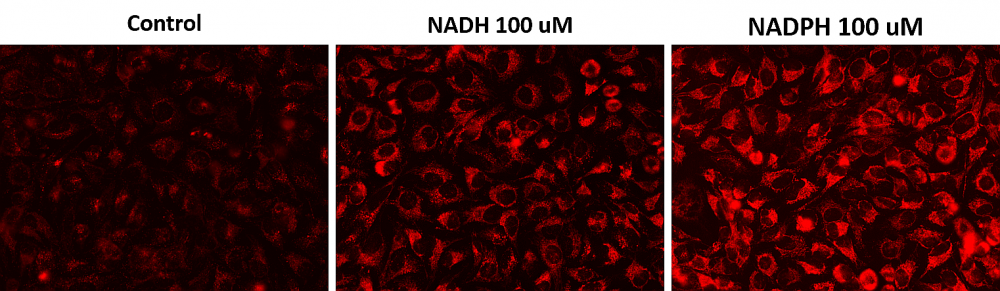
Our Cell Meter™ Intracellular NADH/NADPH Fluorescence Imaging assay offers an efficient method for monitoring intracellular NADP⁺/NADPH levels in live cells. This assay utilizes our cell-permeable JZL1707 NAD(P)H sensor, which binds NADH/NADPH with high sensitivity and specificity. Upon association with NADH/NADPH, JZL1707 NAD(P)H sensor generates a strong fluorescence signal. This signal can either be monitored using a fluorescence microplate reader at Ex/Em = 540/590 nm or visualized using a fluorescence microscope equipped with a Cy3® or TRITC filter set.
Fig. 12
Fluorescence images of NADH/NADPH in HeLa cells using
Cell Meter™ Intracellular NADH/NADPH Fluorescence Imaging Kit (Catalog Number 15290). HeLa cells were incubated with 100 µM NADH or 100 µM NADPH in serum-free medium for 30 minutes and then co-incubated with JZL1707 NAD(P)H sensor working solution for another 30 minutes. The fluorescence signal was measured using fluorescence microscope with a Cy3® filter.
This document (01.0246.251203r1) was last updated on Sat Feb 28 2026. All trademarks and registered trademarks mentioned herein are the property of their respective owners.