
Products
Services
Resources
Selection Guides
About
Phosphate and Pyrophosphate
Phosphate (Pi) is one of the most important inorganic ions in biological systems. It functions in a variety of roles. One of the most important roles is as a molecular switch, turning enzyme activity on and off through the mediation of the various protein kinases and phosphatases in biological systems. Numerous enzymes of therapeutic relevance produce phosphate directly or through coupled reactions. These potential drug development targets include lipid and protein phosphatases, ATPases, GTPases, prenyltransferases and phosphodiesterases. Phosphate also plays a critical role in biomineralization and metabolic regulation, making sensitive and reliable phosphate assays essential for enzymology, drug discovery, and biochemical research. The importance of phosphate in drug discovery and other fields makes high quality phosphate assays indispensable.
In the presence of inorganic phosphate, MESG is converted to 2-amino-6-mercapto-7-methlpurine by purine nucleoside phosphorylase (PNP) with a red shift of absorption wavelength. This feature has been used to quantify phosphate spectrophotometrically. The enzymatic removal of the ribose moiety from MESG results in a shift in the wavelength of maximum absorbance (λmax) from 330 nm to 360 nm. Because conversion of MESG requires inorganic phosphate, the increase in absorbance at 360 nm can be used to measure phosphate concentration. When the PNP enzyme and MESG substrate are in excess relative to phosphate, the increase in absorbance at 360 nm is quantitative for inorganic phosphate. Assuming there is no preexisting phosphate, any increase in the absorbance at 360 nm reflects the liberation of inorganic phosphate from enzymatic reactions present in the assay.
Fig. 1
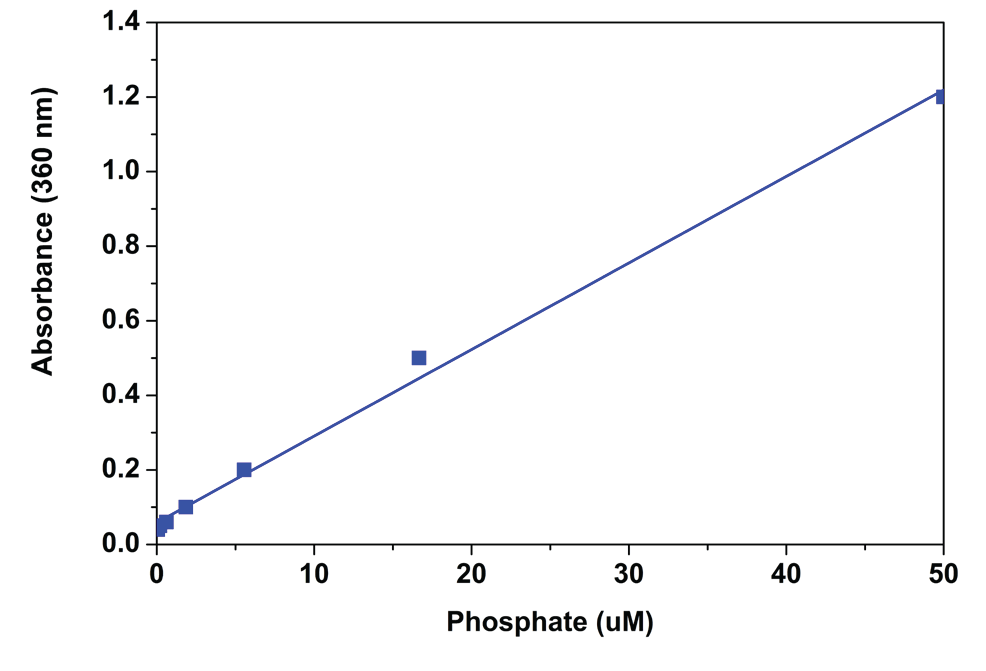
Phosphate dose responses were measured with the PhosphoWorks™ Colorimetric MESG Phosphate Assay Kit in a 96-well UV plate. As low as 0.2 µM phosphate can be detected with 30 minutes incubation.
Our PhosphoWorks™ Phosphate Assay Kit has been developed for measuring the activity of any Pi-generating enzyme through the complexation of malachite green with phosphate under acidic conditions. The measurement of Pi is based on the change in absorbance of the malachite green derivative in the presence of molybdate. This assay kit is formulated to give sensitive detection of Pi, providing an alternative to hazardous radioactive methods and other less sensitive colorimetric assays. Unlike other malachite dye formulations, this kit gives a completely stable end-point signal.
Fig. 2
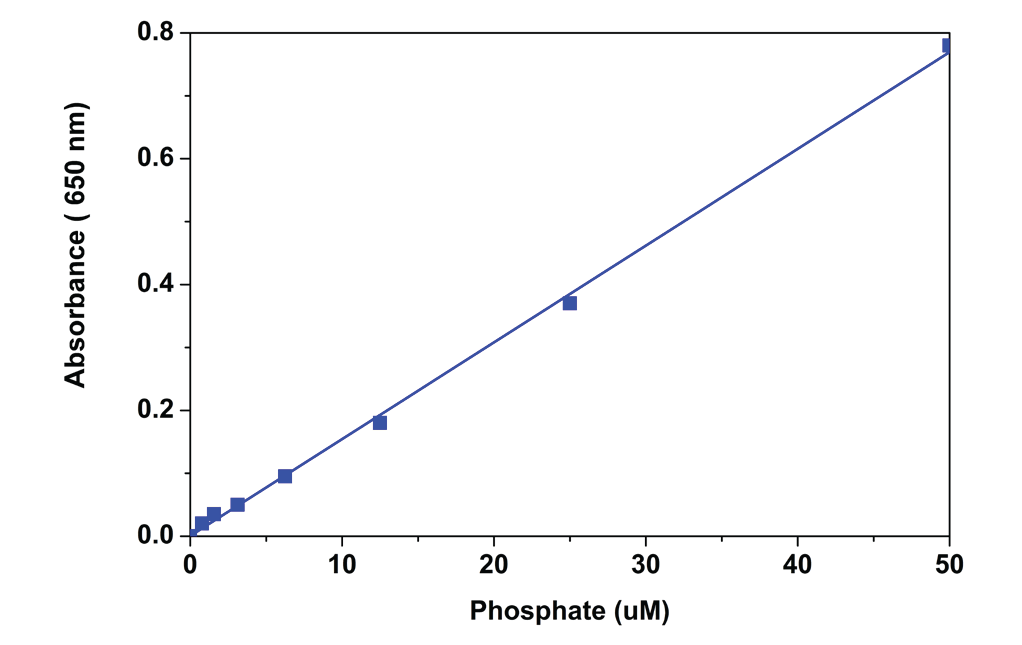
Phosphate dose responses were measured with the PhosphoWorks™ Colorimetric Phosphate Assay Kit in a 96-well clear plate. As low as 0.1 µM phosphate can be detected with 10 minutes incubation.
Detection of many phosphoester–metabolizing enzymes is difficult because suitable substrates are not available. While traditional colorimetric and radioisotope-based methods have been widely used to measure inorganic phosphate release, fluorimetric approaches provide enhanced sensitivity and flexibility for certain enzymatic and high-throughput applications. We have developed the PhosphoWorks™ Fluorimetric Phosphate Assay Kit for measuring the activity of any Pi-generating enzyme using our red fluorescent phosphate sensor. The measurement of Pi is based on the change in the absorbance and fluorescence of the phosphate sensor. The assay is shown to quantitate phosphate in solution at concentrations as low as 0.1 µM. It can be used to measure the
kinetics of phosphate release from phosphatases (such as GTPases and ATPases) by coupling the two enzymatic reactions. The kit provides sensitive detection of Pi, an alternative to hazardous radioactive methods and other less sensitive colorimetric assays. It comes with all the essential reagents including phosphate sensor, phosphate standards and assay buffer. The assay can be performed in a convenient 96-well or 384-well microtiter-plate format and easily adapted to automation with no separation steps required.
Fig. 3
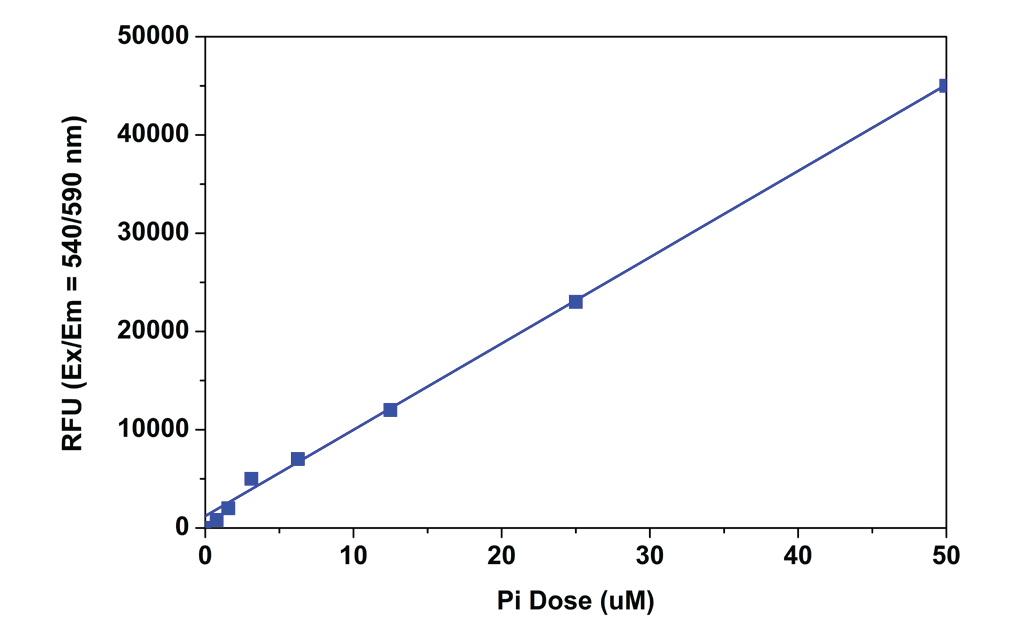
Phosphate dose responses were measured with PhosphoWorks™ Fluorimetric Phosphate Assay Kit in a 96-well black plate. As low as 0.1 µM phosphate can be detected with 1 hour incubation.
Pyrophosphate (PPi) is produced by a number of biochemical
reactions, such as ATP hydrolysis, DNA and RNA polymerizations,
cyclic AMP formation by the enzyme adenylate cyclase and the
enzymatic activation of fatty acids to form the coenzyme A esters. Our PhosphoWorks™ Pyrophosphate Assay Kit provides the most robust spectrophotometric method for measuring pyrophosphate. It uses our proprietary fluorogenic pyrophosphate sensor, enabling sensitive fluorescence-based quantification of pyrophosphate concentration in biochemical assays. The assay is much easier than the enzyme-coupling pyrophosphate methods that require at least two enzymes for the pyrophosphate detections. PhosphoWorks™
Pyrophosphate Assay Kit provides all the essential components
for assaying pyrophosphate. It has been successfully used in high
throughput screening (HTS). Please inquire special HTS bulk package discount for the screening of >10,000 assays.
Fig. 4
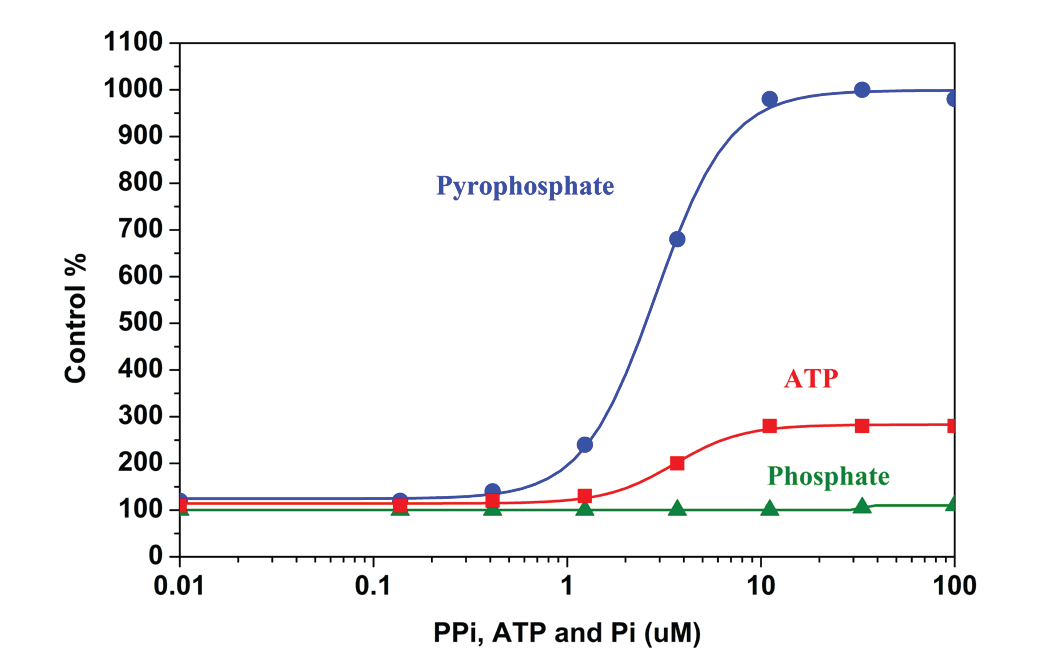
Pyrophosphate and phosphate dose responses were measured with the PhosphoWorks™ Fluorimetric Pyrophosphate Assay Kit in a 96-well black solid plate. As low as 1 µM (100 picmoles/well) pyrophosphate can be detected with 10 minutes incubation.
This document (01.0245.251203r1) was last updated on Sat Feb 28 2026. All trademarks and registered trademarks mentioned herein are the property of their respective owners.