
Products
Services
Resources
Selection Guides
About
Reactive Fluoresceins
Fluorescein derivatives are one of the most commonly used fluorescent labels for biological detection in flow cytometry and immunofluorescence due to their high absorptivity, excellent fluorescence quantum yields and good water solubility. The most widely used fluoresceins include fluorescein isothiocyanate (FITC) for labeling proteins (particularly antibodies) and carboxyfluoresceins (5-FAM and 5(6)-FAM) for labeling peptides and oligonucleotides. We offer a broad selection of fluorescein based-dyes, substrates and conjugates, as well as a series of iFluor® fluorescent labeling dyes with improved characteristics optimized for cellular labeling and detection.
Fig. 1
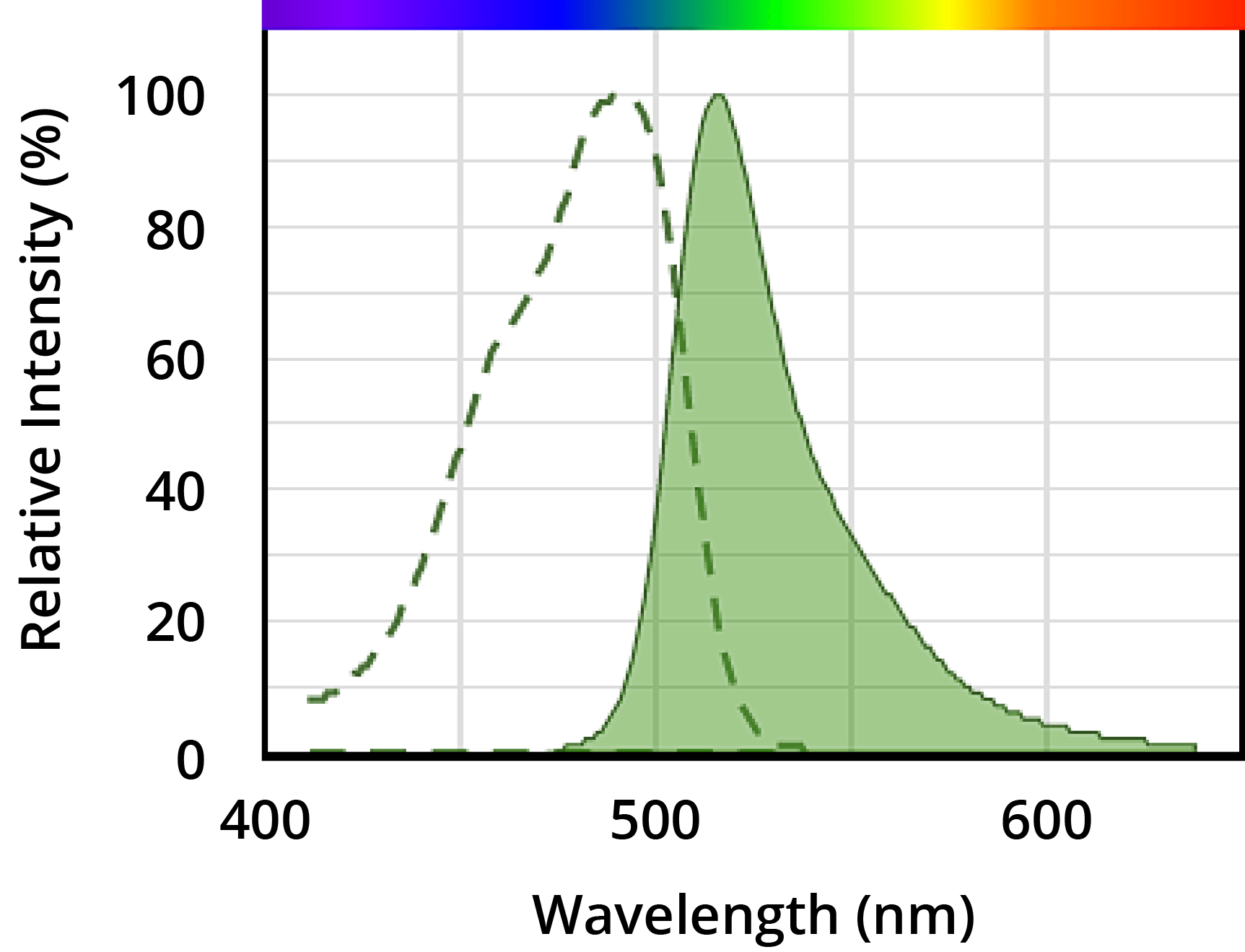
Excitation and emission spectra for fluorescein-5-isothiocyanate (5-FITC) CAS 3326-32-7 (Catalog Number 121).
Reactive fluoresceins and fluorescein derivatives are widely used to covalently label biomolecules such as antibodies, carbohydrates, nucleic acids, proteins, peptides and oligonucleotides. Resulting in green fluorescence, fluorescein conjugates are often used as substrates for detecting enzymatic activity or to provide contrast in multicolored fluorescence investigation when combined with blue, yellow or red fluorescent probes. Fluorescein and fluorescein derivatives are readily available in a variety of dye-labeling chemistries.
Despite its bright green fluorescence, fluorescein based-dyes and conjugates have a number of caveats that may restrict its use in certain applications, including rapid photobleaching, pH-sensitive fluorescence and susceptibility to quenching. The iFluor® 488 dye, with identical spectral properties similar to fluorescein, produces brighter, more photostable conjugates with reduced pH-sensitivity over a wide range. iFluor® 488 dye molecules can be conjugated to biomolecules at high molar ratios with minimal self-quenching (see the figure below).
Fig. 2

Comparison of fluorescence intensity between HeLa cells labeled with goat anti-mouse IgG–FITC and goat anti-mouse IgG–iFluor® 488. Photobleaching rates were compared between iFluor® 488–labeled goat anti-mouse IgG and conventional fluorescein (FITC)–labeled goat anti-mouse IgG. Tubulin in HeLa cells was labeled with (top series) iFluor® 488 goat anti-mouse IgG or (bottom series) FITC goat anti-mouse IgG. Images were acquired at 60-second intervals using a Keyence X710 fluorescence microscope. TFI represents total fluorescence intensity, as calculated using ImageJ software.
This document (01.0081.211015r2) was last updated on Sat Feb 28 2026. All trademarks and registered trademarks mentioned herein are the property of their respective owners.