
Products
Services
Resources
Selection Guides
About
Phalloidin Conjugates
Phalloidin is a bicyclic heptapeptide isolated from the poisonous death cap mushroom, Amanita phalloides. Its high binding affinity for the grooves between filamentous actin (F-actin) over monomeric G-actin is widely used to visualize and quantitate F-actin in tissue sections, cell cultures, or cell-free preparations. Compared to actin-specific antibodies, the non-specific binding of phalloidin is negligible, thus providing minimal background and high contrast during cellular imaging. Once bound to F-actin, phalloidin shifts the equilibrium of monomers and filaments toward the filaments side and inhibits ATP-hydrolysis. The interaction stabilizes actin filaments by preventing subunit dissociation, and it promotes actin polymerization by lowering the critical concentration.
Fig. 1
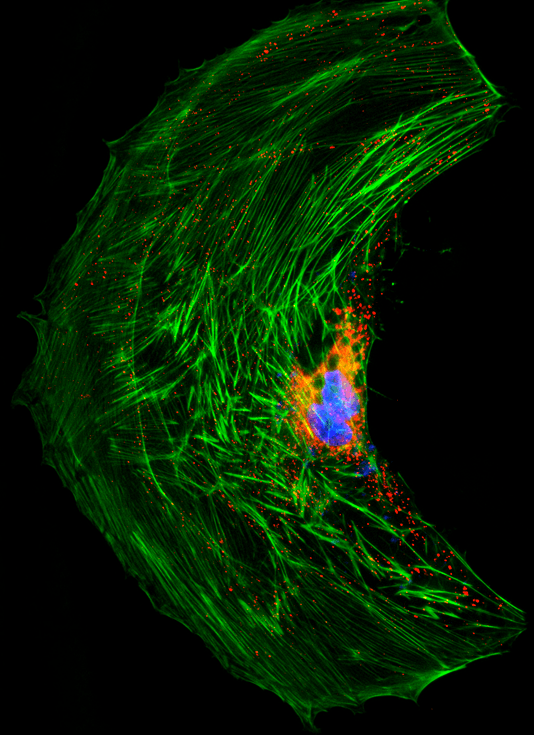
Actin filaments visualized with Phalloidin-iFluor® conjugates. Respectively, F-actin, nucleus, and lysosomes were stained with Phalloidin iFluor® 488, Nuclear Blue™ DCS1, and LysoBrite™ Red.
When conjugated to fluorescent dyes, phalloidin can be used at nanomolar concentrations to label and visualize F-actin in fixed and permeabilized cells, cell cultures, and cell-free experiments, as well as formaldehyde-fixed and permeabilized tissue sections. Phalloidin conjugates exhibit similar affinity for all types and sizes of actin filaments, binding in a stoichiometric ratio of 1:1 (phallotoxin:actin) in both muscle and nonmuscle cells. Compared to antibodies, phalloidin derivatives' are small (< 2 kDa), and phalloidin-bound filaments do not impede the functional properties of the filaments. The small size also permits denser F-actin labeling producing more detailed stains when imaged at higher resolutions. In addition, because actin is evolutionarily conserved, the binding properties of phalloidin derivatives can be utilized in staining a wide range of animal and plant cells.
- Phalloidin-iFluor® Dye Conjugates
- Alexa Fluor® equivalent XFD
- Unlabelled Phalloidin
- Phalloidin-PEG4-DBCO
Exploiting the excellent fluorescence properties of our iFluor® dyes, AAT Bioquest has developed a series of phalloidin conjugates spanning the UV-Vis-NIR spectrum, which selectively bind to F-actins. Used at nanomolar concentration, these iFluor® phalloidin derivatives are convenient for many actin-related assays. Such assays include labeling, identifying, and quantitating F-actins in formaldehyde-fixed and permeabilized tissue sections, cell cultures, or cell-free experiments. Compared to traditional fluorescein isothiocyanate (FITC) and rhodamine conjugates, Phalloidin-iFluor® conjugates offer F-actin stains that are superior in brightness and photostability. Phalloidin-iFluor® conjugates are equivalent, and in most cases superior, to Alexa Fluor® conjugates in performance.
We encourage the research community to try our Phalloidin-iFluor® conjugates with their respective protocols for a more intense fluorescence in their F-actin staining. Phalloidin-iFluor® 700, iFluor®-750, and iFluor®-790 conjugates are among the few near-infrared stains available for multicolor imaging. The sufficient spectral separation from commonly used red fluorophores.
This document (01.0047.211015r1) was last updated on Tue Feb 17 2026. All trademarks and registered trademarks mentioned herein are the property of their respective owners.
Phalloidin Conjugates