
Products
Services
Resources
Selection Guides
About
404 Not Found
Actin and tubulin are among the most abundant and highly conserved cytoskeletal proteins in eukaryotic cells. Together, they form the microfilament and microtubule networks that provide structural support and drive essential cellular processes including intracellular transport, cell division, motility, and signal transduction. Fluorescent probes for these proteins—particularly phalloidin derivatives for F-actin and taxol-based or Tubulite™ probes for tubulin—are indispensable tools for visualizing cytoskeletal architecture at high resolution.
Actin dynamically polymerizes from monomeric G-actin into filamentous F-actin. Interactions between F-actin and actin-binding proteins rapidly assemble and disassemble filaments, organizing them into bundles and networks that support intracellular transport, cytokinesis, cell motility, polarity, gene regulation, and signal transduction.
F-actin stains characterize cytoskeletal structure and function. Because the actin cytoskeleton is highly dynamic in living cells, visualization typically requires cold methanol or paraformaldehyde fixation prior to labeling. In fixed cells, actin structures can be visualized using actin antibodies, fluorescent phalloidin conjugates, or electron microscopy. Antibodies recognize both monomeric and filamentous actin, producing higher background compared to probes that bind only F-actin. Properly designed fluorescent phalloidin conjugates bind exclusively to F-actin's quaternary structure, yielding low background and high contrast.
Fig. 1
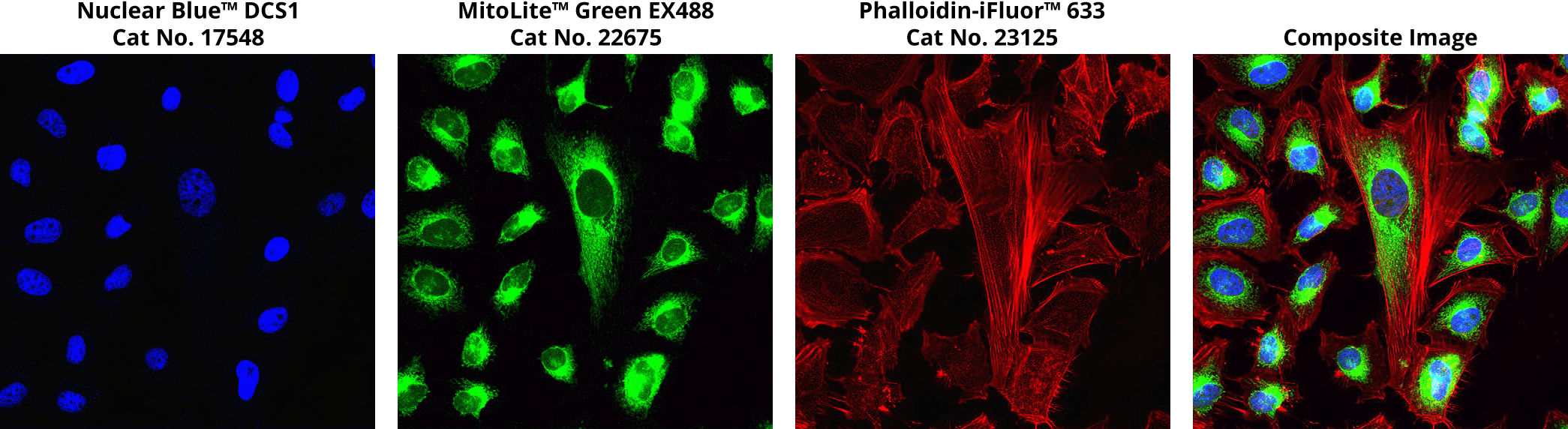
Fluorescence composite image. Live HeLa cells were stained with mitochondria dye MitoLite™ Green EX488 (Catalog Number 22675) and imaged. After fixation in 4% formaldehyde, cells were stained with F-actin probe Phalloidin-iFluor™ 633 Phalloidin (Catalog Number 23125) and nuclear counterstain Nuclear Blue™ DCS1 (Catalog Number 17548).
Phalloidin is a bicyclic heptapeptide isolated from the death cap mushroom (Amanita phalloides). It binds with high affinity to grooves between F-actin subunits while showing minimal affinity for monomeric G-actin. This selectivity produces negligible non-specific binding and high-contrast cellular imaging. Upon binding F-actin, phalloidin shifts the monomer-filament equilibrium toward filaments and inhibits ATP hydrolysis, stabilizing actin filaments by preventing subunit dissociation and promoting polymerization by lowering the critical concentration.
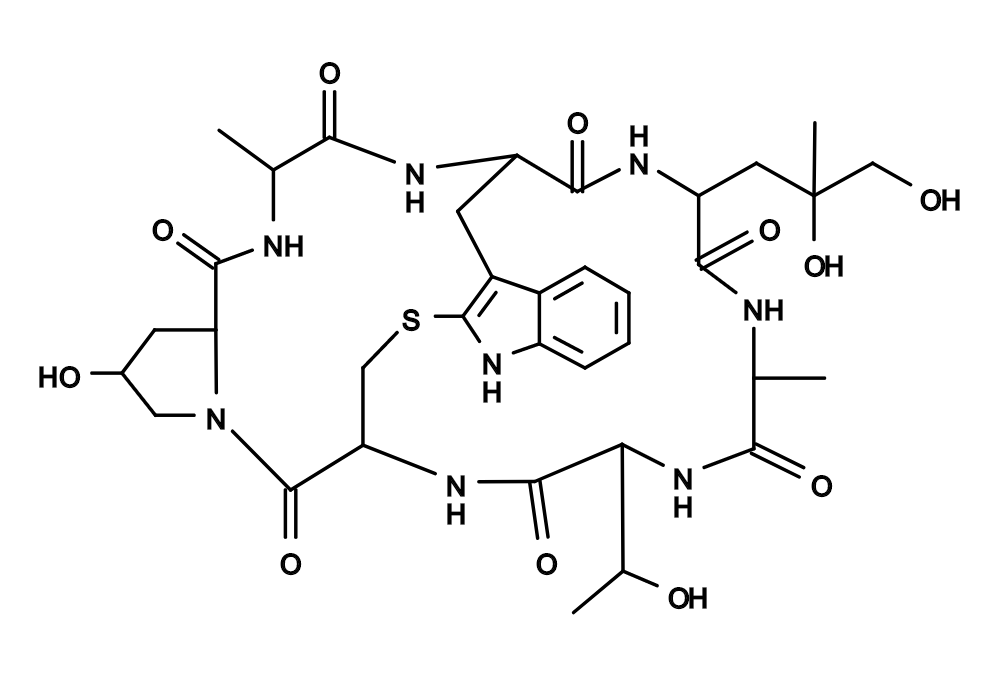
Phalloidin derivatives are water-soluble and selectively stain F-actin at nanomolar concentrations. Their tight binding to filaments over monomers minimizes non-specific staining and background noise, producing excellent contrast. At less than 2 kDa, phalloidin derivatives are substantially smaller than antibodies, permitting denser F-actin labeling and more detailed high-resolution images.
Unlabeled phalloidin (Cat No. 5301) serves primarily as a control for blocking F-actin staining or as a building block for developing custom conjugates.
Biotinylated phalloidin provides indirect F-actin visualization using fluorescent or enzyme-conjugated avidin/streptavidin. While indirect detection offers signal amplification, it requires additional reagents and approximately two-fold higher phalloidin concentrations. Biotinylated phalloidin is particularly useful for pull-down and immunoprecipitation assays investigating protein interactions with F-actin.
Fluorescently-labeled phalloidins directly visualize F-actin distribution in fixed and permeabilized cells. Their small size enables dense F-actin labeling for detailed, high-resolution imaging.
AAT Bioquest's iFluor® phalloidin conjugates span the full color spectrum, combining the excellent fluorescence properties of iFluor® dyes with phalloidin's F-actin selectivity. Used at nanomolar concentrations, these conjugates label, identify, and quantitate F-actin in formaldehyde-fixed and permeabilized tissue sections, cell cultures, and cell-free experiments. Compared to traditional FITC and rhodamine conjugates, Phalloidin-iFluor® conjugates offer superior brightness and photostability, matching or exceeding Alexa Fluor® conjugate performance.
Fig. 3
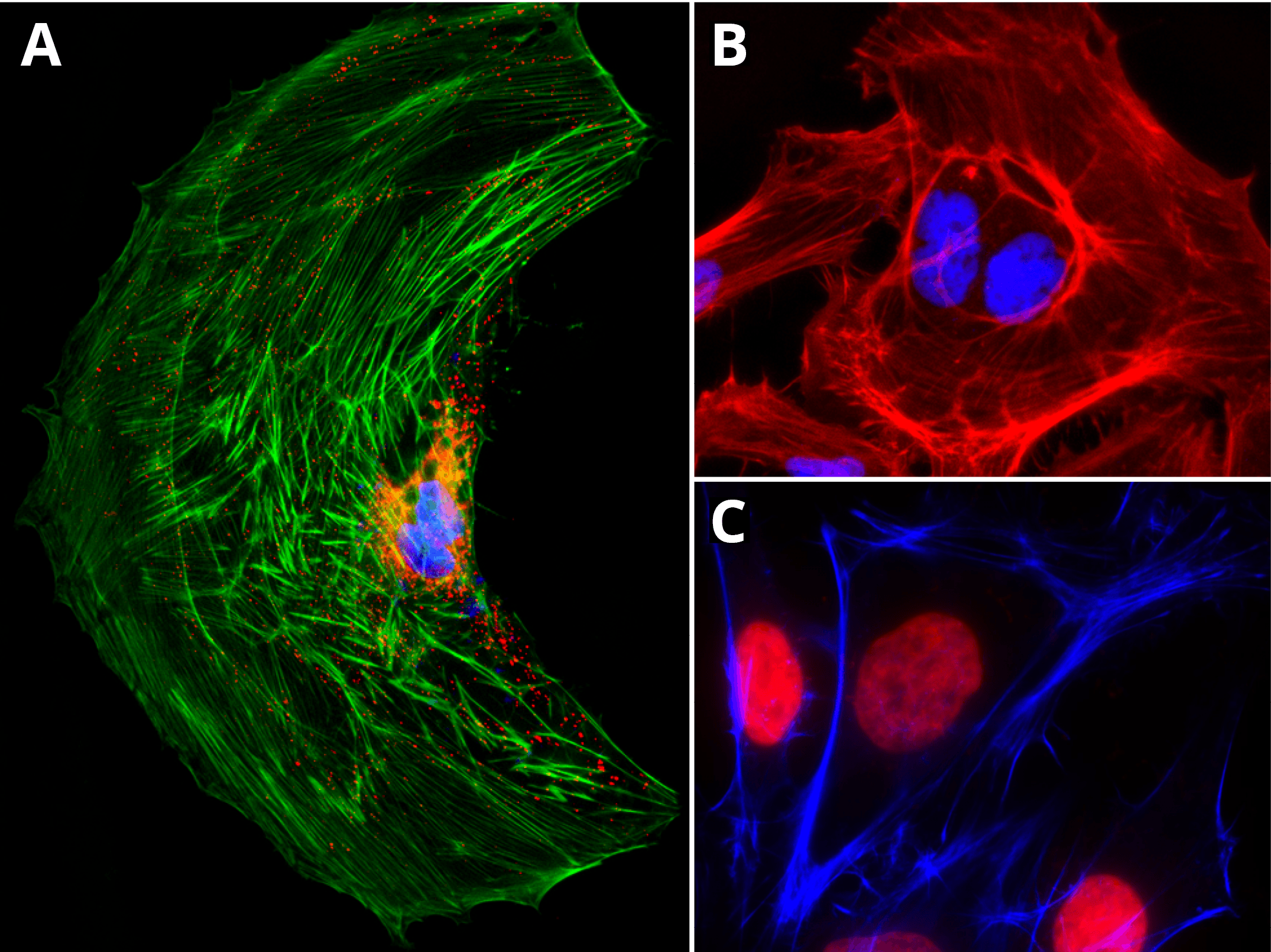
A) Actin filaments visualized with Phalloidin-iFluor® conjugates. Respectively, F-actin, nucleus, and lysosomes were stained with Phalloidin iFluor® 488, Nuclear Blue™ DCS1, and LysoBrite™ Red.
B) Fluorescence image of HeLa cells fixed with 4% formaldehyde then stained with Phalloidin-iFluor® 700 Conjugate and nuclei stain Nuclear Blue™ DCS1.
C) HeLa cells were fixed in 4% formaldehyde and then stained with Phalloidin iFluor® 350 conjugate and nuclei stain Nuclear Orange™ DCS1.
Storage and Handling: Phalloidin-iFluor® 350 through iFluor® 596 conjugates are supplied as 1000X DMSO stock solutions ready for use. Phalloidin-iFluor® 633 through iFluor® 790 conjugates are supplied as lyophilized powder requiring reconstitution to 1000X stock. Store at -20 °C protected from light; avoid freeze-thaw cycles. Conjugates are stable for at least six months under proper conditions.
Phalloidin-iFluor® 700, 750, and 790 conjugates are among the few near-infrared F-actin stains available with sufficient spectral separation from commonly used red fluorophores.
Tubulin is the principal component of microtubules—cylindrical polymers essential for cell division, intracellular transport, and maintaining cell shape. α-tubulin and β-tubulin heterodimers polymerize into dynamic microtubule structures that form the mitotic spindle, organize organelle positioning, and serve as tracks for motor protein transport.
Unlike phalloidin-based F-actin staining, which requires fixed cells, tubulin can be visualized in both live and fixed cells using different probe strategies.
Tubulite™ probes are cell-permeable fluorescent reagents for real-time visualization of tubulin structures in live cells without fixation. Upon cellular entry, intracellular esterases cleave the lipophilic blocking group, producing a charged, membrane-impermeant form that remains well-retained within cells. Available in green, red, and deep red fluorescence, Tubulite™ probes enable multiplexing with other fluorescent labels including GFP and DAPI nuclear stains.
Note: Tubulite™ probes are not recommended for studying dynamic cellular processes as they may interfere with tubulin activity and cell division. They are unsuitable for fixed-cell imaging as fluorescence is lost during fixation.
Taxol promotes tubulin assembly into stable aggregated structures. Fluorescent taxol conjugates such as OG488 Taxol (Oregon Green® 488 paclitaxel/Flutax-2) effectively label microtubules in cells and solutions. The OG488 Diacetate Taxol Conjugate offers enhanced cell permeability—diacetate groups are cleaved by intracellular esterases to release the fluorophore for live-cell tubulin labeling.
The following protocol stains F-actin in cultured cells using AAT Bioquest Phalloidin-iFluor® 488 Conjugate.
Phalloidin is toxic. While each vial contains only trace amounts, always handle with appropriate care.
- Phalloidin-iFluor® 488 Conjugate (Cat No. 23115)
- PBS (buffer recipe)
- 3.0–4.0% methanol-free formaldehyde
- BSA
- Cell culture
- Optional: 0.1% Triton X-100, ethanolamine, FluoroQuest™ Mounting Medium with DAPI (Cat No. 20004)
- Warm Phalloidin-iFluor® 488 vial to room temperature and centrifuge briefly before opening.
- Prepare 1000X stock solution by adding 30 μL DMSO to the vial.
- Prepare 1X working solution: add 1 μL of 1000X stock to 1 mL PBS with 1% BSA. Mix well. This provides staining solution for 10 wells at 100 μL/well. Store unused 1000X stock at -20°C protected from light.
Note: Optimal phalloidin concentration may vary between cell types. - Fix cells in 3.0–4.0% methanol-free formaldehyde in PBS at room temperature for 10–30 minutes. Avoid methanol-containing fixatives as methanol disrupts actin.
- Aspirate fixation solution carefully.
- Rinse fixed cells 2–3 times in PBS.
- Optional: Quench excess formaldehyde with 10 mM ethanolamine in PBS for 5 minutes.
- Optional: Increase permeability by incubating with 0.1% Triton X-100 in PBS for 3–5 minutes. Rinse 2–3 times with PBS.
- Add 100 μL/well of working solution. Stain at room temperature for 20–90 minutes.
- Rinse gently 2–3 times with PBS to remove excess conjugate.
- Optional: Add FluoroQuest™ Mounting Medium with DAPI and incubate for 2 hours to inhibit photobleaching and counterstain nuclei.
- Image using a fluorescence microscope with FITC filter set.
This document (01.0084.211015r1) was last updated on Tue Feb 17 2026. All trademarks and registered trademarks mentioned herein are the property of their respective owners.
Featured products
| Name | Excitation (nm) | Emission (nm) |
|---|---|---|
| Phalloidin-iFluor® 488 Conjugate | 491 | 516 |
Actin and Tubulin Probes