
Products
Services
Resources
Selection Guides
About
Cell Viability and Proliferation
Cell viability and proliferation assays are commonly performed to assess cell health, particularly in response to stimuli or treatments. Although often grouped together, these assays are designed to monitor and measure different parameters.
Cell viability assays measure the rate of ongoing cellular activities (e.g., cellular metabolism) or enzyme activity and test for cytolysis or membrane leakage. On the other hand, cell proliferation assays monitor the growth of a cell population or detect the generation of daughter cells. Since no single assay can comprehensively assess the health of a cell population, it is most effective to use a combination of several different methods (including apoptosis assays) in your experiment. AAT Bioquest offers a broad range of reagents and kits for assessing cell viability and proliferation.
Application | Example Products | Detection Principle |
|---|---|---|
Cell Viability | Calcein AM, Cell Meter™, Cell Explorer™ | Active esterases in live cells cleave AM functional group and activate fluorescence |
Cell Viability | MTT, WST-8, CCK-8 | Metabolically active cells reduce tetrazolium salts to colored formazan products. |
Cell Viability | Nuclear DCS Dyes | Live cells exclude membrane-impermeable dyes; dead cells with compromised membranes stain positive. |
Cell Viability | Live or Dead™ | Dual staining enables simultaneous identification and quantification of live and dead cells. |
Cell Proliferation | CFSE, CytoTrace™ | Amine-reactive dyes covalently label cells; fluorescence is diluted with each cell division. |
Cell Proliferation | XdU, BrdU | Nucleoside analogs are incorporated during DNA synthesis and detected as a readout of proliferation. |
Cell viability assays are used to evaluate the percentage of living cells in a sample population by monitoring characteristics associated with healthy cell function. In this regard, two strategies are commonly implemented—quantitating cell metabolic activity and quantitating cell membrane integrity.
Metabolic cell viability assays rely on endogenous enzyme activity within living cells to activate fluorogenic or colorimetric reporters. Conversely, non-viable cells demonstrate reduced or non-existent metabolic activity, leading to diminished or no assay signal. Two popular classes of enzymes targeted for this application are intracellular esterases and mitochondrial reductases.
A variety of fluorogenic esterase substrates, including Calcein AM and various fluorescein diacetate derivatives, serve as viability probes for assessing enzymatic activity and cell-membrane integrity. The properties of these probes facilitate their passive diffusion across intact plasma membranes of most cell types. Once inside the cell, these non-fluorescent substrates are hydrolyzed by intracellular esterases into fluorescent products that are retained by cells depending on integrity of plasma membranes. On the contrary, cells that are dead or have damaged membranes will rapidly leak both the unhydrolyzed substrates and their products from their cytosol. Fluorogenic esterase substrates are detectable with fluorescence microscopes, flow cytometers, and fluorescence microplate readers. For ready-to-use kits, the Cell Meter™ Cell Viability Assay Kits offer multiple color options for high-throughput microplate-based analysis, while Cell Explorer™ Live Cell Labeling Kits offer multiple color options for uniform labeling of live cells for fluorescence imaging applications.
Tetrazolium-based assays provide simple, colorimetric readouts for high-throughput cell viability screening. These assays measure metabolic activity through reduction of tetrazolium salts to colored formazan products by mitochondrial reductases. The amount of formazan produced can be measured using a spectrophotometer and is proportional to the number of viable cells in a population. When cells die, they lose their metabolic activity, resulting in little to no visible color change.
The principle behind dye exclusion assays is based on the premise that viable cells with healthy plasma membranes are impermeable to several polar dyes such as trypan blue or cell-impermeant nucleic acid stains. The basics of this method consist of mixing cells in suspension with an impermeable dye and utilizing a fluorescence microscope, microplate reader or flow cytometer to examine the number of stained cells against the total cell population. The number of stained cells will represent the percentage of dead cells in the entire population. Dye exclusion assays directly quantify dead or membrane-compromised cells, from which the viable cell fraction can be inferred.
Dead cell stains selectively label cells with compromised membrane integrity using membrane-impermeant dyes that enter dead cells and bind nucleic acids. Live cells, with intact membranes, are minimally stained, since the dye cannot diffuse into the cell. For quenching of fluorescence from dead cells, which may aid in the reduction of background fluorescence, please see Nuclear Black™ DCS (Catalog Number 17691).
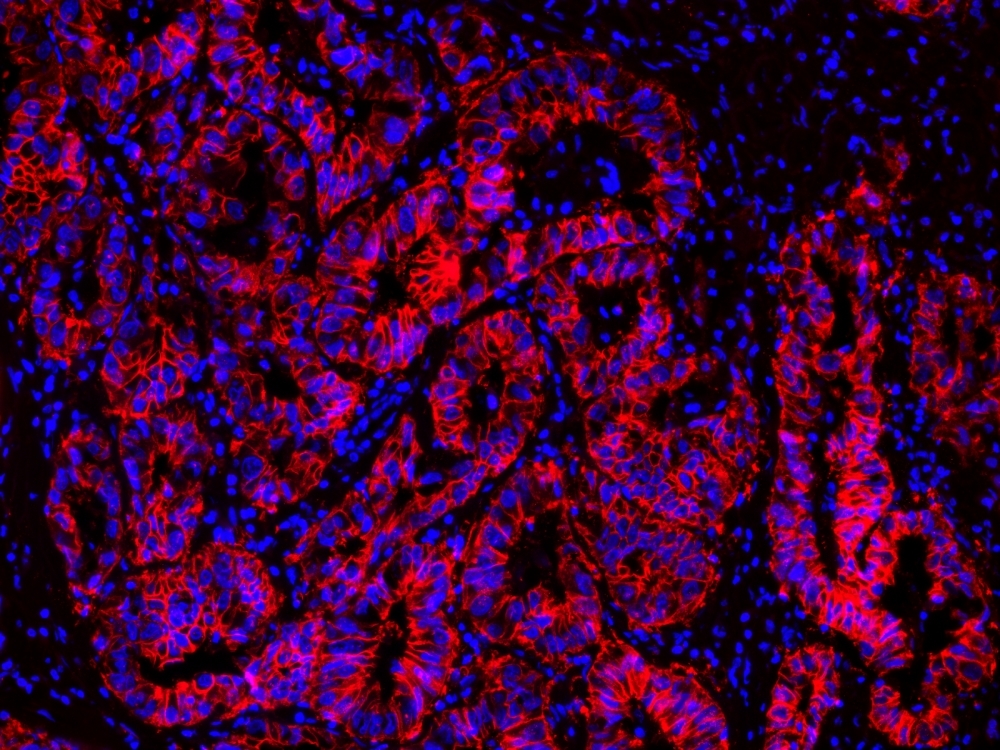
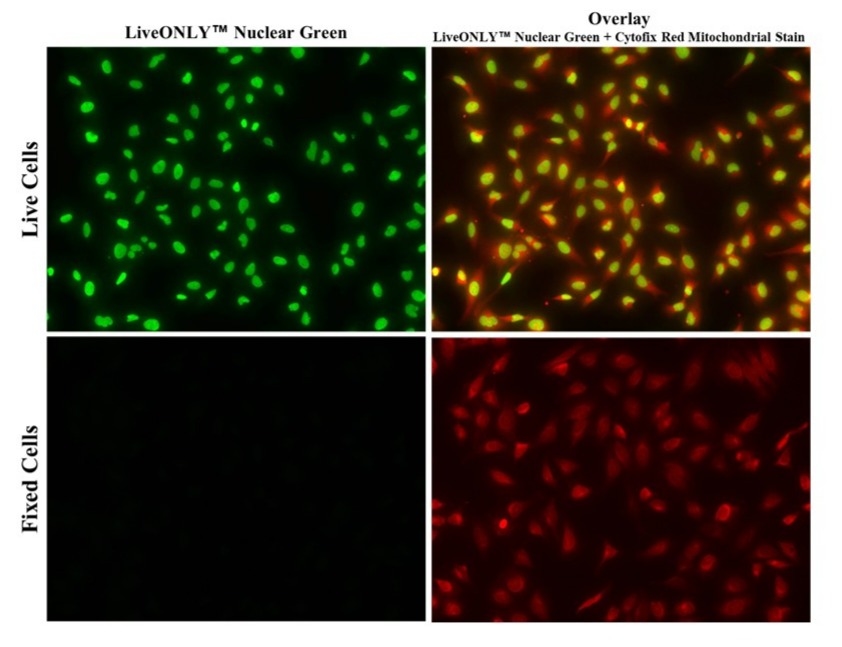
Dyes in the Nuclear LCS family are cell-permeant nuclear stains that label live cells but may also stain cells with compromised membranes. For selective live cell staining, a fluorogenic dye, such as calcein am, which is activated by cellular metabolic activity is recommended. Alternatively, LiveONLY™ Nuclear Green and LiveONLY™ Nuclear Red offer live cell selectivity without dependence upon cell metabolic activity.
Fixable viability dyes employ amine reactive dyes to assess viability of mammalian cells. In viable cells, the fluorescent dye’s reactivity is restricted to cell-surface amines resulting in low fluorescence intensity. In dead cells or cells with compromised membranes, the dye reacts with intracellular free-amines and cell-surface amines generating an intense fluorescence signal. The difference in fluorescence intensity between dead and live cell populations is substantial and can be preserved after fixation.
Fig. 3
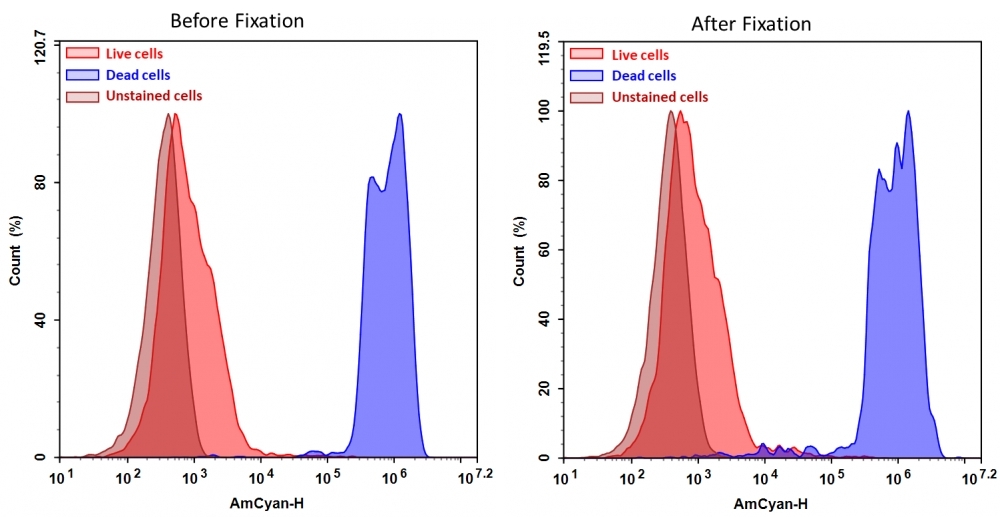
Detection of Jurkat cell viability by Cell Meter™ fixable viability dye. Jurkat cells were treated and stained with Cell Meter™ VX450 (Catalog Number 22540), and then fixed in 3.7% formaldehyde and analyzed by flow cytometry. The dead cell population (Blue peak) is easily distinguished from the live cell population (Red peak) with AmCyan channel, and nearly identical results were obtained before and after fixation.
Dual detection kits, such as the Live or Dead™ Cell Viability Assay Kits, provide simple and robust method for assessing cell viability of adherent or non-adherent cells. These kits employs two probes, a fluorogenic esterase substrate and a cell-impermeant DNA-binding dye, for a two-color discrimination of live cells from dead cells in a population.
Fig. 4
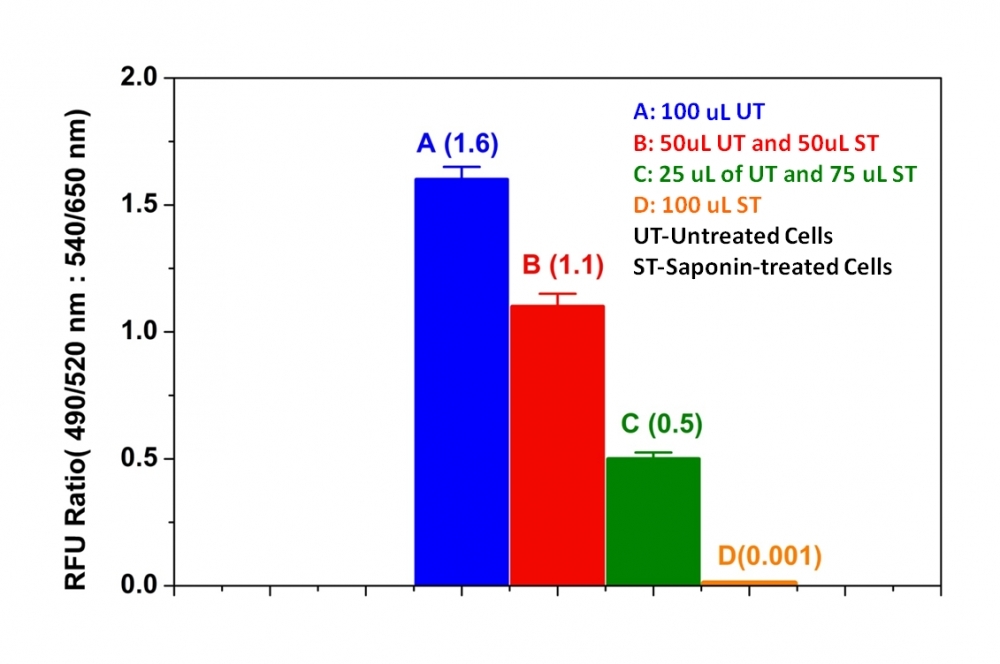
The Effect of Jurkat cells on Saponin induced cell death measured with Cell Meter™ Cell Viability Assay Kit. Jurkat cells at 2 x10⁶ cells/mL were treated with or without 0.5% Saponin for 5 minutes. Cells were centrifuged and the supernatant were replaced with fresh medium. 100 uL of untreated cells (A), 50 uL each of untreated and treated cells (B), 25 uL of untreated and 75 uL treated cells (C), and 100 uL of 0.5% saponin treated cells (D) were plated in a 96-well black wall/clear bottom Poly-D-lysine plate. The cells were incubated with 100 µL/well of CytoCalcein™ Green/ Propidium Iodide dye-working solution for 1 hr at 37 °C. The fluorescence intensity was measured at Ex/Em = 490/525 nm and 540/650 nm with bottom read mode using NOVOstar instrument (BMG Labtech). The ratio of 490/525 nm to 540/650 nm fluorescence intensity on live and dead cells were showed as indicated (n=6).
Cell proliferation and cell cycle assays are designed to assess the growth of a cell population or detect the generation of daughter cells. When combined with cytotoxicity testing, proliferation assays can characterize the effects of novel pharmacological compounds on cell proliferation and cytotoxicity. This is an important area of investigation in cancer biology and drug-discovery research.
Cell tracking dyes enable monitoring of cell division over multiple generations by fluorescence dilution, though signal loss can also result from cell death or dye efflux and should be controlled experimentally. CFSE and CytoTell® dyes are retained in the cytoplasm through covalent attachment to free amines (e.g., proteins) and diluted equally between daughter cells during division, allowing proliferation analysis by flow cytometry. The progressive dilution of fluorescence intensity with each division creates distinct peaks representing different generations.
Fig. 5
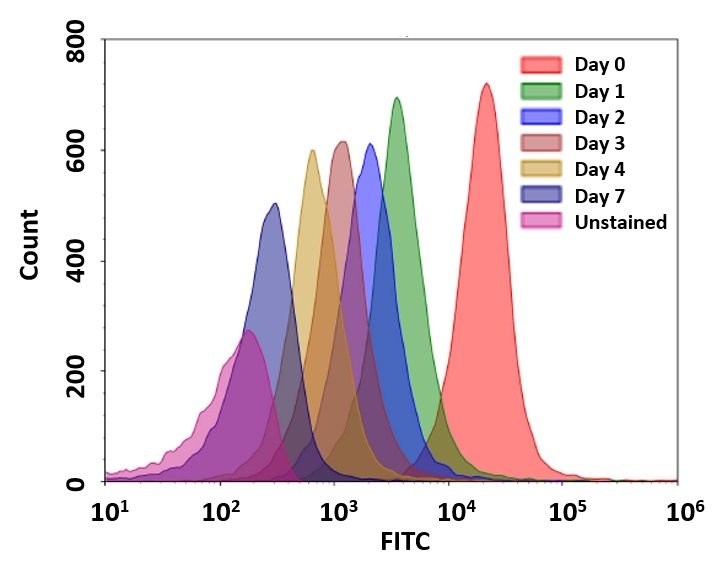
Cell tracking assay using CytoTell™ UltraGreen. Jurkat cells (~2x10^6 cells/mL) were stained with CytoTell™ UltraGreen on Day 0. Cells were passed serially at 1:1 ratio for 7 days. Fluorescence intensity was measured using ACEA NovoCyte flow cytometer in FITC channel. Successive generations were represented by different colors.
DNA synthesis assays directly measure cell proliferation by detecting incorporation of nucleoside analogs during S-phase. Traditional BrdU detection requires antibody-based methods and DNA denaturation, while the Bucculite™ platform uses click chemistry for antibody-free detection of incorporated nucleoside analogs with high sensitivity and compatibility with fluorescence-based detection.
Fig. 6
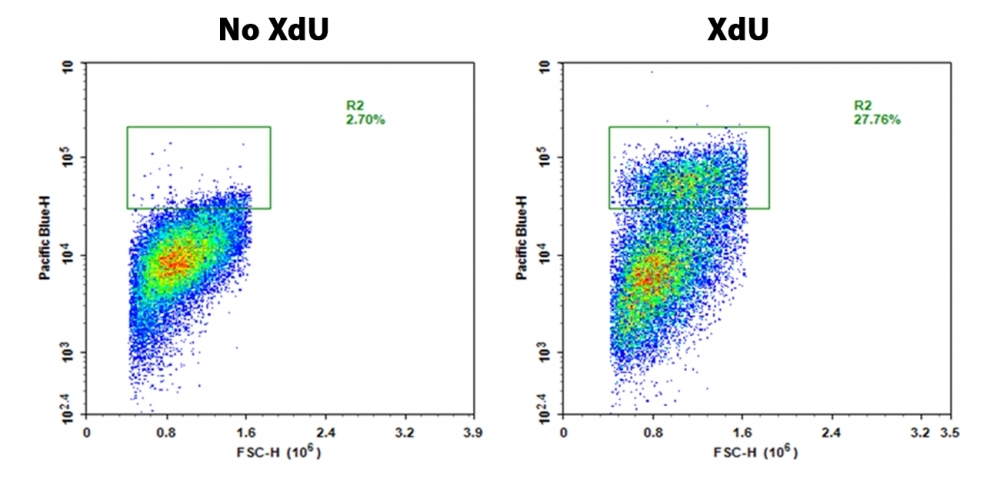
The flow cytometric response of S-phase Jurkat cells detected with Bucculite™ XdU Cell Proliferation flow cytometry kit (Catalog Number 22321). Jurkat cells were seeded at 50,000 cells/well/100 µL overnight in a 6-black wall plate. Cells were treated with XdU at 37 ºC for 3 hours, fixed and permeabilized as per protocol. Cells were then stained with mFluor™ Violet 450-azide for 30 mins in staining buffer, and washed three times with PBS. The fluorescence response was measured with NovoCyte flow cytometer using Pacific Blue channel.
This document (01.0225.251203r1) was last updated on Sat Feb 28 2026. All trademarks and registered trademarks mentioned herein are the property of their respective owners.