
Products
Services
Resources
Selection Guides
About
iFluor® Brand
The Next Generation of Fluorescent Dyes for Biomolecule Labeling
AAT Bioquest's iFluor® dyes are a comprehensive family of water-soluble fluorescent dyes engineered for covalent labeling of proteins, antibodies, peptides, nucleic acids, and other biomolecules. With over 45 spectrally distinct dyes --- including the iFluor® Ultra series --- spanning from UV to near-infrared, iFluor® dyes deliver superior brightness, photostability, and water solubility compared to classic fluorophores such as FITC, Alexa Fluor®, Cy® dyes, and Texas Red®.
Fig. 1
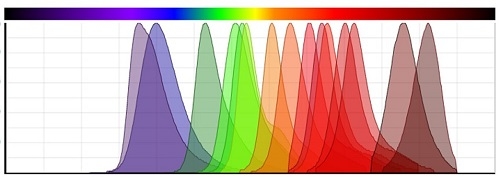
Emission spectra of select iFluor® dyes, ranging from UV to near-infrared (NIR)
Applications
iFluor® dyes are trusted across a wide range of biological research applications:
- Fluorescence Microscopy --- Exceptional brightness and photostability make iFluor® dyes ideal for widefield, confocal, and super-resolution imaging of fixed and live cells
- Flow Cytometry --- Full spectral coverage from UV to NIR enables high-dimensional multicolor panels on any cytometer platform
- Antibody & Protein Labeling --- Reactive dye forms and ReadiLink™ rapid labeling kits provide fast, high-yield conjugation to antibodies, proteins, and peptides
- Cell & Tissue Experiments --- Phalloidin, Annexin V, WGA, and secondary antibody conjugates support cell staining, apoptosis detection, membrane labeling, and immunohistochemistry in both cultured cells and tissue sections
Why iFluor®?
Advantage | Details |
|---|---|
Superior Brightness | High extinction coefficients and quantum yields produce brighter conjugates with lower background than competing dye platforms |
Exceptional Photostability | Resists photobleaching under prolonged excitation, enabling extended imaging sessions and time-lapse experiments |
Full Spectral Coverage | 45+ dyes from 345–860 nm covering every major laser line: 355, 405, 488, 532, 561, 594, 633, 640, 685, 780 nm and beyond |
High Water Solubility | Minimized aggregation and non-specific binding in aqueous buffers for cleaner staining and lower background |
Versatile Chemistry | 10 reactive forms for labeling virtually any biomolecule — amines, thiols, click chemistry handles, and more |
pH Stability | Fluorescence is unaffected across physiological pH ranges (pH 4–10) |
Performance: iFluor® vs. Classic Fluorophores
iFluor® dyes consistently outperform legacy fluorophores in head-to-head comparisons across brightness, photostability, and conjugation yield.
iFluor® 488 vs. FITC
iFluor® 488 is a direct replacement for FITC with dramatically higher fluorescence intensity and photostability in both microscopy and flow cytometry.
Fig. 2
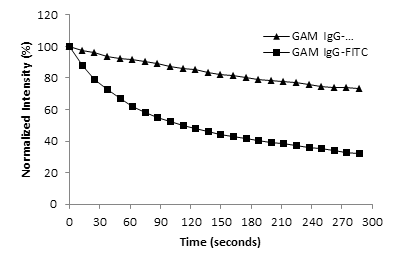
Fluorescence intensity comparison between HeLa cells labeled with GAM IgG-FITC and GAM IgG-iFluor® 488.
Fig. 3
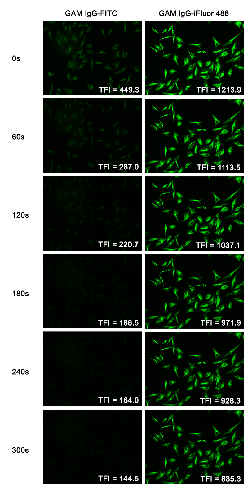
HeLa cells captured on a Keyence X710 fluorescence microscope. Total fluorescence intensity (TFI) calculated by ImageJ confirms iFluor® 488 superiority over FITC.
iFluor® 594 vs. Texas Red®, DyLight® 594, and Alexa Fluor® 594
iFluor® 594 offers an exceptionally high extinction coefficient (200,000 M⁻¹cm⁻¹) and conjugation yield, making it the brightest option in the orange-red channel.
Fig. 4
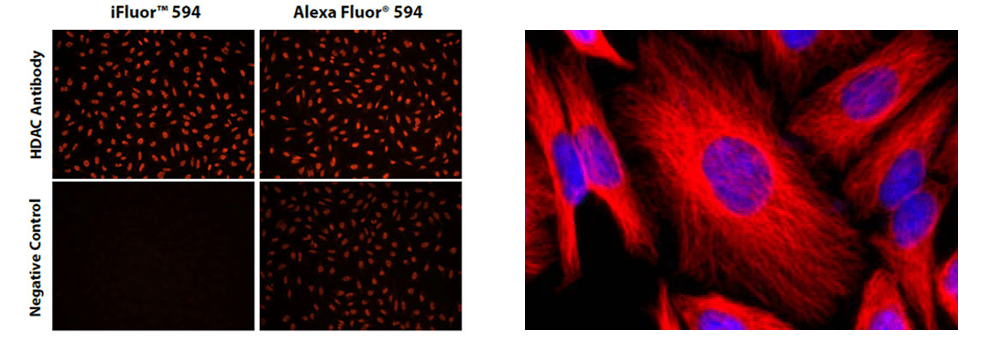
HeLa cells stained with iFluor® 594 (left panels) or Alexa Fluor® 594 (right panels) secondary conjugates under identical conditions. iFluor® 594 demonstrated significantly lower background and higher signal-to-noise ratio.
iFluor® 700 vs. Alexa Fluor® 700
iFluor® 700 provides stronger 633 nm laser absorption and a higher stain index than Alexa Fluor® 700, making it ideal for multicolor flow cytometry panels.
Fig. 5
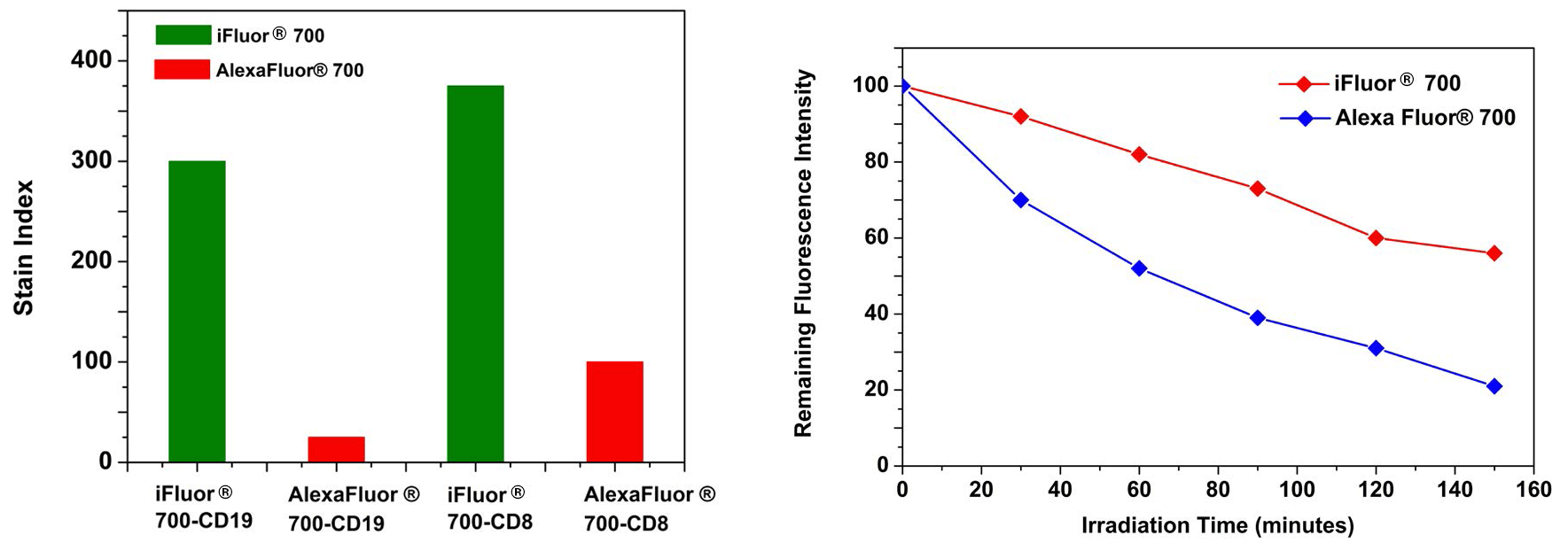
Left: Stain index comparison of iFluor® 700 vs. Alexa Fluor® 700. Right: Photostability comparison of APC-iFluor® 700 Tandem vs. APC-Alexa Fluor® 700 tandem.
Spectral Properties
Scientists use both extinction coefficient (EC) and quantum yield (QY) to evaluate fluorophore performance, as Brightness = EC x QY. The table below lists all iFluor® and iFluor® Ultra dyes with known spectral data, sorted by excitation wavelength.
Dye | Ex/Em (nm) | EC (M⁻¹cm⁻¹) | QY |
|---|---|---|---|
iFluor® 350 | 345/450 | 20,000 | 0.95 |
iFluor® 405 | 403/427 | 37,000 | 0.91 |
iFluor® 430 | 433/497 | 20,000 | 0.78 |
iFluor® 440 | 434/480 | 40,000 | 0.67 |
iFluor® 450 | 451/502 | 40,000 | 0.82 |
iFluor® 460 | 468/493 | 80,000 | 0.80 |
iFluor® 488 | 491/516 | 75,000 | 0.90 |
iFluor® Ultra 488 | 491/516 | 75,000 | 0.90 |
iFluor® 500 | 501/520 | 80,000 | — |
iFluor® 514 | 511/527 | 75,000 | 0.83 |
iFluor® 532 | 537/560 | 90,000 | 0.68 |
iFluor® 546 | 541/557 | 100,000 | 0.67 |
iFluor® 555 | 557/570 | 100,000 | 0.64 |
iFluor® 560 | 560/571 | 120,000 | 0.57 |
iFluor® 568 | 568/587 | 100,000 | 0.57 |
iFluor® 570 | 557/570 | 120,000 | 0.71 |
iFluor® Ultra 594 | 586/600 | 180,000 | 0.52 |
iFluor® 594 | 587/603 | 200,000 | 0.53 |
iFluor® 597 | 598/618 | 100,000 | 0.70 |
iFluor® 605 | 603/623 | — | — |
iFluor® 610 | 610/628 | 110,000 | 0.85 |
iFluor® 620 | 621/636 | — | — |
iFluor® 625 | 624/640 | — | — |
iFluor® 633 | 640/654 | 250,000 | 0.29 |
iFluor® Ultra 647 | 655/670 | 250,000 | 0.39 |
iFluor® 647 | 656/670 | 250,000 | 0.25 |
iFluor® 660 | 663/678 | 250,000 | 0.26 |
iFluor® 665 | 667/692 | 110,000 | 0.22 |
iFluor® 670 | 671/682 | 200,000 | 0.55 |
iFluor® 680 | 684/701 | 220,000 | 0.23 |
iFluor® 690 | 685/704 | 220,000 | 0.30 |
iFluor® 700 | 690/713 | 220,000 | 0.23 |
iFluor® 710 | 716/739 | 150,000 | 0.60 |
iFluor® 720 | 716/740 | 240,000 | 0.14 |
iFluor® 740 | 740/764 | 225,000 | 0.20 |
iFluor® Ultra 750 | 749/773 | 250,000 | 0.32 |
iFluor® 750 | 757/779 | 275,000 | 0.12 |
iFluor® A7 | 764/782 | 275,000 | 0.10 |
iFluor® 770 | 777/797 | 250,000 | 0.16 |
iFluor® 780 | 784/808 | 250,000 | 0.16 |
iFluor® 790 | 787/812 | 250,000 | 0.13 |
iFluor® 800 | 801/820 | 250,000 | 0.11 |
iFluor® 810 | 811/822 | 250,000 | 0.05 |
iFluor® 820 | 822/850 | 250,000 | — |
iFluor® 840 | 836/879 | 200,000 | — |
iFluor® 860 | 853/878 | 250,000 | — |
Antibody Labeling Kits
ReadiLink™ Rapid Antibody Labeling Kits
ReadiLink™ kits let you label your own antibodies with iFluor® dyes in under 30 minutes with no purification required. They use Tide Quencher (TQ) technology to quench unreacted free dye, eliminating background fluorescence without column purification.
Fig. 6
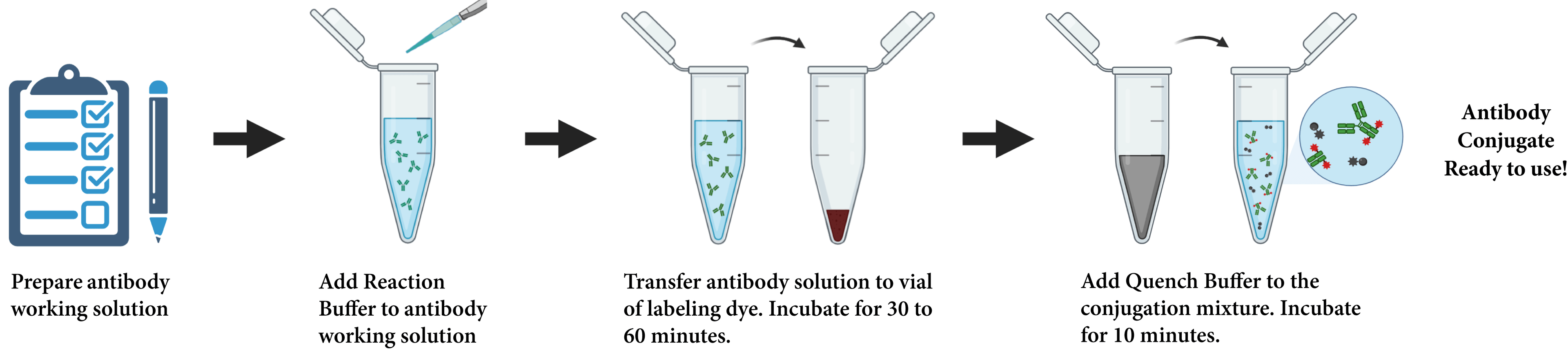
Overview of the ReadiLink™ xtra Rapid Antibody Labeling protocol. In just two simple steps, and with no purification necessary, covalently label microgram amounts of antibodies in under an hour.
Buccutite™ Conjugation Kits
Buccutite™ kits are designed for conjugating phycobiliproteins (PE, APC) and enzymes (HRP, ALP), enabling custom PE and APC tandem conjugation with iFluor® dyes as energy-transfer acceptors.
Ready-to-Use Bioconjugates
Secondary Antibodies
iFluor® secondary antibody conjugates are available as goat anti-mouse IgG (H+L) and goat anti-rabbit IgG (H+L) in 20+ iFluor® colors, plus goat anti-human IgG in select colors. Optimized fluorophore-to-protein ratios provide maximum brightness with minimal quenching. Compatible with indirect immunofluorescence, Western blotting, ELISA, and tissue section imaging.
Fig. 7
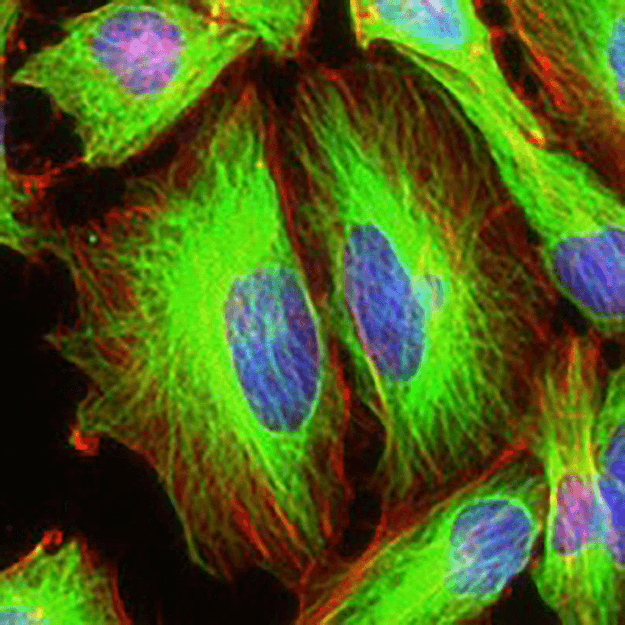
HeLa cells stained with mouse anti-tubulin followed by iFluor® 488 Goat Anti-Mouse IgG (green, Cat# 16448), Phalloidin-iFluor® 555 Conjugate (red, Cat# 23119), and Hoechst 33342 (blue, Cat# 17530).
Phalloidin Conjugates
Phalloidin-iFluor® conjugates are high-affinity F-actin probes for visualizing and quantifying actin filaments in fixed, permeabilized cells and tissue sections. Phalloidin selectively binds F-actin over monomeric actin, stabilizing filaments and preventing depolymerization. Effective at nanomolar concentrations for high-contrast cytoskeletal imaging.
Available in 15 iFluor® colors: 350, 405, 488, 514, 532, 555, 568, 594, 633, 647, 660, 680, 700, 750, 790
Fig. 8
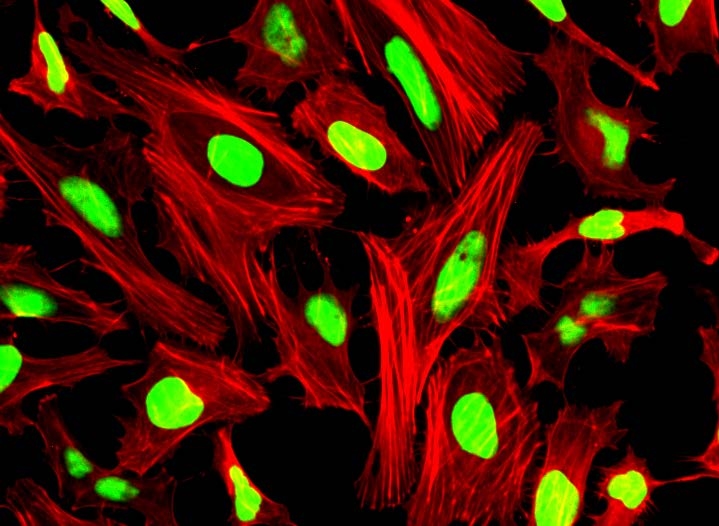
HeLa cells stained with Phalloidin-iFluor® 680 conjugate (actin filaments) and Nuclear Green DCS1 (nuclei).
Annexin V Conjugates
Annexin V-iFluor® conjugates detect early-stage apoptosis by binding phosphatidylserine (PS) exposed on the outer leaflet of the plasma membrane --- detectable before morphological changes become observable. Compatible with both flow cytometry and fluorescence microscopy.
Available in 10 iFluor® colors: 350, 488, 555, 568, 594, 633, 647, 680, 700, 750
Fig. 9
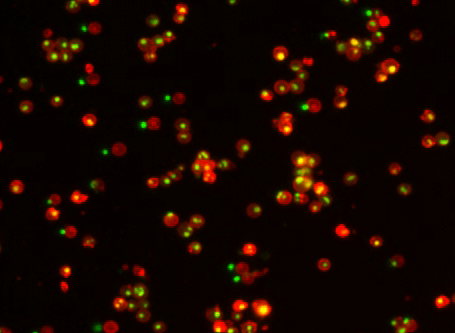
Apoptotic Jurkat cells labeled with Annexin V-iFluor® 555 (Cat# 20072) and Nuclear Green DCS1.
Streptavidin Conjugates
iFluor® streptavidin conjugates are high-affinity reagents for biotin-based detection systems. Used as second-step reagents with biotinylated primary antibodies for indirect immunofluorescent staining. Includes tandem variants such as APC-iFluor® 750 and RPE-iFluor® 647/750 streptavidin conjugates.
Available in 19+ iFluor® colors spanning UV to near-infrared (350 through 860)
WGA Conjugates
Wheat germ agglutinin (WGA) conjugates bind N-acetyl-D-glucosamine and sialic acid residues. Applications include plasma membrane staining, yeast bud scar labeling, fibrotic scar tissue visualization, and Gram bacterial cell membrane labeling.
Available in 10 iFluor® colors: 350, 488, 532, 555, 594, 647, 680, 700, 750, 790
dUTP Conjugates
iFluor® dUTP conjugates are dye-modified deoxyuridine 5'-triphosphates for enzymatic incorporation into DNA via nick translation, reverse transcription, random primed labeling, or PCR. Used for FISH probe production and microarray-based experiments.
Available in 7 iFluor® colors: 350, 440, 488, 532, 560, 570, 647 --- plus PEG12-linked variants (488, 555, 647)
CD Antibody Conjugates
Pre-conjugated iFluor®-CD antibodies are ready for immunophenotyping by flow cytometry and fluorescence microscopy. Ready-to-use format with pre-validated specificity and optimized fluorophore-to-protein ratios.
CD Targets | 100+ markers including CD3, CD4, CD8, CD14, CD19, CD20, CD25, CD34, CD45, CD56, and many more |
|---|---|
UV/Violet | iFluor® 350, 405, 430, 450, 488, 514 |
Visible | iFluor® 532, 546, 555, 568, 594 |
Far-Red/NIR | iFluor® 610, 633, 647, 660, 680, 700, 750, 790, 800, 820, 840, 860 |
Tandem Dye Conjugates
iFluor® dyes serve as energy-transfer acceptors in tandem conjugates with PE, APC, and PerCP, extending the spectral range of these bright phycobiliproteins into far-red and near-infrared channels for multicolor flow cytometry.
Donor | Tandem Conjugates Available |
|---|---|
PE | PE-iFluor® 700, PE-iFluor® 750, PE-iFluor® 790 |
APC | APC-iFluor® 700, APC-iFluor® 750, APC-iFluor® 800, APC-iFluor® A7 |
PerCP | PerCP-iFluor® 700, PerCP-iFluor® 710, PerCP-iFluor® 720, PerCP-iFluor® 750, PerCP-iFluor® 780 |
Helixyte™ iFluor® Nucleic Acid Labeling Dyes
Helixyte™ iFluor® dyes enable non-enzymatic fluorescent labeling of DNA, RNA, and oligonucleotides. The dyes react with the N7 position of guanine residues to form a stable coordination complex between the nucleic acid and the fluorophore, with no enzymatic incorporation required. Six fluorophore options are available for multiplexing.
Fig. 10
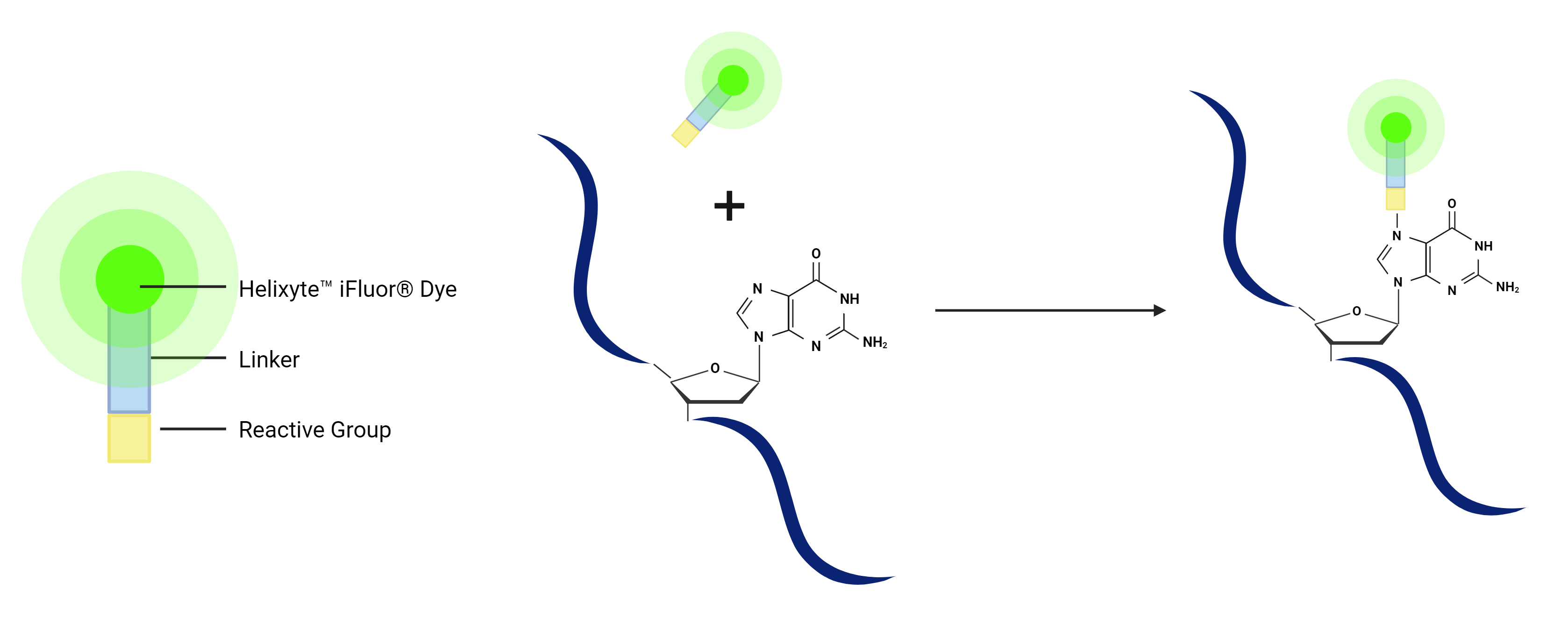
Helixyte™ iFluor® nucleic acid labeling method. A simple, non-enzymatic workflow for labeling DNA, RNA, and oligonucleotides. The dyes react with the N7 of guanine residues to form a stable coordination complex between the nucleic acid and the fluorophore label.
Power Styramide™ Signal Amplification (PSA™)
Power Styramide™ (PSA™) is an enzymatic amplification technology that couples the brightness and photostability of iFluor® dyes to a horseradish peroxidase (HRP)-mediated Styramide™ reaction. Reactive Styramide™ radicals are generated locally and covalently deposited near the target site, producing over 100-fold signal enhancement compared to conventional ICC, IHC, or ISH methods with minimal background noise.
Feature | PSA™ Performance |
|---|---|
Sensitivity vs. conventional ICC/IHC | Over 100-fold signal enhancement |
Sensitivity vs. traditional TSA | Up to 50-fold greater, due to enhanced Styramide™ radical reactivity |
Signal stability | Covalent deposition remains stable under stringent conditions including FISH protocols |
Imaging compatibility | Automated slide scanning, confocal microscopy, super-resolution microscopy |
Multiplexing | Multiple biomarkers concurrently without excessive background or cross-talk |
Available Styramide™ reagents | 19 iFluor® colors (350 through 860) |
PSA™ Imaging Kits | Complete kits with goat anti-rabbit, anti-mouse, or anti-human IgG secondaries |
PSA™ is especially valuable for detecting low-abundance targets --- weakly expressed proteins, rare tumor markers, and circulating tumor cells in blood samples --- that might otherwise escape detection with conventional methods. Its robust, reproducible nature and high-throughput compatibility support large-scale analyses without compromising image quality.
Fig. 11
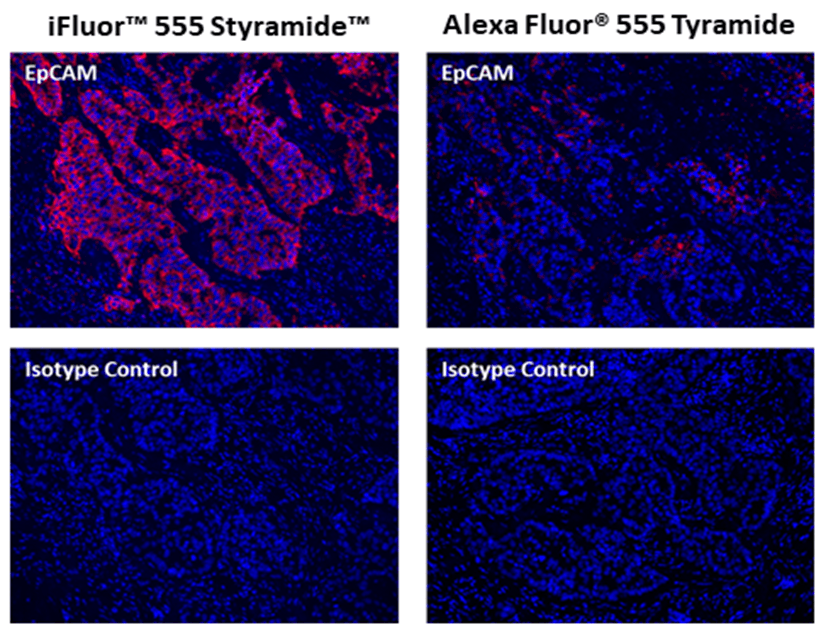
Fluorescence IHC in FFPE human lung adenocarcinoma. Sections stained with HRP-labeled secondary antibody followed by iFluor® 555 Styramide™ (Left) or Alexa Fluor® 555 tyramide (Right). iFluor® Styramide™ shows markedly higher signal intensity.
Fig. 12
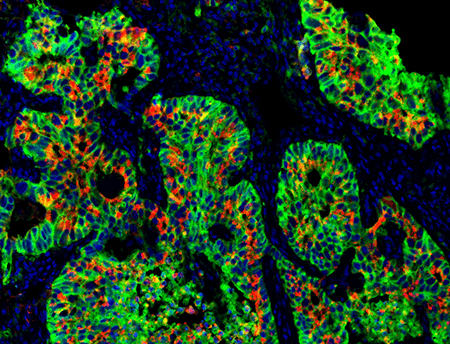
Sequential multiplexed immunostaining of FFPE human lung adenocarcinoma using iFluor® 488 PSA™ Imaging Kit (EpCAM, green) and iFluor® 555 PSA™ Imaging Kit (Pan-Keratin, red). Nuclei stained with DAPI (blue).
Product Platform Summary
Category | Catalog | iFluor® Colors Available |
|---|---|---|
| Reactive Dyes (SE, Maleimide, Azide, Alkyne, etc.) | 488+ products | 45+ dyes, 345–860 nm |
| iFluor® Ultra Reactive Dyes | SE and Maleimide | 488, 594, 647, 750 |
| Secondary Antibodies | Goat anti-mouse, anti-rabbit, anti-human IgG | 20+ colors |
| Phalloidin Conjugates | F-actin probes | 15 colors |
| Annexin V Conjugates | Apoptosis detection | 10 colors |
| Streptavidin Conjugates | Biotin-based detection | 19+ colors |
| WGA Conjugates | Membrane and glycocalyx staining | 10 colors |
| dUTP Conjugates | FISH probes, nucleic acid labeling | 7 colors + PEG12 variants |
| CD Antibody Conjugates | 100+ CD targets for immunophenotyping | 22+ colors |
| PE/APC/PerCP Tandem Conjugates | Multicolor flow cytometry | 12 tandems (PE, APC, PerCP donors) |
| Helixyte™ iFluor® Nucleic Acid Labeling | Non-enzymatic DNA/RNA labeling | 6 fluorophore options |
| ReadiLink™ Antibody Labeling Kits | No-purification antibody labeling | All major dyes |
| Power Styramide™ (PSA™) | Ultra-sensitive signal amplification | 19 colors |
iFluor®, ReadiLink™, Buccutite™, Tide Quencher™, Styramide™, and Helixyte™ are trademarks of AAT Bioquest, Inc. Alexa Fluor® is a registered trademark of Thermo Fisher Scientific. Cy® is a registered trademark of Cytiva. Texas Red® is a registered trademark of Thermo Fisher Scientific. DyLight® is a trademark of Thermo Fisher Scientific.
This document (01.0353.260403r1) was last updated on Fri Apr 03 2026. All trademarks and registered trademarks mentioned herein are the property of their respective owners.
iFluor® Brand