
Products
Services
Resources
Selection Guides
About
Apoptosis, Necrosis and Cell Death
Apoptosis, necrosis, and cell death are fundamental biological processes involved in tissue homeostasis, development, and disease pathogenesis. Understanding the mechanisms of these cellular events, and having the proper tools for their detection, is critical for cancer research, drug development, immunology, and neurodegenerative disease studies.
AAT Bioquest offers a comprehensive portfolio of fluorescent probes, conjugates, and assay kits for detecting and quantifying various forms of cell death. For selecting the optimal detection assay, please refer to the two tables below, which separate reagents based on type of apoptosis to be detected and stage of apoptosis to be detected.
I want to detect... | Characteristics | Key Markers | Detection Methods |
|---|---|---|---|
Apoptosis (Extrinsic) | This pathway is death receptor-mediated and is initiated by FasL, TNF-α, or TRAIL. | Caspase-8 → Caspase-3/7 | Caspase-8 substrates, Annexin V |
Apoptosis (Intrinsic) | This pathway is mitochondrial-mediated and is triggered by DNA damage or cellular stress. | ΔΨm loss → Caspase-9 → Caspase-3/7 | JC-10, Caspase-9 substrates, Annexin V |
Necrosis | Necrosis is an uncontrolled process characterized by membrane rupture and inflammation. | Membrane permeability | PI, 7-AAD, Nuclear DCS1 |
Ferroptosis | Ferroptosis is driven by iron-dependent lipid peroxidation. | Fe²⁺ accumulation, GSH depletion | FerroBrite™, GSH assays |
Pyroptosis | Pyroptosis is an inflammatory form of cell death that is caspase-1 dependent. | Caspase-1 activation | Caspase-1 binding assays |
Stage of Apoptosis | Timing | Biomarker | Detection Method |
|---|---|---|---|
Early | 0-4 hours | PS externalization | Annexin V binding |
Early | 0-4 hours | Caspase-8/9 activation | Substrate cleavage or inhibitor binding |
Mid | 2-8 hours | ΔΨm collapse | JC-10, MitoTell™ dyes |
Mid | 4-12 hours | Caspase-3/7 activation | Fluorogenic substrates |
Late | 8-24 hours | DNA fragmentation | TUNEL assay |
Late/Necrosis | 12+ hours | Membrane permeability | PI, 7-AAD, Nuclear DCS1 dyes |
Annexin V is a 35 kDa protein that binds phosphatidylserine (PS) with high affinity in a calcium-dependent manner. In healthy cells, PS is restricted to the inner plasma membrane leaflet by ATP-dependent flippases. During early apoptosis, PS translocates to the outer leaflet where it serves as an "eat me" signal for phagocytes. This occurs before membrane integrity is lost, making Annexin V an excellent marker for early apoptosis when paired with a membrane-impermeant viability dye, such as propidium iodide; cells in early apoptosis will stain annexin V+/PI-.
- Annexin V binding requires Ca²⁺ (2.5 mM)—EDTA buffers abolish signal
- Pair with a viability dye (PI, 7-AAD) to distinguish early apoptotic from late apoptotic/necrotic cells
- For fixation protocols, use Live or Dead™ fixable stains instead of PI/7-AAD
- PS exposure can occur independently of apoptosis (e.g., activated platelets, some tumor cells)
- Confirm results with a second apoptosis marker when possible
Annexin V conjugates are available in the full spectrum range, from UV to NIR, and are compatible with flow cytometer or fluorescence microscope applications. Conjugate labels include:
- iFluor® dyes — Superior brightness and photostability; recommended for most applications
- mFluor™ Violet dyes — Optimized for 405 nm violet laser with minimal spillover
- XFD dyes — Spectral match to Alexa Fluor® for drop-in replacement
Fig. 1
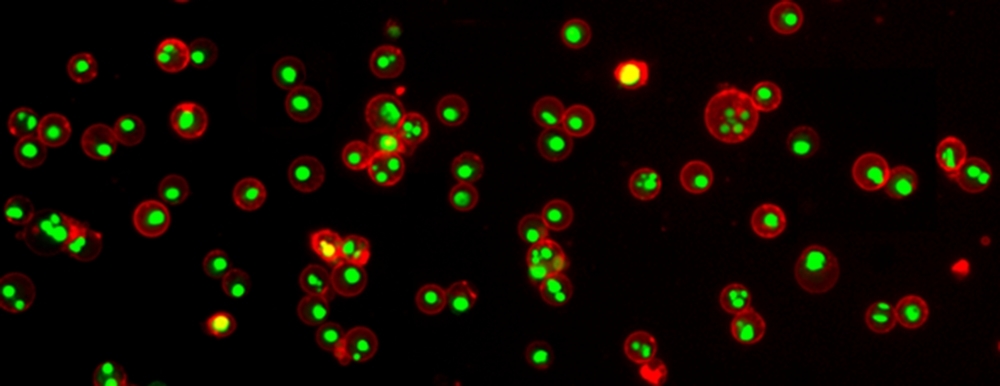
Jurkat cells were treated with 1 µM staurosporine for 4 hours to induce apoptosis. Following treatment, cells were stained with Annexin V-iFluor® 555 conjugate (Catalog Number 20072). Nuclei were labeled with Nuclear Green™ DCS1 (Catalog Number 17550). Images were acquired on a confocal microscope.
For unlabeled protein or biotin-streptavidin conjugation compatibility, see Annexin V, Recombinant (Catalog Number 20015) and Annexin V-Biotin (Catalog Number 20018), respectively.
These kits include an annexin V conjugate, a calcium-containing binding buffer, and a cell-impermeant DNA dye for two-color analysis. Additionally, PS Sensor kits are available which use calcium-independent probes, making them useful for EDTA-harvested cells or calcium-sensitive systems.
- Flow cytometry kits — Bright fluorophores optimized for single-cell analysis
- Microplate kits — No-wash protocols for high-throughput screening
- 405 nm excitation kits — Leaves 488 nm channel open for GFP or other green markers
Fig. 2
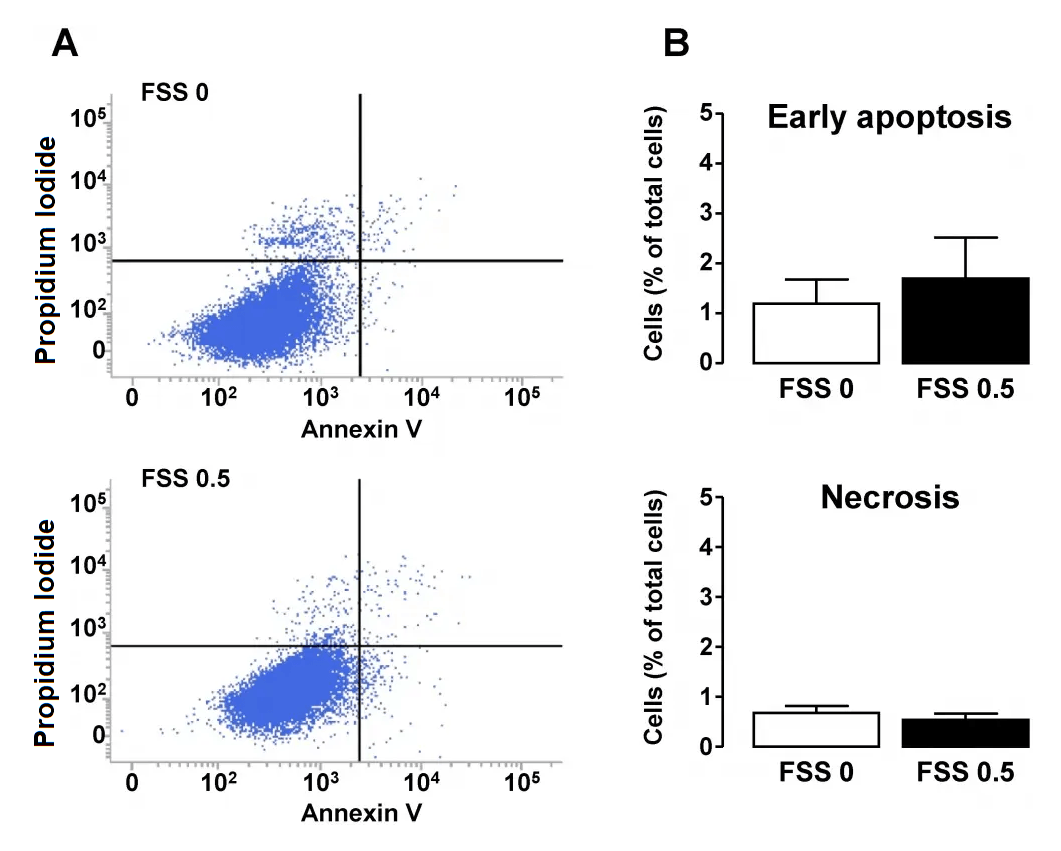
Effect of FSS on apoptosis and necrosis in tubular cells. Confluent monolayers of HK-2 cells were submitted to FSS 0 (static) or FSS 0.5 Pa (FSS 0.5) for 48h. A/ Cells were stained with Annexin-V and then immediately subjected to analysis of phosphatidylserine externalization (Annexin-V fluorescence, X-axis) and Propidium Iodure (PI) uptake (PI fluorescence, Y-axis) using flow cytometry. Living, early apoptotic or necrotic (primary or secondary) cells were distinguished by the criteria of Annexin-V−/PI−(bottom left quadrant), Annexin-V+/PI− (bottom right quadrant) and Annexin-V+/PI+ (upper right quadrant), respectively. B/ Proportions of early apoptosis and necrosis cells were quantified and results are expressed as a percentage of the total population of cells. Data represent mean ± SEM of 7 experiments. *HK-2 cells were assessed for apoptosis and necrosis using Cell Meter Annexin V Binding Apoptosis Assay Kit (AAT Bioquest), according to the manufacturer's instructions. Source: Graph from Shear Stress-Induced Alteration of Epithelial Organization in Human Renal Tubular Cells by Damien Maggiorani, et al., PLoS ONE, July 2015.
Caspases are cysteine-aspartic proteases that serve as the central executioners of apoptosis. Detecting caspase activation provides direct evidence of apoptotic pathway engagement and helps identify whether the extrinsic (death receptor) or intrinsic (mitochondrial) pathway is activated.
Caspase | Role | Pathway | When to Use |
|---|---|---|---|
Caspase-1 | Inflammatory | Pyroptosis | Use caspase-1 to study inflammasome activation or IL-1β processing. |
Caspase-3/7 | Executioner | Both intrinsic and extrinsic | Use caspase-3/7 for general apoptosis detection, as it is the most common choice. |
Caspase-8 | Initiator | Extrinsic (death receptor) | Use caspase-8 to study death receptor signaling involving Fas, TRAIL, or TNF. |
Caspase-9 | Initiator | Intrinsic (mitochondrial) | Use caspase-9 to study DNA damage or stress-induced apoptosis. |
Pan-caspase | Multiple | All | Use pan-caspase reagents when the pathway is unknown or for initial screening. |
Method | Principle | Sample Type | Best For |
|---|---|---|---|
Fluorogenic Substrates (AFC, AMC) | Peptide cleavage by active caspases releases a fluorophore. | This method is used with cell lysates. | This method is best for quantitative high-throughput screening and kinetic studies. |
FAM-FMK Inhibitors | These inhibitors bind irreversibly to active caspases. | This method is used with live cells. | This method is best for flow cytometry and single-cell analysis. |
Cell-Permeable Substrates | These substrates are cleaved intracellularly by active caspases. | This method is used with live cells. | This method is best for no-wash imaging and real-time monitoring. |
Luminogenic Substrates | Caspase cleavage releases aminoluciferin for bioluminescent detection. | This method works with lysates or live cells. | This method is best for ultra-sensitive detection applications. |
Fluorogenic substrates contain a caspase recognition sequence linked to a quenched reporter. Cleavage of the substrate frees the fluorophore, producing a signal proportional to caspase activity. Inhibitors, such as Z-VAD-FMK, are also available and are useful for blocking apoptosis, such as for rescue experiments.
These kits enable microplate or flow cytometry detection of specific caspase activities.
Fig. 3
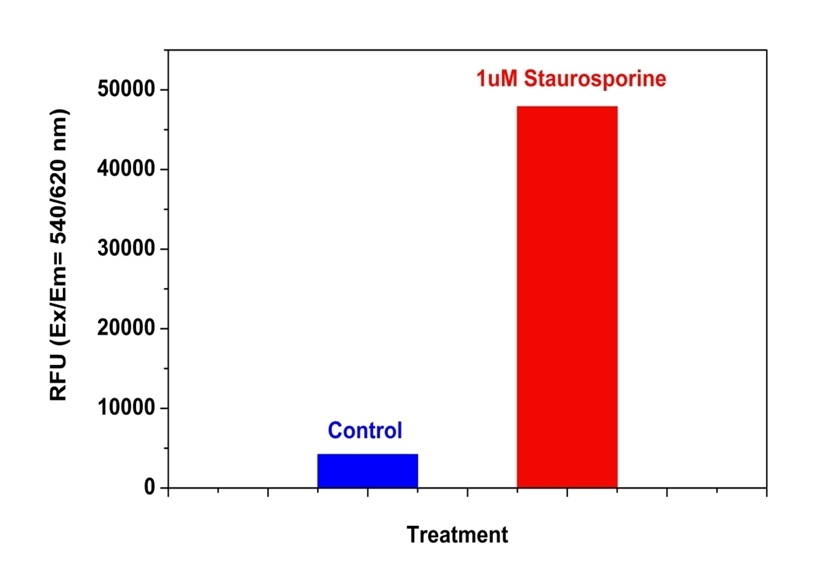
Detection of Caspase 3/7 Activities in Jurkat cells. Jurkat cells were seeded on the same day at 200,000 cells/90 µL/well in a Costar black wall/clear bottom 96-well plate. The cells were treated with or without 1 µM of staurosporine for 5 hours. The caspase 3/7 working solution (100 µL/well) was added and incubated at room temperature for 1 hour. The fluorescence intensity was measured at Ex/Em = 540/620 nm (Cutoff = 610 nm) with FlexStation fluorescence microplate reader (Molecular Devices).
These kits contain cell-permeable fluorescent inhibitors that enable single-cell caspase detection in live cells via flow cytometry or imaging.
Terminal deoxynucleotidyl transferase dUTP nick end labeling (TUNEL) detects DNA fragmentation during late-stage apoptosis. TdT enzyme incorporates fluorescently labeled dUTPs at 3'-hydroxyl ends of fragmented DNA, providing direct visualization of apoptotic cells.
- Fixed cell/tissue kits — For FFPE sections and fixed cell preparations
- Live cell kits — Sodium cacodylate-free formulation for live cell applications
- Multiple colors — Blue, green, red, and deep red options for multiplexing
Fig. 4
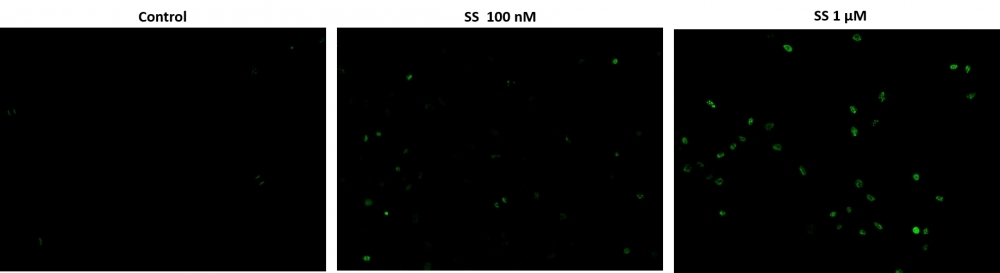
Fluorescence images of TUNEL reaction in HeLa cells with the treatment of 100 nM or 1 µM staurosporine (SS) for 4 hours as compare to untreated control. Cells were incubated with TUNEL working solution for 1 hour at 37°C. The green fluorescence signal was analyzed using fluorescence microscope with a FITC filter set. Fluorescently labeled DNA strand breaks shows intense fluorescent staining in SS treated cells.
Loss of mitochondrial membrane potential (Δψₘ) is a critical early event in the intrinsic apoptotic pathway. Δψₘ collapse leads to mitochondrial permeability transition pore opening, cytochrome C release, and downstream caspase activation.
Probe Type | Principle | Advantages |
|---|---|---|
JC-10 | Ratiometric; forms green monomers (depolarized) or orange J-aggregates (polarized) | Quantitative ratio measurement; superior water solubility vs JC-1 |
MitoLite™/MitoTell™ | Single-color; fluorescence decreases upon ΔΨm collapse | Simple single-channel detection; good for multiplexing |
Fig. 5
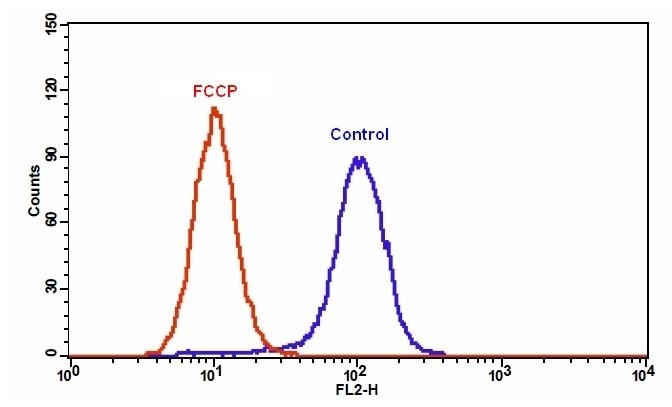
The decrease in fluorescence intensity of MitoTell™ Orange with the addition of FCCP in Jurkat cells. Jurkat cells were loaded with MitoTell™ Orange alone (Blue) or in the presence of 30 µM FCCP (Red) for 15 minutes. The fluorescence intensity of MitoTell™ Orange was measured with a FACSCalibur (Becton Dickinson, San Jose, CA) flow cytometer using FL2 channel.
Dead cell stains distinguish between early apoptotic, late apoptotic, necrotic, and viable cells. Membrane-impermeant dyes selectively enter cells with compromised membranes, complementing apoptosis-specific markers.
Fig. 6
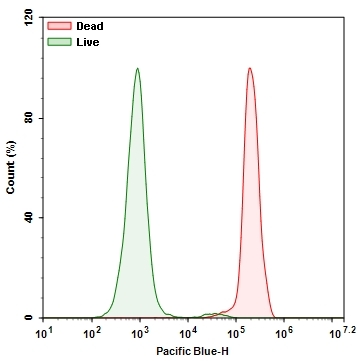
Detection of Jurkat cell viability by Live or Dead™ Fixable Dead Cell Staining Kits (Catalog Number 22600). Jurkat cells were treated and stained with Stain It™ Blue . The cells were fixed in 3.7% formaldehyde and analyzed by flow cytometry as described above. Live (Green) and Dead (heat-treated, Red) cells were distinguished with Pacific Blue channel. The live cell population is easily distinguished from the dead cell population, and nearly identical results were obtained using unfixed cells.
For dead cell depletion, see ReadiPrep™ Dead Cell Removal Kit (Catalog Number 67300).
Our multiplexing kits combine spectrally compatible reagents for three-color detection in a single sample, enabling comprehensive cell death analysis. These multiplex kits typically include:
- Apoptosis marker (annexin V or PS sensor)
- Necrosis marker (cell-impermeant DNA dye)
- Nuclear counterstain or live cell marker
Additionally, we offer specialized probes to address emerging areas such as ferroptosis, a regulated but non-apoptotic form of cell death. These probes include:
- FerroBrite™ Green (Catalog Number 20205) — Detects ferroptosis (iron-dependent lipid peroxidation)
- OxiVision™ Lipid Peroxidation Sensors — Fluorescent probes for lipid peroxides
- Intracellular GSH kits (Catalog Number 22809, 22810) — Glutathione depletion precedes ferroptosis
This document (01.0224.251203r1) was last updated on Sat Feb 28 2026. All trademarks and registered trademarks mentioned herein are the property of their respective owners.
Apoptosis, Necrosis and Cell Death