
Products
Services
Resources
Selection Guides
About
pH Probes
Intracellular pH plays an important modulating role in various cellular events, including cell growth, calcium regulation, enzymatic activity, receptor-mediated signal transduction, ion transport, endocytosis, chemotaxis, cell adhesion, and much more. With the help of pH-sensitive fluorescent indicators, researchers are able to monitor intracellular pH fluctuations within live cells with improved sensitivity and spatial resolution compared to bulk measurements.
In general, a cell's intracellular pH will differ amongst its various cellular compartments. For instance, the pH of the cytosol typically ranges between approximately 7.0 to 7.4 under physiological conditions, while acidic organelles such as lysosomes exhibit pH values ranging from approximately 4.5 to 6.0 depending on maturation state. Therefore, when selecting a pH indicator it is important to match its pKa to the pH of the experimental system. In addition to classic choices like Phenol Red, AAT Bioquest offers a variety of fluorescent pH indicators, pH indicator dextran-conjugates and other reagents for pH measurements in biological systems.
BCECF, and its membrane-permeant AM ester, is the most widely used fluorescent pH indicator for measuring intracellular pH. It has a pKa of ~6.98 which is ideal for measuring changes in cytosolic pH across various cell types, as well as, monitoring pH changes in near-neutral environments. BCECF has an absorption maximum at ~504 nm, an isosbestic point at ~440 nm and an emission maximum at ~527 nm. Although BCECF exhibits dual-excitation ratiometric properties, several characteristics make ratiometric imaging less than optimal. The large distance separating its isosbestic point from its excitation maximum, its poor intracellular retention properties and its weak absorption at ~440 nm all contribute to its poor signal-to-noise ratios. Moreover, BCECF is supplied as a complex mixture of isomers. This isomeric variability can lead to inconsistent calibration curves and reduced reproducibility between experiments.
RatioWorks™ BCFL is a novel ratiometric indicator designed by AAT Bioquest to overcome the poor performance and isomeric variability concerning BCECF. Similar to BCECF, RatioWorks™ BCFL has a pKa ~7, an absorption maximum at ~503 nm and emission maximum at ~528 nm. However, RatioWorks™ BCFL has an isosbestic point at ~454 nm. This red-shift in its isosbestic is ideal for ratiometric imaging as it enables RatioWorks™ BCFL to generate significantly higher signal-to-noise ratios than BCECF. RatioWorks™ BCFL ratiometric imaging makes intracellular pH determination essentially independent of several variable factors, including dye concentration, path length, cellular leakage and photobleaching rate. RatioWorks™ BCFL is available as a membrane-impermeant acid, and as amine-reactive succinimidyl ester for labeling antibodies and proteins.
- Suitable for single-wavelength measurements and ratiometric imaging of intracellular pH
- Higher signal-to-noise ratios than BCECF
- Improved cellular retention for minimal background interference
- Single isomer design for more consistent and reproducible results
- Suitable for fluorescence microscopy, flow cytometry and fluorescence microplate-based assays
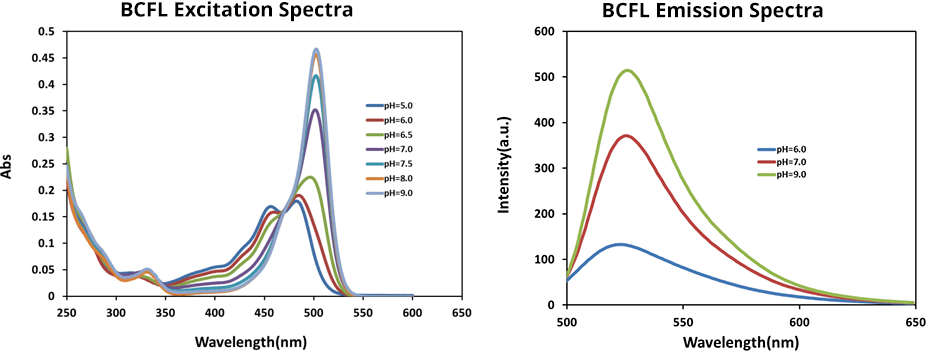
Fig. 2
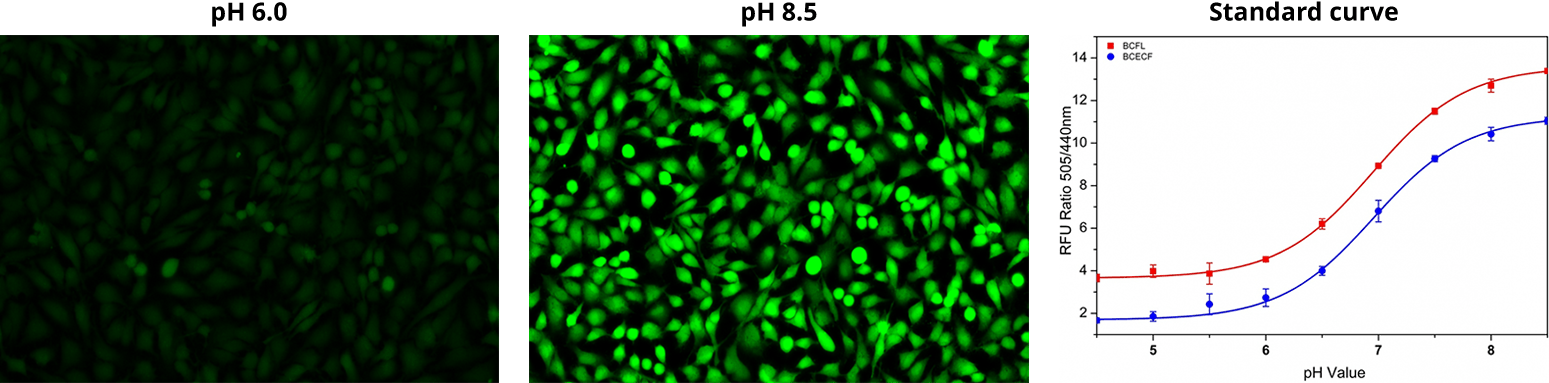
Hela cells labeled with RatioWorks™ BCFL, AM. Hela cells were incubated with 5 µM of RatioWorks™ BCFL, AM (Catalog Number 21190) for 30 minutes at 37 °C. Images were captured using a microscope FITC filter. Incubation of BCFL, AM solution with Hela cells showed a homogenous uptake of RatioWorks™ BCFL, AM and stained cell cytosol. Standard curve created using RatioWorks™ BCFL, AM (Catalog Number 21190) and BCECF,AM (Catalog Number 21202). Hela cells were incubated with 5 µM RatioWorks™ BCFL, AM for 30 minutes 37 °C. The Spexyte™ Intracellular pH Calibration Buffer Kit (Catalog Number 21235) was used to clamp the intracellular pH with extracellular buffers at pH 4.5 to 8.5. Averages of 4 data points were plotted and a 4-parameter trend line was fitted to get the pH standard curve from 6 to 8.
Acidotropic probes, such as PDMPO and AAT Bioquest Protonex™ dyes, possess unique properties that are ideal for measuring the pH of acidic organelles in live cells. As weak bases, these dyes preferentially accumulate within acidic organelles through protonation and ion trapping mechanisms. This protonation not only reduces background interference, but also activates its pH-dependent fluorescence.
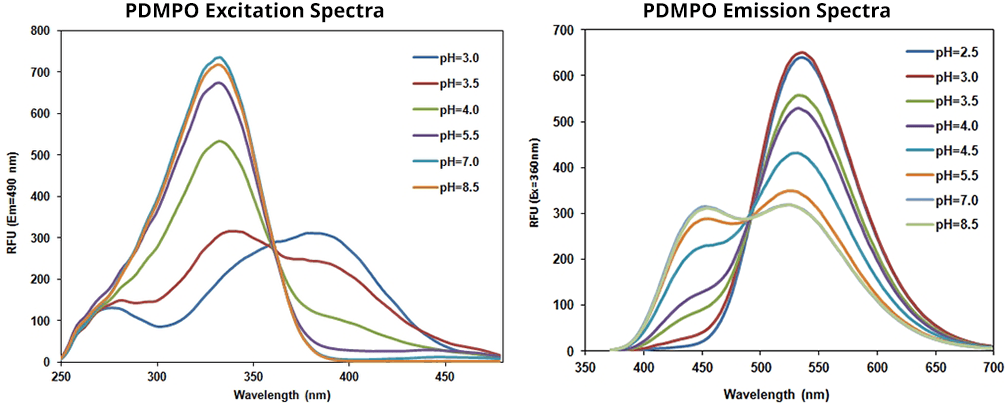
RatioWorks™ PDMPO is characterized as an acidotropic dual-excitation and dual-emission pH probe. Its pKa ~4.47 and unique pH-dependent fluorescence is an ideal combination for measuring pH in acidic organelles. At near neutral conditions RatioWorks™ PDMPO emits an intense blue fluorescence at ~450 nm when illuminated at its excitation maximum (~333 nm). In more acidic environments, however, this fluorescence shifts to an intense yellow at ~550 nm. RatioWorks™ PDMPO also exhibits a secondary excitation maximum at ~386 nm. This enables intracellular pH measurement to be performed on violet laser-equipped flow cytometers. RatioWorks™ PDMPO has been successfully used as a tracer during biosilicification and has seen wide application in silica related studies. RatioWorks™ PDMPO is also available as an amine-reactive succinimidyl ester for labeling proteins and antibodies and conjugated to dextran for investigating endocytic pathways.
Protonex™ Green 500 and Protonex™ Red 600 are novel pH-sensitive fluorescent dyes developed by AAT Bioquest for monitoring acidic cell compartments, such as endosomes and lysosomes, with reduced signal variability and improved accuracy. In near-neutral environments Protonex™ dyes are essentially non-fluorescent. It is not until exposure to an acidic environment does the fluorescence intensities of Protonex™ dyes increase. The optimal excitation and emission maxima of Protonex™ Green 500 are ~445 nm and ~503 nm, respectively, while Protonex™ Red 600 excites at ~575 nm and emits at ~597 nm. Protonex™ dyes are available as an amine-reactive succinimidyl ester for labeling proteins and antibodies, as well as, conjugated to dextran or latex beads for investigating endocytic pathways.
For longer-wavelength options, Protonex™ Red 670 and 780 are available in multiple reactivities as well. Newest and unique within the series, Protonex™ Lyso-Red 670 is a cell-permeable, far-red fluorescent probe that preferentially accumulates in acidic organelles, enabling visualization of lysosome-enriched compartments in live cells. It remains quiescent or weakly fluorescent under alkaline pH conditions, exhibiting significant fluorescence enhancement as acidity increases.
- Protonex™ Green 500 and Protonex™ Red 600 exhibit a pKa ~6.5
- Protonex™ dyes are non-fluorescent at neutral pH and increase in fluorescence emission intensity with acidification
- Successful at tracking internalization in live cells and monitoring phagocytotic and endocytotic pathways
- Minimal dye fluorescence at neutral pH eliminates the need for wash steps
- Suitable for multiplex analysis with other fluorescent dyes and conjugates
- For use with fluorescence microscope, flow cytometer, fluorometer and high content instruments
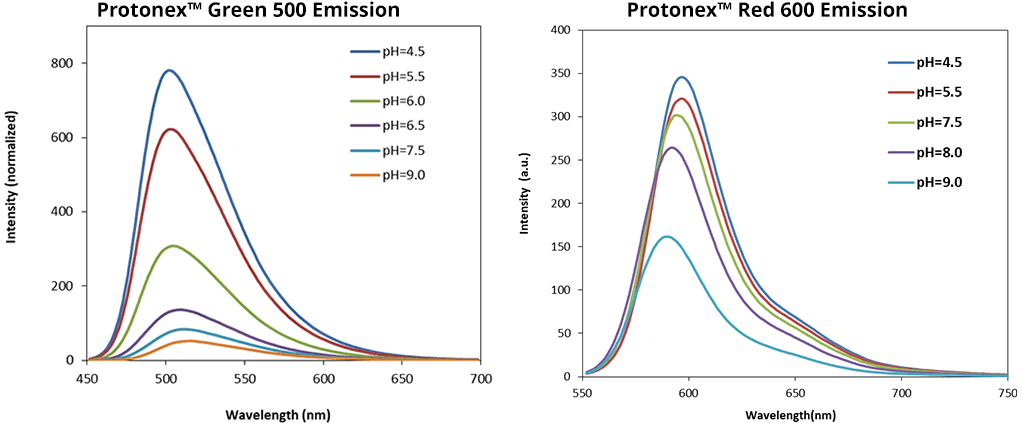
Fig. 5
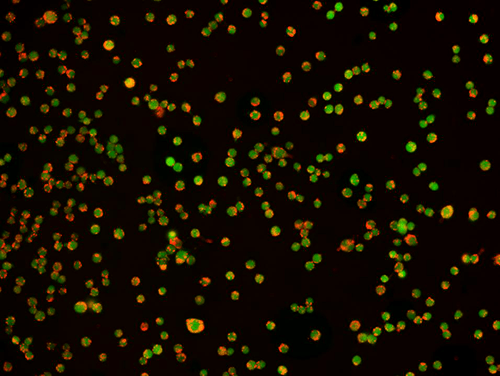
Phagocytosis was examined in RAW 264.7 cells by Protonex™ Red 600-Latex Bead Conjugate (Catalog Number 21209). RAW 264.7 cells were incubated with Protonex™ 600 Latex Beads in growth medium for 4 hours. CytoTrace™ Green CMFDA (Catalog Number 22017) was used to track live cells. The image (20X) was taken using a Keyence Fluorescence Microscope.
SNARF (Seminaphtharhodafluor) indicators are dual-emission ratiometric pH probes that exhibit a pH-dependent shift in their fluorescence emission spectrum. Unlike intensity-based pH indicators, SNARF dyes shift from orange-yellow (~580 nm) emission under acidic conditions to deep red (~640 nm) emission at basic pH when excited at a single wavelength (~514-549 nm). This spectral shift enables true emission-ratio measurements that are independent of dye concentration, path length, photobleaching, and instrument sensitivity variations. AAT Bioquest offers three SNARF variants spanning pKa values from ~6.4 to ~7.5, covering applications from mildly acidic organelle tracking to near-neutral cytosolic pH monitoring.
- True dual-emission ratiometry - pH-dependent emission spectral shift enables ratio measurements at two emission wavelengths from a single excitation
- Single-excitation compatibility - All SNARF variants excite at ~514-549 nm, compatible with argon-ion (514 nm) and yellow-green (532/561 nm) laser lines
- Concentration-independent readout - Emission ratio eliminates artifacts from uneven dye loading, photobleaching, and path length variations
- Three pKa options - SNARF-1 (pKa ~7.5), SNARF-5F (pKa ~7.2), and SNARF-4F (pKa ~6.4) cover pH ranges from mildly acidic to basic
- Multiple reactive forms - Available as AM esters for intracellular loading, NHS esters and maleimides for bioconjugation, and click chemistry-compatible alkyne/azide derivatives
- Long-wavelength emission - Orange-to-red emission (580-640 nm) minimizes interference from cellular autofluorescence
This document (01.0089.211015r2) was last updated on Sat Feb 28 2026. All trademarks and registered trademarks mentioned herein are the property of their respective owners.